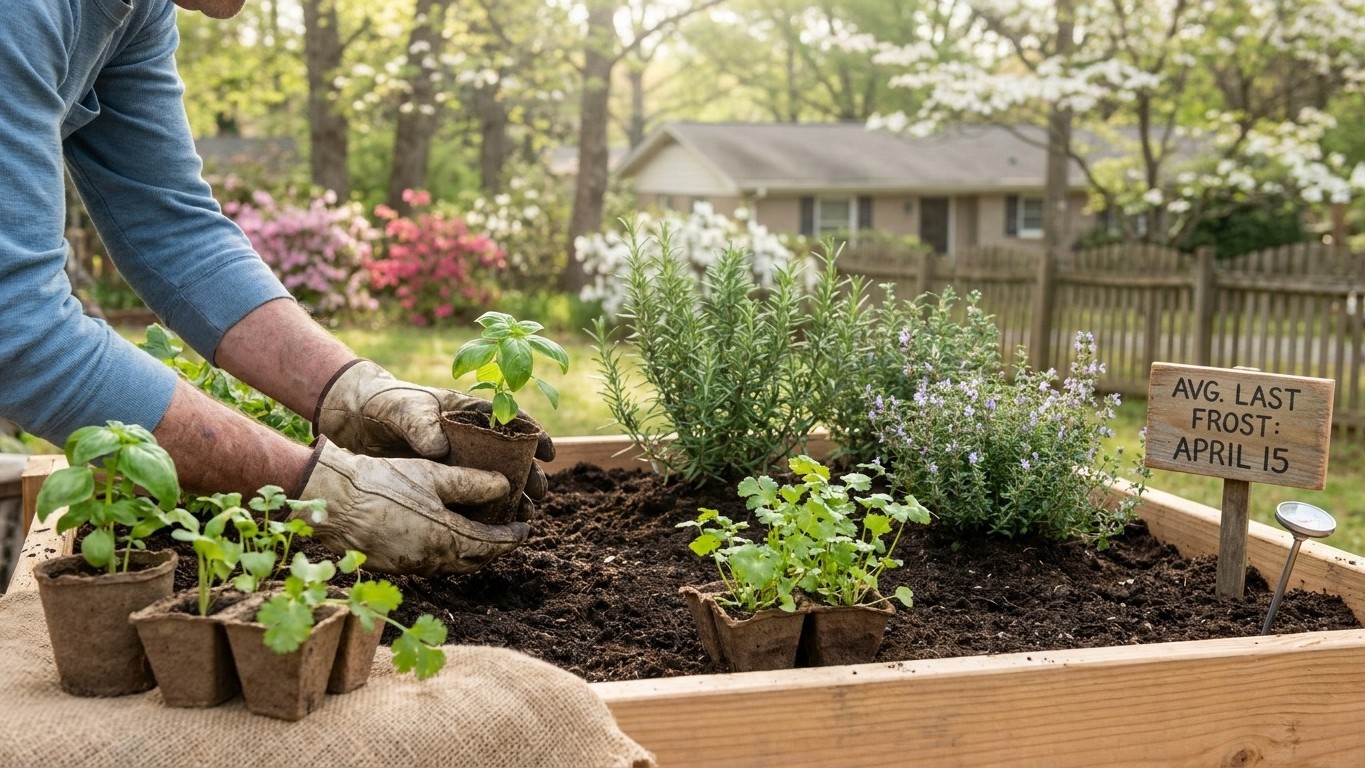

Sow hardy herbs like parsley, chives, and cilantro outdoors around early May, once the soil has dried out and warmed a little past the average last frost. Tender herbs like basil need to wait until closer to the end of May, and the “average” frost date itself is only a coin flip, not a guarantee.
The short answer for Quebec
The Montreal region’s mean last spring frost falls on May 6, and the mean first fall frost lands on October 5, according to Environment and Climate Change Canada’s 1981-2010 normals for the MONTREAL/ST-HUBERT A station. That gives a frost-free stretch of roughly 152 days on paper. But a mean date is not a safe date: in one year out of two, frost arrives after May 6, sometimes well after. Treat that date as the middle of a range, not a green light.
What this means in practice for herb sowing is a split calendar. Cold-tolerant herbs, parsley, chives, cilantro, dill, can go into the ground or into cold frames from late April through early May, since a light frost rarely kills them outright. Tender annual herbs, basil above all, along with anything described as a warm-season crop, should wait until the risk has genuinely passed, which in most years means the last week of May rather than the calendar’s mean date.
Perennial herbs bring a second constraint that has nothing to do with spring sowing: winter survival. The coldest month here averages a daily minimum of 6.7°F. That single number decides whether a perennial herb makes it through winter outdoors at all, regardless of how well it grew over summer. Rosemary, bay laurel, and lemongrass do not tolerate that kind of cold in open ground; they need pots that come indoors or a heavily insulated cold frame.
The reference station sits at Canadian hardiness zone 5b, per Natural Resources Canada’s Plant Hardiness Site using 1991-2020 normals. That number matters for choosing perennial herbs like thyme, sage, and oregano, which generally hold up fine in 5b with some winter mulch. It does not, however, tell you anything about a garden two hundred kilometers north or five hundred feet higher in elevation; more on that below.
So the short answer: sow hardy herbs from late April, hold tender ones until late May even though the mean frost date says May 6, and plan winter protection for perennials given a coldest-month minimum well below freezing.
What will not work here

Basil sown outdoors right at the average frost date is the single most common failure. Since frost falls after May 6 in roughly half of all years on record, a basil seedling set out the first warm weekend of May has a coin-flip chance of getting nipped or killed. The fix isn’t a different herb; it’s patience, plus a willingness to start basil indoors three to four weeks ahead and transplant once the soil has genuinely warmed, not just once the calendar has turned.
Long-season Mediterranean perennials left unprotected outdoors over winter are the second predictable failure. A coldest-month average minimum of 6.7°F is well below what rosemary, bay laurel, or lemongrass can shrug off in open ground. Gardeners who plant these as if they were hardy perennials, the way a warmer-climate guide might suggest, typically lose the whole plant by March. The workaround is containers that move indoors or into an unheated but frost-buffered garage before the first fall frost, which averages October 5 here, again a midpoint rather than a deadline.
Season length also rules out some choices
A roughly 152-day frost-free window, calculated from the two mean dates above, is workable for most culinary herbs but tight for anything described as needing a long, hot season to mature fully, such as certain slow basil varieties bred for warmer climates or herbs that need a full summer of heat to set flavorful oils. Direct-sowing these late, after the soil has warmed in late May, and then losing three or four weeks to a cool, wet spring, can leave a plant that never quite reaches its full character before the fall frost cuts it down in October.
Finally, watering on a weekly schedule regardless of weather is a habit that fails here in both directions. A dry stretch in July can stress shallow-rooted herbs like cilantro or basil faster than a once-a-week routine accounts for, while a wet, humid August, common in this part of the province, can rot herbs planted too close together, particularly ones with dense foliage like sage or oregano. Spacing for airflow matters more here than the seed packet distances suggest, especially in a humid summer.
What changes across Quebec
The 5b hardiness rating and the May 6 / October 5 frost dates all come from one weather station near Montreal. Quebec is not one climate zone; it is a province that stretches from the mild St. Lawrence lowlands to the far north, and hardiness ratings shift accordingly. Natural Resources Canada’s own comparison work shows how broad a single Canadian zone label can be: zone 4a alone, as a category, spans conditions that would fall anywhere from USDA 3a to 7a if measured on the American scale. That is a reminder that these zone numbers describe a wide band of conditions, not a precise point, even before accounting for how much Quebec’s geography varies.
A garden north of Montreal, at higher elevation, or further from the moderating effect of the St. Lawrence River will typically see its last spring frost later than May 6 and its first fall frost earlier than October 5, which shortens the usable sowing window from both ends. A garden closer to the river, in a low-lying, sheltered spot, may see the opposite: a slightly longer window than the regional average suggests.
There is no single planting date for “Quebec” as a whole. The right move for any individual gardener is to check the actual hardiness zone for their own municipality on Natural Resources Canada’s Plant Hardiness Site, rather than assume the Montreal-area figures used here apply directly to their yard. The map exists precisely because zone labels change over short distances once elevation and latitude shift.
What stays constant across the province is the underlying logic: hardy herbs go in first, tender herbs wait for real warmth rather than a calendar date, and perennial survival depends on winter cold more than on anything that happens during the growing season.
Where to check this for your own county
Quebec’s own provincial resource for agriculture, the Ministère de l’Agriculture, des Pêcheries et de l’Alimentation (MAPAQ), is the place to look next.
What to look for once there: any regional planting calendar specific to your area of the province, and any variety trial results for herbs, since certain basil, cilantro, or parsley cultivars perform noticeably differently depending on how much heat and how many frost-free days a specific region actually gets. A variety bred to mature quickly will outperform a slower one in a shortened season, and that kind of detail rarely makes it into a province-wide figure.
A county or regional recommendation will always beat a provincial one, for a simple reason: it accounts for local soil, local microclimate, and local frost behavior that a single reference station near Montreal cannot capture.
A specific herb variety or a hyper-local sowing date calls for a finer level of detail than a regional figure can give. That gap is exactly what a regional extension resource or MAPAQ’s own regional offices are built to fill.
Checking this against your own garden
Every date here is an average pulled from decades of weather records at one station. Your own garden, at your own elevation, in your own microclimate, will tell you something more precise than any calendar can, if you know what to watch for.
Soil warmth by feel is the first and most reliable check. Push a finger a couple of inches into the bed on a dry morning; if the soil still feels cold and heavy rather than loose and faintly warm, tender herbs like basil aren’t ready yet, no matter what the date says. Cold, wet soil rots seeds and stalls germination even when the air temperature looks fine on a thermometer.
The first true leaves on any herb seedling already up, whether self-sown dill from last year or an early parsley sowing, are the second signal. True leaves, the ones that look like the mature plant rather than the rounded first seed leaves, mean the plant has settled into active growth in your specific bed. If neighboring beds or a friend’s garden a few miles away are further along, that’s a real clue about a warmer or more sheltered microclimate nearby, useful information the next time you plan sowing dates.
The third thing worth tracking is how quickly perennial herbs like chives or established thyme green up after winter. An early, vigorous flush suggests your spot runs warmer than the regional average; a slow, late one suggests it runs colder, closer to what a north-of-Montreal or higher-elevation garden would typically see. Over two or three seasons, those observations build a more accurate personal calendar than any single mean date ever will.
Some gardeners also time this by the Moon: when to plant herbs by the moon, as almanac tradition rather than fact.