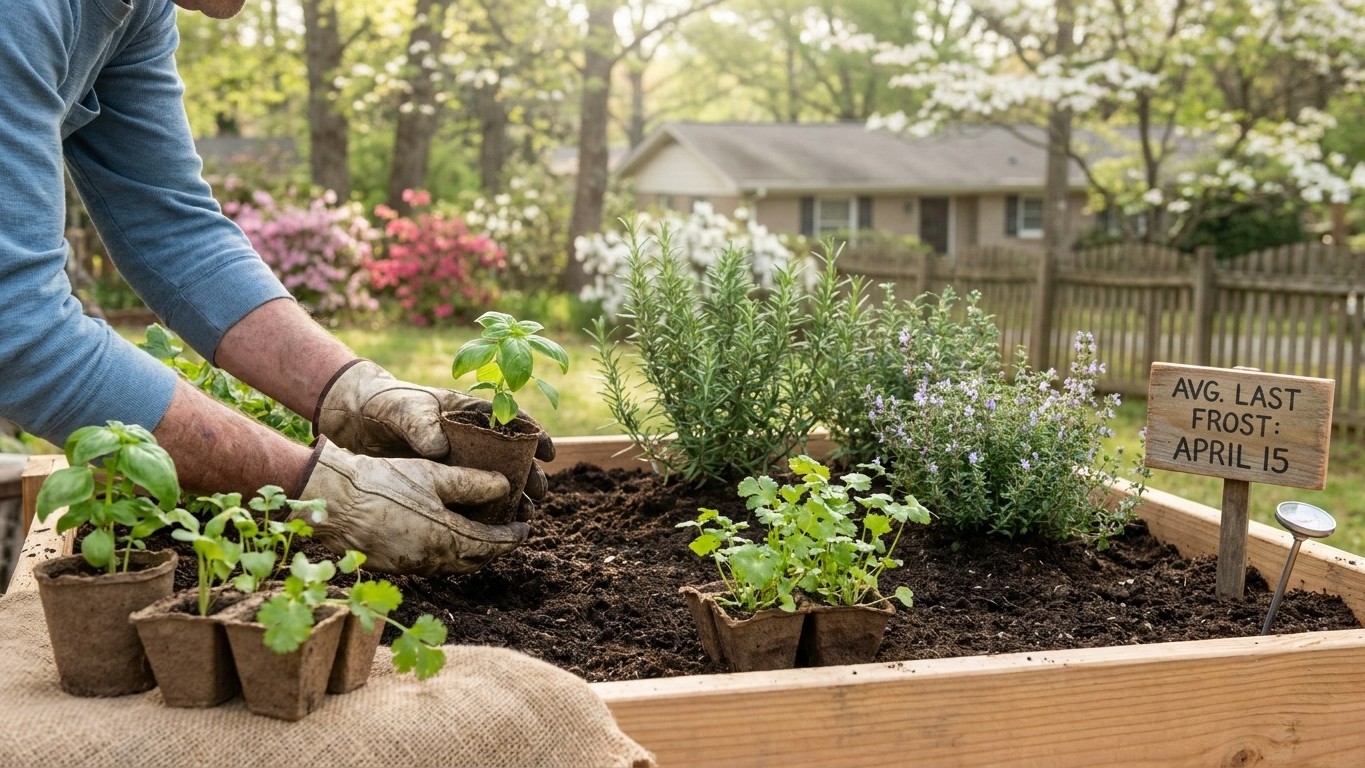

Tender herbs like basil, dill and cilantro go into South Carolina soil after the last spring frost window closes, roughly late February to mid-March depending on where you garden. Cold-hardy herbs like parsley, cilantro (again, this time for a spring crop) and chives can go in weeks earlier. The state’s long frost-free stretch, nearly nine months at the coast, gives herb gardeners more room to maneuver than almost any other part of the East Coast.
The short answer for South Carolina
At the Charleston reference station (USW00013880), the last spring frost falls somewhere between February 28 and March 17, and the first fall frost arrives between November 20 and December 5. Those dates come from NOAA’s 1991-2020 Climate Normals and mark a 30-70% probability band for a 32°F freeze. That means on February 28, there’s roughly a 70% chance of still seeing a freeze somewhere in that range, and by March 17, the odds have dropped to about 30%. It’s a betting line, not a guarantee, and the further you push into that window, the safer the bet.
For tender herbs, basil chief among them, wait until you’re past the 70% mark, meaning closer to mid-March for most of the state. Basil seed rots in cold, wet soil, and transplants set out too early just sit there sulking until the soil catches up. Parsley, cilantro, chervil and chives handle a light frost fine, so they can go in during the earlier half of that window, even a few weeks before the last frost date if the soil is workable.
The fall side of the calendar matters just as much and gets ignored more often. Cilantro and dill both prefer cooler weather and tend to bolt fast once summer heat sets in, so a second sowing timed to mature before the November 20 to December 5 frost window often outperforms anything planted in spring. Count backward from that window based on the herb’s days-to-maturity, and you’ll usually land on a late-summer sowing date, not a fall one.
Perennial herbs like rosemary, sage, thyme and oregano follow a different clock entirely. Their survival depends less on frost dates and more on winter cold, and here the coldest-month mean minimum of 38.9°F (Charleston reference station) tells the real story. That’s a mild number. It means winters here rarely punish established perennial herbs the way a Midwest or New England winter would, and most of these plants can go in the ground anytime from early spring through early fall without worrying much about a hard freeze finishing them off.
What will not work here

The mistake gardeners moving from cooler states make is treating South Carolina’s long season as universally forgiving. It isn’t. A frost-free stretch running from late February or mid-March all the way to late November, call it roughly 260 to 270 days, sounds like an invitation to grow anything, anytime. But length isn’t the same as mildness, and the middle of that stretch, June through August, is where cool-season herbs go to die.
Cilantro and chervil in particular fold under sustained summer heat. Both bolt to seed within a couple of weeks once daytime temperatures push consistently into the 80s and 90s, and no amount of shade cloth fully rescues a planting that’s already flowering. Gardeners who sow cilantro in May expecting a summer-long harvest usually get three weeks of usable leaf and a lot of coriander seed instead. The fix isn’t more water or better soil. It’s timing the sowing so the plant matures in the cool shoulder seasons, not the furnace in between.
Humidity causes a second, quieter failure. South Carolina summers run wet as well as hot, and herbs planted at the spacing recommended on a seed packet meant for a drier climate often develop powdery mildew or downy mildew by midsummer. Basil is especially prone to this once foliage stays damp overnight, which happens easily when plants are crowded and airflow is poor. Spacing plants wider than the package suggests, and watering the soil rather than the leaves, does more to prevent this than any fungicide applied after the fact.
Watering habits built for a drier region also backfire here. A once-a-week soak works fine in a place with cool, dry summers, but South Carolina’s combination of heat and humidity means soil dries fast between rains and then stays soggy after a downpour, a swing that stresses shallow-rooted herbs like basil and cilantro more than a steady, moderate watering schedule would. Herbs that tolerate that swing best, rosemary, thyme, oregano, tend to be the Mediterranean perennials bred for exactly this kind of feast-or-famine moisture pattern.
Herbs sorted by how they handle South Carolina summer
- Struggles in peak summer heat and humidity: cilantro, chervil, dill (bolts fast)
- Tolerates it with wider spacing and even moisture: basil, parsley
- Built for it: rosemary, thyme, oregano, sage
What changes across South Carolina
South Carolina spans USDA hardiness zones 7a to 9a, a spread built entirely from one measurement, the average annual extreme minimum temperature. That’s a three-zone range inside one state’s borders, and it means there’s no single answer to “when do I plant” once you leave the immediate coast. A gardener working from the Charleston reference station’s numbers, cited above, is working from data typical of the Lowcountry, and the caution attached to those figures matters: peninsular Charleston itself runs milder still than the airport station used for the official readings, while Upstate South Carolina, up around the Piedmont and foothills, runs several weeks tighter at both ends of the season.
What that means in practice is that a gardener near the coast can often push a basil transplant out earlier than the state-level window suggests, and stretch a fall cilantro crop later into December before frost shuts it down. A gardener in the Upstate should do the opposite: treat the state’s frost dates as optimistic, add a couple of weeks of caution on the spring end, and expect fall frost to arrive noticeably before December.
None of this is a reason to guess. The USDA Plant Hardiness Zone Map lets you enter a ZIP code and get the zone for that specific location, not a statewide average.
Where to check this for your own county
South Carolina’s state-level pattern is built from one weather station’s normals. That’s useful for understanding the shape of the season, but it isn’t a substitute for county-level guidance, and Clemson Cooperative Extension exists specifically to fill that gap. Start at clemson.edu/extension, which connects to the Home & Garden Information Center (HGIC) and to county extension offices across the state.
What you’re looking for there is twofold. First, a planting calendar built for your specific region rather than the state as a whole, since Clemson’s HGIC publishes guidance broken out by crop and, in many cases, by climate zone within South Carolina. Second, variety trial results and county-specific recommendations, since an herb variety that thrives in the Lowcountry’s sandy, humid conditions may perform differently in the Piedmont’s clay soil and drier air.
As an example of how granular Clemson’s HGIC gets with its calendars, look at its lawn maintenance series: separate published calendars exist for Bermudagrass, Zoysiagrass, Centipedegrass, and St. Augustinegrass, each timed to that specific species rather than lumped into one generic “lawn calendar.” HGIC’s herb and vegetable fact sheets follow the same logic, organized by plant rather than by region alone, so search HGIC directly for the herb you’re growing, and call your county office if you can’t find a local calendar. A county recommendation beats a state one every time.
Checking this against your own garden
Every date here comes from a 30-year average measured at one station. Your garden is not that station, and the surest way to know it’s ready is to read the soil and the plants themselves, not the calendar. Three signs matter more than anything printed here.
Feel the soil at planting depth, about an inch or two down, with your hand rather than a thermometer. If it feels cool and damp like a spring morning, basil seed will just sit there; if it feels closer to room temperature, it’s ready to germinate. Watch your parsley and cilantro seedlings for their first true leaves, the second set that looks like the mature plant rather than the rounded seed leaves that emerge first. That’s the point where the plant has committed to growing, and it’s a better transplant signal than counting days since sowing. And watch how fast any cilantro or chervil already in the ground starts sending up a central flower stalk. Once that stalk appears, the plant has decided summer has arrived, regardless of what the calendar says, and that’s your cue that your particular yard runs warmer, or the season turned hotter, faster than the state averages assumed.
The Moon calendar is a separate, older custom: see when to plant herbs by the moon, written as tradition rather than fact.