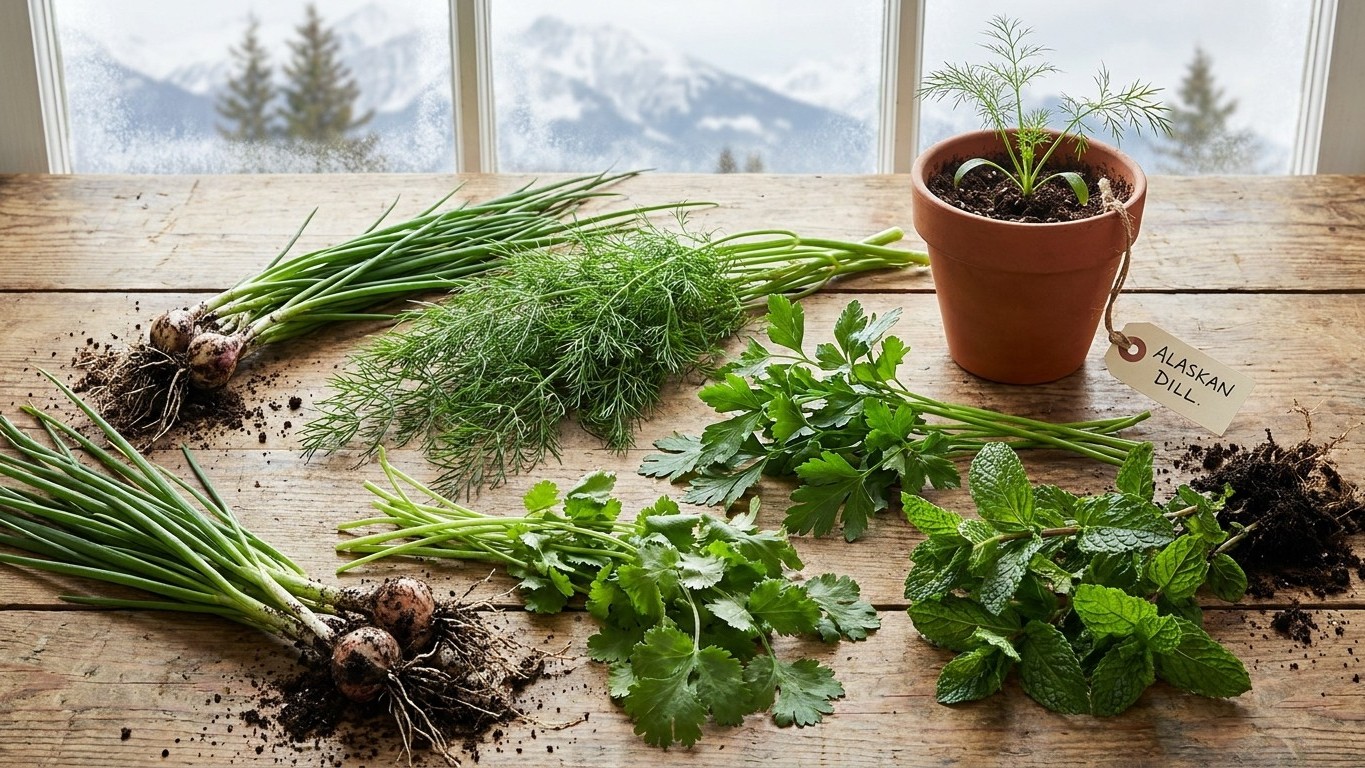

Tennessee’s herb garden works best when you split your list by life cycle: warm-season annuals like basil, dill, and cilantro thrive in the state’s long frost-free stretch, herbaceous perennials like chives, mint, and oregano shrug off the whole hardiness range, and woody Mediterranean herbs like rosemary hold on reliably only in the warmer, lower-elevation counties.
The short answer for Tennessee
Start with the frost window, because it decides everything else. The last spring freeze at the reference station lands somewhere between March 31 and April 12, and the first fall freeze arrives between October 28 and November 8. Do the math on the worst-case pairing (a late April 12 spring frost against an early October 28 fall frost) and you still get roughly 199 frost-free days. Pair the earliest spring frost with the latest fall frost and the window stretches past 220 days. Either way, that’s a long season by national standards, and it’s the single fact that makes Tennessee forgiving ground for herbs.
That length matters more than the average winter cold, because most kitchen herbs are grown as warm-season annuals here regardless of what USDA zone map they’d technically survive in. Basil, dill, and cilantro don’t care about January. They care about how many warm weeks they get between frosts, and Tennessee hands them nearly seven months of it.
The harder question is what survives winter in the ground, and that’s where the coldest-month figure comes in. The mean daily minimum temperature in the coldest month sits at 30.1°F at the Nashville reference station. That’s an average, not a floor, so plenty of nights drop well below it. Woody Mediterranean perennials like rosemary and bay laurel are marginal at that kind of average low. Herbaceous perennials like chives, oregano, thyme, and mint tolerate it without much complaint, since their hardiness rating sits well under the state’s coldest zone band.
| Herb type | Examples | Fit for Tennessee |
|---|---|---|
| Warm-season annual | Basil, dill, cilantro | Strong, thanks to the long frost-free window |
| Hardy herbaceous perennial | Chives, mint, oregano, tarragon | Reliable across the whole zone range |
| Woody Mediterranean perennial | Rosemary, bay laurel, lavender | Reliable only in the warmer, lower counties |
So the decision tree is simple: plant annual culinary herbs for volume and flavor every year without worrying about winter, plant the hardy perennial group once and expect it back, and treat the woody Mediterranean group as a bet that depends on exactly where in the state your garden sits.
What will not work here
Rosemary left in the ground over winter is the classic disappointment. A mean coldest-month minimum of 30.1°F means the average night in January flirts with freezing, and cold snaps push well past that average on the worst nights. Rosemary varieties bred for cold tolerance can take real punishment, but plenty of the varieties sold at garden centers are not those varieties, and an unprotected plant in a Tennessee front bed can die back to the roots or die outright in a hard week. Bay laurel is worse off, since it has almost no cold tolerance to spare even in a mild winter.
Cilantro fails for the opposite reason: heat, not cold. It’s a cool-season herb that bolts to seed once summer heat sets in, and Tennessee’s frost-free season runs warm and humid for most of its 199 to 222 days. A spring planting gives you a few weeks of usable leaf before the plant switches to flowering and seed production. Gardeners who plant cilantro once in April and expect it to hold through August are fighting the plant’s own biology, not a Tennessee-specific quirk, but the state’s summer heat accelerates the timeline.
Weekly watering defeats basil and dill during the hottest stretch of the season. Both herbs are shallow-rooted and lose moisture fast once daytime temperatures climb, and a once-a-week watering habit that works fine in a cooler, drier climate leaves these plants wilting and stressed here. Stressed basil bolts to flower early, which is the plant’s way of finishing its life cycle before it dies of drought, and that shortens your harvest window even if the plant technically survives.
Tight spacing defeats Herbs in Tennessee‘s humid summers in a way it wouldn’t in a drier state. Basil and oregano planted shoulder to shoulder trap moisture between leaves overnight, and that sets up powdery mildew and other fungal problems once the humidity climbs in July and August. The fix isn’t a different herb, it’s more air between plants than a seed packet grown for a dry climate would suggest.
What changes across Tennessee
Tennessee spans hardiness zones 5b through 8a on the USDA map, and that’s a wide enough spread that there is no single winter answer for the whole state. Zone 8a tolerates average annual extreme minimums roughly 25 degrees warmer than zone 5b does, which is the difference between a rosemary bush that shrugs off winter and one that dies to the ground every year.
The pattern runs roughly west to east and low to high. The Cumberland Plateau and the mountains of East Tennessee sit at real elevation, and elevation cools everything: growing seasons start later in spring, end earlier in fall, and winter lows run harder than the Nashville reference figures suggest. A grower on the Plateau should expect the cooler end of both frost windows given in this article, not the earlier, milder end.
Lower-elevation West and Middle Tennessee, by contrast, run toward the warmer end of the state’s zone range, and that’s where woody Mediterranean perennials have the best odds of surviving outdoors without heavy winter protection. A rosemary bush that limps through winter in Nashville might sail through it in Memphis, and might not survive at all up on the Plateau.
None of this tells an individual reader which zone covers their own yard, because zone boundaries in a state with this much elevation change can shift over a few miles. The right move is to check the current USDA Plant Hardiness Zone Map for the specific address, not to guess from a regional description, and then treat the woody perennial herbs in this article as a local experiment rather than a settled fact.
Where to check this for your own county
Tennessee’s state-level picture is built from a single reference station’s climate normals. That’s useful for a general sense of the season, but it’s not a substitute for county-level guidance, and the gap between the two can matter for a herb garden sitting right at the edge of a hardiness zone or up on the Plateau.
The University of Tennessee Institute of Agriculture Extension runs the state’s county-based extension network, and its site is the right next stop. Look for two things there. First, a county-specific planting calendar, which will reflect the actual frost pattern for that elevation and region rather than the statewide range given here. Second, any list of herb or vegetable varieties that local extension agents have trialled in that county, since a variety that performs well in Memphis clay doesn’t automatically perform the same way in a mountain garden with thinner soil and a shorter effective season.
A county recommendation beats a state one every time, because it accounts for the elevation, soil, and microclimate details that a single reference station can’t capture.
Checking this against your own garden
Every date here is a probability built from decades of averages at one weather station. A gardener’s own observation of their own plot outranks all of it, and three simple checks tell more than any calendar.
Feel the soil before trusting the calendar. Push a finger a few inches into the bed where basil or another warm-season herb is headed. If it feels cold and heavy rather than loose and mild, the ground hasn’t caught up to the season yet regardless of what the frost-date window suggests, and transplanting into it invites stalled growth.
Watch for the first true leaves on anything direct-sown, like dill or cilantro. The tiny seed leaves that appear first don’t mean much, but the first set of leaves that actually look like the mature plant’s foliage confirms the seed found conditions it liked. A long gap between sowing and that first true leaf set is the garden’s own way of saying the soil was cooler than the calendar assumed.
Watch for the first flowers on basil or cilantro, because that’s the plant announcing heat stress and the start of bolting. If flowers show up far earlier in the season than expected, that patch of the garden is running hotter than the state average, likely from reflected heat off a wall, a driveway, or a fence, and it’s worth noting for next year’s placement rather than fighting this year’s plant.