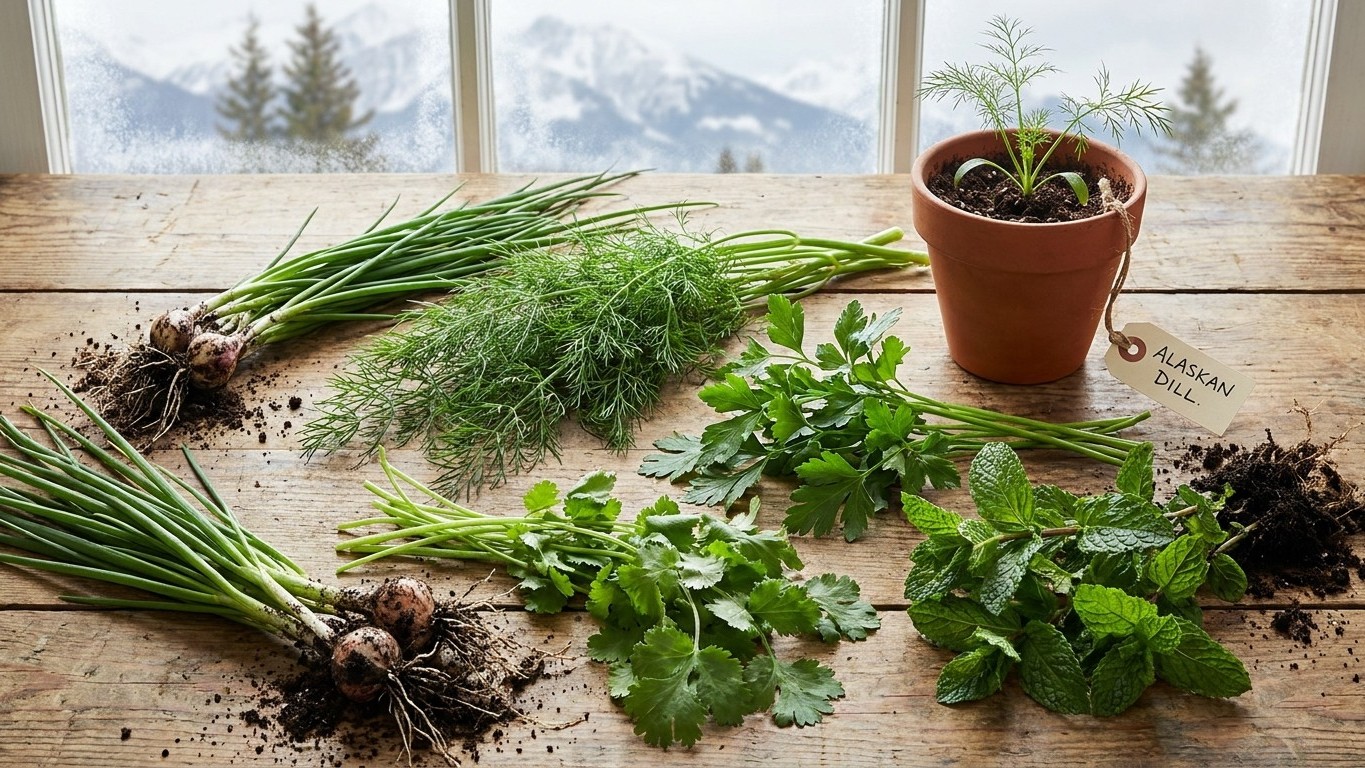

Vermont’s best herb bets split cleanly by type. Hardy perennials like chives, mint, oregano, thyme, and sage handle the state’s winters and are the safest long-term investment. Fast annuals like dill, cilantro, and parsley fit the short growing season. Mediterranean shrubs like rosemary and bay laurel don’t survive winter here at all and need to be treated as annuals or houseplants.
The short answer for Vermont
Start with what the season allows. Burlington’s frost-free window runs from roughly April 30 to May 10 on the late-spring end, closing back down between October 3 and October 13. That’s a working season of somewhere around 150 days in the mildest corner of the state, and it’s the number every herb choice should be measured against.
Hardy perennial herbs are the strongest performers across Vermont’s hardiness range of 3b to 5b. Chives, mint, oregano, thyme, sage, and tarragon are all bred to tolerate winters far colder than what USDA zone 4 or 5 throws at them, so once established they come back year after year without protection. These are the herbs worth planting in a permanent bed rather than a pot you drag indoors every October.
Fast-maturing annuals are the second tier, and they matter because Vermont’s frost-free window doesn’t leave much slack. Dill, cilantro, parsley, and basil started from transplants (not seed sown outdoors) all mature well inside a 150-day season. Basil in particular does better here started indoors four to six weeks before the last frost and transplanted out, rather than direct-seeded, because it shaves weeks off the time it needs in the ground.
Then there’s the category that simply doesn’t belong outdoors year-round: rosemary, bay laurel, and lemongrass. These are shrubby, subtropical plants rated for USDA zones 8 through 10. Vermont’s coldest month averages a daily minimum of 12.9°F, and that’s a mean, not the extreme low the plant would actually face in a hard cold snap. Grow them in containers, treat them as annuals, or bring them inside for winter. There’s no version of a Vermont winter that lets a rosemary bush survive planted in the ground.
The short version, then: build the backbone of a Vermont herb garden out of hardy perennials, fill in with quick annuals timed to the frost dates, and keep the Mediterranean shrubs in pots.
What will not work here

The most common mistake is trying to overwinter herbs rated for climates far milder than this one. Vermont’s hardiness zone spans 3b to 5b, which on the USDA map means average annual extreme minimum temperatures ranging from -35°F in the coldest pockets to -15°F even in the mildest. Rosemary tolerates brief dips into the low 20s at best. Bay laurel is similar. Planting them in open ground and hoping for the best isn’t optimism, it’s a guaranteed replacement purchase the following spring.
Lavender sits in a gray zone worth flagging separately. Some hardy cultivars are bred for zone 4 or 5 and can survive a Vermont winter if the drainage is excellent, but many garden-center lavenders sold in spring are zone 6 or 7 varieties that were never meant to see a Vermont January. Check the tag, not the price.
Season length defeats slow growers
The second failure mode has nothing to do with cold and everything to do with time. A 150-day window sounds generous until you count backward from a long-season variety. Some basil, cilantro, and parsley cultivars are bred for warmer, longer growing regions and simply run out of daylight and heat before they reach a useful harvest size, especially in the parts of the state where the season is shorter than Burlington’s. Direct-seeding a slow basil variety in late May in the Northeast Kingdom is asking it to do in 130 days what it was bred to do in 100 or fewer, in a much warmer place.
Humid valleys punish tight spacing
Vermont’s river valleys and the Champlain lowlands run humid through midsummer, and that humidity is unforgiving toward herbs planted the way a seed packet often suggests, tight and close. Thyme, oregano, and sage are Mediterranean natives that expect dry air moving freely around their leaves. Crowd them into damp clay soil common in Vermont’s valley floors, and powdery mildew and root rot show up well before the plant would otherwise be struggling with cold. Wider spacing than the packet recommends, and a raised bed or mounded row for drainage, solves more problems here than any amount of watering discipline.
What changes across Vermont
Vermont is not one climate. A hardiness range of 3b to 5b is a two-zone spread, and that difference is the gap between a garden that can coax along a marginal perennial and one that can’t. There is no single answer for “when does my herb garden start” in this state, only a range depending on where in it you’re standing.
The frost dates cited above, late April into mid-May for the last spring frost and early to mid-October for the first fall frost, come from the Burlington station on Lake Champlain, which is by a wide margin the mildest part of Vermont. The lake moderates temperature swings in both directions, delaying the first fall freeze and pulling the last spring frost earlier than almost anywhere else in the state.
Move away from the lake and the picture changes fast. The Green Mountains and the Northeast Kingdom run a meaningfully shorter frost-free season, with spring frost lingering later and fall frost arriving earlier. A gardener working at elevation or in the Kingdom should treat the annual-herb calendar built around Burlington’s dates as optimistic, not neutral, and lean harder on the hardy perennial category, since those plants don’t care how short the frost-free window is once they’re established.
The practical shift for anyone north of the Champlain Valley or up in elevation: push transplant dates later, favor the fastest-maturing annual varieties available, and don’t assume a plant description written for “Vermont” was written with your particular hillside in mind. The USDA Plant Hardiness Zone Map can tell you which zone your specific property sits in, down to the ZIP code.
Where to check this for your own county
Everything above describes Vermont as a whole, and Vermont as a whole is a poor stand-in for any one county. The state runs a genuine climate gradient from the lake to the mountains to the Kingdom, and a recommendation built for Burlington will overstate how much season a garden in Craftsbury or Peru actually gets.
The University of Vermont Extension (uvm.edu/extension) is the source built to close that gap. It’s the land-grant university extension for the state, and its role is specifically to localize broad climate data down to county-level guidance that a statewide article like this one can’t provide.
Two things are worth looking for once there. First, a county-level or regional planting calendar, which will adjust the frost-date window used in this article to whatever your specific county actually experiences, rather than the Burlington station figures cited here. Second, look for variety trial results or recommendations specific to your area. Extension offices regularly trial herb and vegetable varieties under local conditions and publish which ones actually perform, information no general state page can substitute for.
The plain fact worth sitting with: a county recommendation beats a state recommendation every time. A state recommendation is the broad one. It’s useful for understanding the range you’re working within, the zone spread, the general frost timing, the categories of herbs that will and won’t survive here, but it isn’t a substitute for the number your own county extension office publishes for your own soil and elevation.
Checking this against your own garden
Frost dates and hardiness zones describe averages built from decades of station data. Your particular yard, with its own slope, soil, and sun exposure, doesn’t have to follow the average exactly, and the surest way to know what it’s actually doing is to watch it directly rather than trust a calendar date.
Soil warmth by feel is the first and most reliable signal. Herbs germinate and transplant successfully once the soil at planting depth (a couple of inches down) feels warm and crumbly rather than cold and compacted, regardless of what the calendar says the date is. A south-facing slope or a raised bed can warm up a full week or two ahead of open ground nearby, which matters more to a seed than any printed date.
The second signal is the first true leaves on any direct-sown annual, like dill or cilantro. The initial seed leaves that pop up first don’t tell you much, but the first set of true leaves, the ones that actually look like the mature plant, signal the seedling has moved past its most fragile stage and the local conditions are supporting real growth.
The third is watching overwintered perennials wake up. Chives, mint, and oregano coming back from the ground each spring are a free, built-in thermometer for your specific yard. When they push new green shoots earlier or later than a neighbor’s patch a mile away, that gap is telling you something real about your own microclimate, information no state-level frost date can capture.