
Vermont herb gardeners get roughly five months of open ground, bracketed by a spring frost window in late April to mid-May and a fall frost window in early-to-mid October. Winters are the real filter here: a coldest-month low near 13°F means most tender herbs survive outdoors only as annuals or as pots brought inside, while a short list of hardy perennials tough it out in the ground year after year.
When the soil is warm enough in Vermont

At Burlington’s reference station (NOAA station USW00014742), the last spring frost falls in a window of April 30 to May 10, based on 1991-2020 Climate Normals and the 30-70% freeze probability band. That’s a probability range, not a guarantee, so a frost after May 10 is still possible in a cold year, and one before April 30 is possible in a mild one. Treat it as the middle of a bell curve, not a switch that flips.
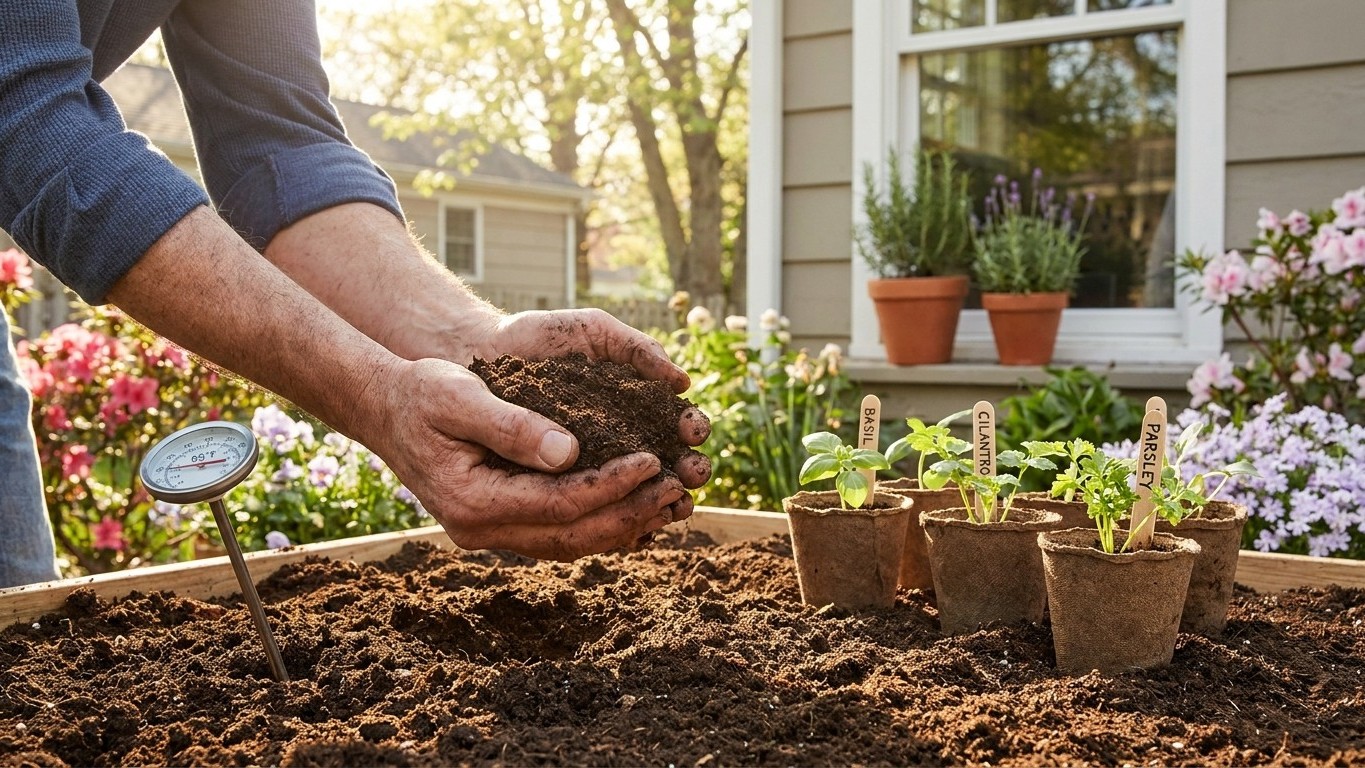
Frost date matters less than what it stands in for. Herbs don’t care about the thermometer reading at 32°F; they care about soil temperature, and soil warms on its own schedule, usually a week or two behind the last frost date as the ground releases winter cold. A garden bed can sit frost-free and still be too cold for seed to germinate reliably, especially in a state where snowmelt keeps the topsoil damp and sluggish to warm well into May.
That lag matters most for warm-season herb types, the ones native to Mediterranean or tropical climates, which stall or rot in cool, wet soil even without a frost touching them. Cool-season herb types tolerate the gap better and can go in as soon as the soil can be worked, often before the frost window has fully closed. The practical move is to wait past the midpoint of the frost window before setting out anything heat-loving, and to use raised beds or black landscape fabric if the goal is to push that date earlier, since both warm the root zone faster than bare open ground.
One more layer worth flagging: the Burlington figures describe the mildest corner of the state, the lake-moderated strip along Lake Champlain. The Green Mountains and the Northeast Kingdom run their frost windows substantially later in spring and earlier in fall, which shrinks the whole calendar discussed here. A gardener in Newport or Stowe should treat the Burlington dates as an optimistic reference point, not a local forecast.
None of this touches on identifying wild look-alikes of cultivated herbs. Several toxic plants closely resemble common kitchen herbs, and that kind of identification is outside what a planting-calendar page can responsibly cover. Buy nursery starts or certified seed, and keep foraging decisions to people trained for that specific skill.
How long the season lasts here
Subtracting the two NOAA windows gives a growing season that runs from late April/early May to early/mid-October, somewhere in the neighborhood of five months at the Burlington reference station. That’s a workable window for herbs, most of which mature faster than fruiting vegetables, but it’s not a long one by national standards, and it narrows further the higher and further from the lake you go.
A five-month window is long enough to support a second sowing of fast-growing herb types, planted directly after an early crop is cut back or pulled, provided that second sowing goes in with enough time to reach a usable size before the fall frost window opens in early October. It’s not long enough for a third round in most years, and it puts real pressure on slower-maturing types, which need to go in as early as the soil allows if they’re going to produce much of anything before the season closes.
This is also where the transplant-versus-direct-seed decision gets made. In a shorter season, starting seed indoors and setting out transplants buys back weeks that direct-seeding in cold soil would otherwise waste, especially for herb types that germinate slowly. Anyone transplanting into Vermont’s cool spring soil should check the root system before setting it out, since a plant held too long in a small container often becomes root-bound and struggles to establish, undoing the head start it was meant to provide. For the mechanics of timing a second planting once the first is spent, the site’s succession sowing guide lays out how to stagger sowings against a known frost window.
The takeaway for planning purposes: treat the first sowing as the one that matters most, get warm-season types in only after the soil has genuinely caught up to the calendar, and reserve the second-sowing option for herbs that mature quickly enough to fit inside what’s left of the window.
Heat and water in Vermont

Vermont summers don’t push herbs the way a Southern or Plains summer does. Extreme heat above 90°F is an occasional event here, not a defining feature of the season, and the more common stress on an herb bed comes from the opposite direction: cool nights, overcast stretches, and humid air that slows fruit and flower development and gives fungal disease time to take hold on crowded foliage. Mildew on basil and other soft-leaved herbs shows up more often from damp, still air than from any lack of water.
That reframes the whole growing question. Instead of asking how a herb handles heat, the real question in Vermont is how it handles cold, because winter, not summer, decides what lives here permanently. The coldest month’s average daily minimum at the Burlington reference station is 12.9°F, and that single figure is the one that separates a perennial herb bed from a container collection that gets carried indoors every fall.
The state’s hardiness zone, per the USDA Plant Hardiness Zone Map (2023 edition, based on 1991-2020 normals), spans 3b to 5b across the territory. That’s a wide range for one state, built on the average annual extreme minimum temperature, and it means a herb rated hardy in a 5b pocket near the lake can still fail outright in a 3b valley in the Northeast Kingdom, even though both addresses have a Vermont mailing zip code. Anyone shopping for a “hardy” perennial herb needs to know which end of that range their own yard sits on before trusting a tag.
Practically, that pushes Vermont herb growers toward two separate strategies rather than one. Perennial herb types suited to the region’s coldest zones can stay in the ground year-round with basic winter mulch. Everything else, meaning most of the herbs associated with warm-climate cooking, gets grown as an annual from seed or transplant each spring, or potted and moved to a bright indoor spot before the first hard frost closes out the season in October.
Which herbs suit Vermont
Given a five-month window, a cool damp summer, and winters that bottom out near 13°F on average in the coldest month, the herbs that suit this territory best split cleanly into a few groups by type rather than by variety.
- Cold-hardy perennial types, native to temperate climates, that can survive the region’s harsher winters in the ground with mulch, particularly in the milder 5a-5b pockets near Lake Champlain.
- Fast-maturing annual types, both cool- and warm-season, that fit comfortably inside a single sowing window and don’t need the full five months to produce usable growth.
- Warm-season culinary types that need heat and airflow, best grown in raised beds or containers where soil warms faster and foliage gets better circulation against mildew.
- Tender perennial types with a reputation elsewhere as landscape plants, which in Vermont’s climate are really container plants that spend winter indoors near a bright window.
Airflow and spacing matter more here than in a hot, dry climate, since the state’s humid, overcast summer stretches are exactly the conditions that let fungal disease spread through a crowded bed. Wider spacing and morning sun exposure to dry dew off the leaves do more for a Vermont herb patch than any amount of extra water.
What this page won’t do is name a specific cultivar. Variety trials run by land-grant universities test dozens of named cultivars against local disease pressure, local frost timing, and local soil, and the results shift from one growing season to the next as new resistant lines come onto the market. A general guide has no way to know which named variety is currently performing best in a Burlington backyard versus a Northeast Kingdom hillside. The University of Vermont Extension service, at uvm.edu/extension, publishes exactly that kind of locally trialed variety guidance, and it’s the only source with the standing to make a specific recommendation stick.
This page also isn’t the place to weigh in on any herb’s traditional medicinal reputation. Several herbs commonly grown for the kitchen carry a long folk history as remedies; that history exists, and evaluating it is outside the scope of a planting guide focused on climate and timing.