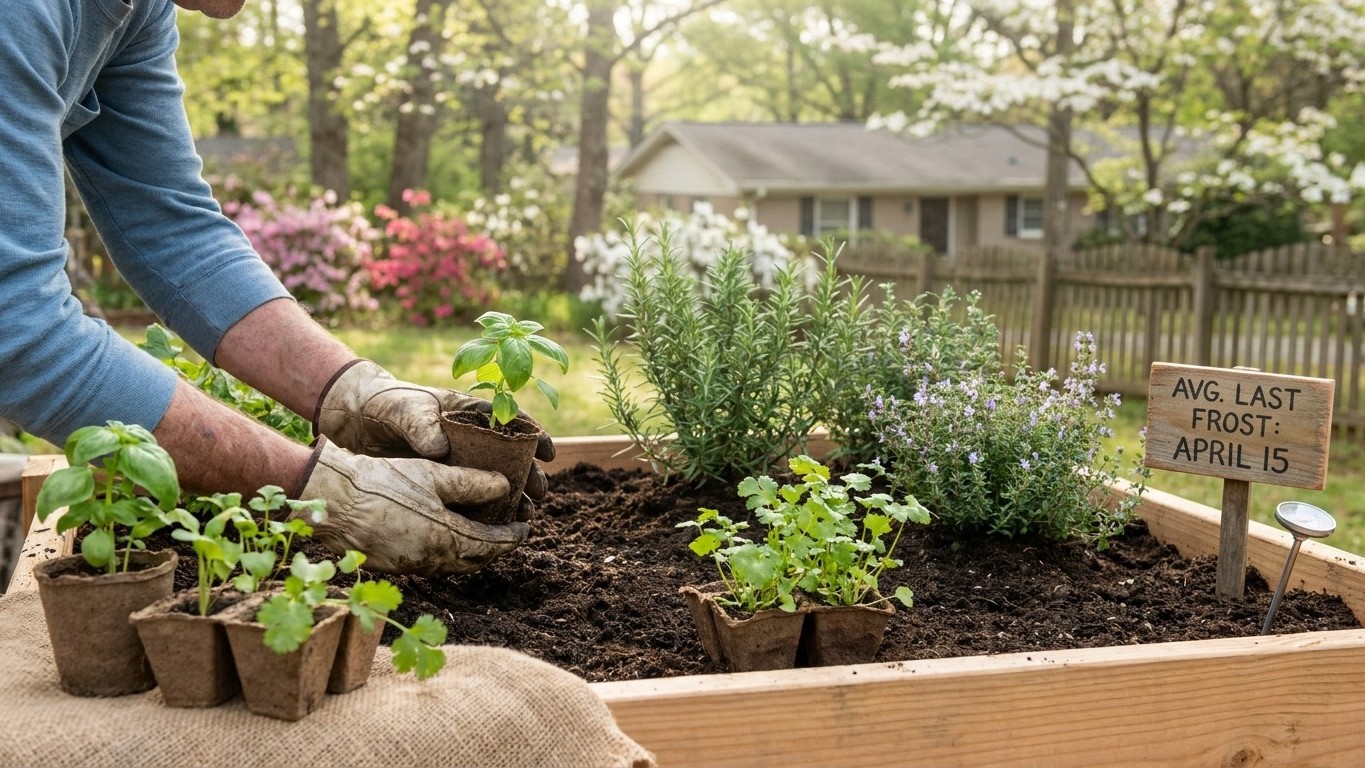

In Burlington, the safe outdoor planting window for tender herbs like basil and cilantro runs from around May 10 through early June, based on NOAA frost data. Hardy herbs such as chives and parsley can go in earlier, especially if started indoors in March. Move away from Lake Champlain, though, and that window compresses fast.
The short answer for Vermont
NOAA’s 1991-2020 climate normals for the Burlington station (USW00014742) put the last spring frost between April 30 and May 10, and the first fall frost between October 3 and October 13. Those aren’t fixed calendar dates. They mark the window where the probability of a 32°F freeze sits between 30% and 70% for that station specifically. Plant tender herbs before April 30 and you’re betting against odds that lean toward frost. Wait until after May 10 and the odds have tipped comfortably in your favor.
That gives Burlington a frost-free stretch of roughly 145 to 165 days, depending on where in the band each frost actually lands in a given year. For tender annual herbs, basil, cilantro, dill, that’s the working season. Start seed indoors four to six weeks before the May window opens, then transplant once nighttime lows are reliably staying above 45-50°F, not just above freezing. A single cold, damp night in the upper 30s won’t necessarily kill basil, but it will stunt it for weeks, and Vermont springs deliver plenty of those nights even after the “official” frost date has passed.
Hardy and semi-hardy herbs work on a different clock. Chives, parsley, cilantro (which actually prefers cool soil), and dill can go into the ground two to three weeks before that last-frost band closes, since they tolerate a light frost without much damage. Perennial herbs like thyme, oregano, sage, and established chives can often go out even earlier as transplants, once the soil itself has thawed and can be worked, typically a couple of weeks ahead of the tender-herb date.
On the back end, that October 3-13 window is your harvest deadline for anything not cold-hardy. Basil in particular turns black at the first real frost and often sulks well before that, once nights dip into the low 40s. If you’re succession-planting cilantro or dill for a fall crop, count backward from October 3, not October 13, to give yourself the safer margin.
What will not work here

Vermont’s growing season, even at its mildest near the lake, is short enough to eliminate a handful of herbs outright as outdoor, seed-started crops. Rosemary is the clearest case. It’s slow from seed under the best conditions, often taking two to three weeks just to germinate, and a Vermont season of roughly 150 days rarely gives it enough runway to reach a usable size before fall frost ends things. Buying started rosemary plants sidesteps the germination problem, but it doesn’t solve the second one.
That second problem is winter. The mean daily minimum temperature in the coldest month at the Burlington reference station is 12.9°F. That’s not a record low or a rare cold snap; it’s the average low night in the coldest stretch of a typical winter. Rosemary, bay laurel, and lemongrass simply don’t survive exposure at that temperature outdoors, even with mulch. Gardeners who treat these as garden perennials in milder states end up disappointed here every single year. In Vermont they have to be grown as container plants and brought inside before the first fall frost, then treated as houseplants until the following late spring.
Lavender sits in a gray zone for the same reason. Some of the hardier cultivars can survive a Vermont winter with excellent drainage and a protected spot, but the margin is thin given that 12.9°F average minimum, and a harder winter than average will take out plants that looked fine the year before. This isn’t a herb to plant once and forget; it’s one to watch closely for the first two winters before deciding it’s staying.
Close spacing is its own trap here, separate from cold. Herbs like oregano, bee balm, and bergamot planted tight, the way a seed packet’s “ideal” spacing often suggests, run into trouble in a state where humid, still summer air sits in valley gardens for days at a time. Powdery mildew shows up on crowded oregano and monarda by midsummer almost every year in these conditions. Spacing plants a few inches wider than the package minimum, and making sure there’s airflow between rows, costs nothing and prevents a problem that’s otherwise a near-guarantee by August.
What changes across Vermont
Vermont spans USDA hardiness zones 3b to 5b, a spread wide enough that no single planting date works for the whole state. That range is built entirely on average annual extreme minimum winter temperature, and the gap between 3b and 5b represents a real difference in what survives the winter outdoors, not just a minor shift in spring timing.
Burlington’s frost dates above reflect the lake-moderated end of that range, the mildest corner of Vermont. Lake Champlain holds heat into the fall and delays the first hard freeze compared to inland areas at the same latitude, and it does the same in reverse in spring, warming the air a bit earlier. The Green Mountains and the Northeast Kingdom don’t get that buffer. At higher elevations and in the state’s northeastern counties, both frost dates move inward, a later last spring frost and an earlier first fall frost, which shortens the usable season from the two ends at once.
For a gardener in one of the colder zones within that 3b-5b range, the practical shift is straightforward even without a precise local date: push tender-herb transplanting later than the Burlington window, watch fall weather more closely than the calendar, and treat any borderline-hardy perennial (lavender, some sages) with more caution than a Burlington gardener would.
The USDA Plant Hardiness Zone Map is the tool built for that lookup, using the ZIP code search to find the specific zone for a given address rather than assuming the state average applies.
Where to check this for your own county
The University of Vermont Extension is the state’s land-grant extension service, and it’s the right next stop for anything more specific than what a statewide page can responsibly claim. A state-level page, this one included, has to average across zone 3b and zone 5b conditions, across lakeside microclimates and mountain valleys. A county-level recommendation from UVM Extension doesn’t have to average anything; it can speak to the actual conditions of that county’s growing season.
What’s worth looking for there specifically: a local or regional planting calendar, if the office publishes one, and any variety trial results for herbs suited to that county’s frost timing and soil. Extension offices often track which cultivars have performed well in local trial gardens, information that a national seed catalog or a general gardening site has no way to know. If a county office recommends a particular basil or cilantro variety, that recommendation is grounded in actual local results, not a generic hardiness assumption.
It’s also worth asking, if the office takes calls or emails, about frost timing for that specific county rather than relying on the Burlington-anchored NOAA numbers cited above. Counties away from Lake Champlain and at higher elevation see meaningfully different frost windows, and an extension agent working in that county will know the practical planting dates local gardeners actually use, dates that have been tested against real seasons rather than derived from a single reference station’s climate normals.
None of that replaces the state-level frost window. It sharpens it. Think of the state-level frost window as the starting estimate, and the county-level extension guidance as the correction for wherever the reader’s actual garden sits within Vermont’s zone 3b-5b range.
Checking this against your own garden
Every date here is a statistical estimate built from thirty years of station data. A reader’s own garden, checked in real time, outranks all of it, because it reflects the specific soil, sun exposure, and airflow of that one spot rather than an average across the region.
Soil warmth by feel is the first check. Push a bare hand a couple of inches into the planting bed on a morning before transplanting tender herbs. If it still feels cold and slightly damp in a way that lingers, rather than just cool, the soil hasn’t caught up to the air temperature yet, and transplants set into it will sit and sulk rather than grow, even if the air itself feels warm enough by afternoon.
The second check is watching how quickly early transplants put out new growth after going in. Chives, parsley, or a hardy thyme that sends up fresh green within a week of transplanting are telling the gardener that conditions are genuinely favorable right then, in that specific yard. A transplant that just sits, neither wilting nor growing, for ten days or more is a sign the local microclimate is running colder than the state’s frost-date window suggests, and it’s worth holding back on basil and other tender herbs a bit longer than planned.
The third is simply watching for the first true leaves on anything started from seed directly in the garden, cilantro or dill in particular. True leaves, the second set that appears after the initial seed leaves, signal the plant has moved past its most frost-vulnerable stage and into active growth. Their timing, compared against when the seed actually went in, tells a gardener more about that specific bed’s effective season than any regional average ever will.
Some gardeners also time this by the Moon: when to plant herbs by the moon, as almanac tradition rather than fact.