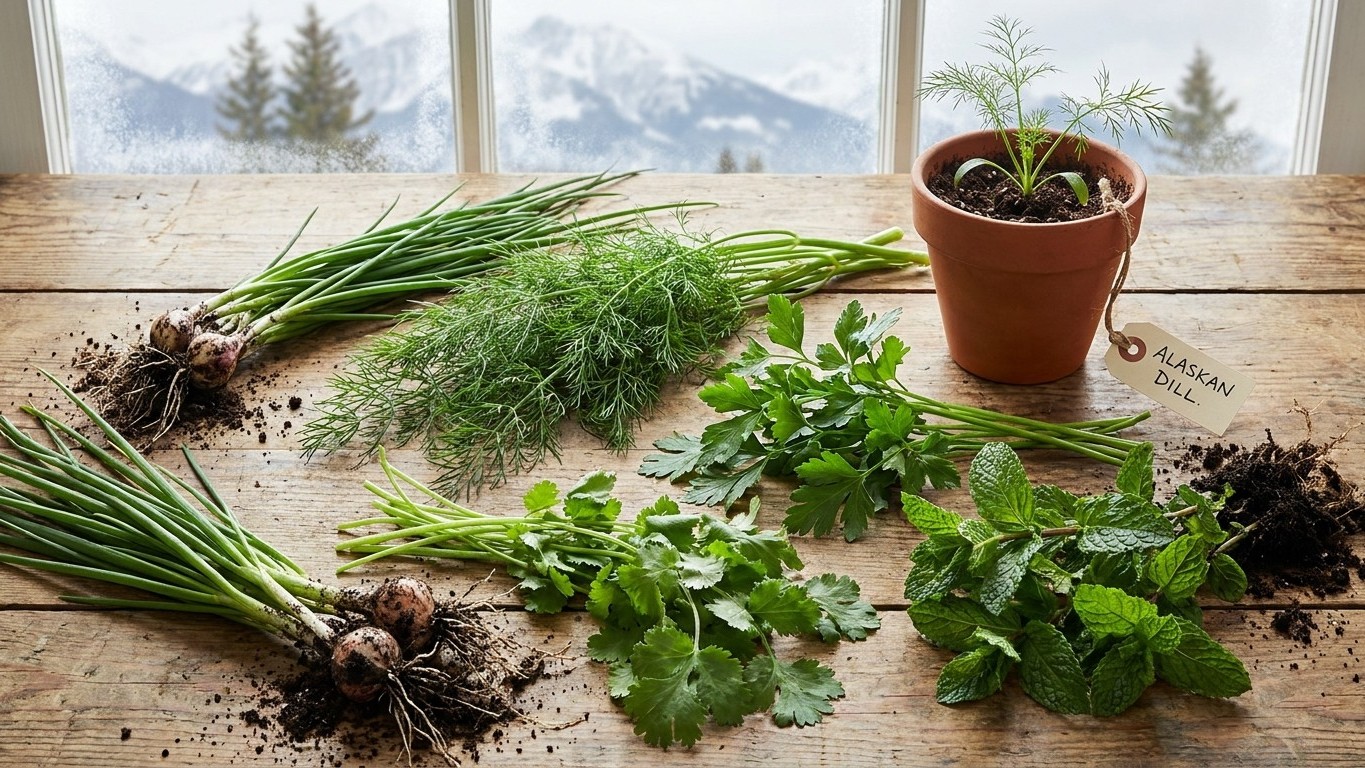

The best herbs for Wisconsin gardens are fast-maturing annuals like basil, dill, and cilantro, plus a short list of genuinely cold-hardy perennials such as chives, thyme, and oregano. Anything that needs a long frost-free stretch or a mild winter to survive outdoors, think rosemary or bay laurel, struggles here no matter how well you tend it.
The short answer for Wisconsin
That answer comes straight from two numbers: the frost-free window and the winter cold. Wisconsin’s last spring frost falls between April 16 and April 29, and the first fall frost arrives between October 17 and October 29, based on NOAA’s 1991-2020 climate normals for station USW00014839. Depending on where you land in that spread, you’re working with roughly five to six months of growing season. That’s plenty for annual culinary herbs, tight for anything that needs a long, warm stretch to bulk up.
Winter is the bigger filter. The coldest month’s average daily minimum runs 17.2°F at the Milwaukee reference station, and Wisconsin spans USDA hardiness zones 3b through 6a. That range decides which perennials can stay in the ground year-round versus which ones need to be treated as annuals or brought indoors.
Here’s how the main herb categories sort out against those two numbers:
| Herb type | Examples | Fit for Wisconsin |
|---|---|---|
| Fast annuals | Basil, dill, cilantro, parsley | Good fit, season is long enough |
| Hardy perennials | Chives, thyme, oregano, mint | Survive winter in most of the state |
| Borderline perennial | Sage, tarragon | Survives with mulch in warmer counties, iffy in the north |
| Tender perennials | Rosemary, bay laurel, lemongrass | Do not survive outdoor winters here |
Basil and dill go in the ground once the soil has warmed past that mid-to-late April frost date and finish well before the mid-to-late October one. Chives, thyme, and oregano are the perennials worth committing garden space to, since a coldest-month average minimum of 17.2°F is within what their root systems tolerate once established. Sage and tarragon sit in a gray zone: they can pull through a Wisconsin winter with decent snow cover or mulch, but a bare, exposed bed in a cold winter can still take them out.
What will not work here
Rosemary and bay laurel are the two most common disappointments in Wisconsin herb gardens, and the reason is arithmetic, not bad luck. Both need winter lows that rarely, if ever, dip below the mid-20s to survive outdoors. Wisconsin’s coldest month averages a daily minimum of 17.2°F, and that’s the average, not the occasional cold snap. Plant either one in open ground here expecting it to come back next spring, and you’re planting an annual you’ll pay perennial prices for.
Lemongrass falls into the same trap. It’s a tropical grass that needs a frost-free period measured in many months, not the roughly five-to-six-month window Wisconsin offers between the April and October frost dates. Gardeners who grow it successfully here almost always do it in a pot they haul indoors before the first fall frost, which defeats the point of planting it as a permanent herb bed resident.
The season-length problem for slow starters
Even within the annual herbs, timing matters more in Wisconsin than in states with a longer frost-free stretch. Herbs that need eight or nine weeks of warm growth before they’re worth harvesting, certain thick-leaf basils or slow parsley varieties, are cutting it close if a gardener waits until the late end of the spring frost window (April 29) to direct-sow. Add a cool, slow spring on top of that, and a slow-maturing herb can run into the fall frost before it’s produced much to harvest.
The far north of the state compounds this. Because Wisconsin’s hardiness zones run from 3b up to 6a, a garden at the cold end of that range is working with a shorter practical season than the frost dates above suggest for the state as a whole, since those dates are drawn from a single reference station. A gardener in a 3b pocket who plants on the same calendar as someone in a 6a pocket near Milwaukee is asking a slow herb to do in less time what it barely manages in more favorable conditions.
The lakeshore adds its own wrinkle. Lake Michigan delays the first fall freeze right along the water, while inland southern Wisconsin typically freezes in early October and the north often much earlier than that. An herb that’s perfectly fine ten miles from the lake can get caught out ten miles further inland.
What changes across Wisconsin
A spread from zone 3b to zone 6a is not a rounding error, it’s close to three full hardiness zones inside one state’s borders. That difference decides whether a perennial herb bed is a safe long-term investment or a yearly gamble. In the milder pockets near 6a, sage, tarragon, and even some marginal thyme cultivars can be treated as reliable perennials. In the coldest 3b pockets, gardeners are often better off treating even chives and oregano with extra winter mulch, or accepting that a hard winter will occasionally take out part of the bed.
The frost-date range tells a similar story. A last-frost date of April 16 versus April 29, and a first-fall-frost date of October 17 versus October 29, is close to a month of difference in growing season length depending on where in the state a garden sits. That month matters most for the slower annual herbs mentioned above, and it matters for anyone deciding whether a marginal perennial is worth the space.
The lakeshore effect described earlier isn’t uniform either. It softens fall frost timing near Lake Michigan but does nothing for a garden thirty miles inland, and it does even less for the far north of the state, where the growing season is shorter to begin with regardless of proximity to water.
None of this means picking a single number and running with it. It means recognizing that “Wisconsin” is not one climate, and a reader should confirm where their own county falls on the zone map before betting a perennial herb bed on numbers pulled from one reference station. The USDA Plant Hardiness Zone Map is the tool for that, not this article.
Where to check this for your own county
This page gives the state-level picture, built from one reference station’s frost dates and one city’s winter minimum. That’s useful for deciding broadly which herb categories make sense in Wisconsin, but it’s not a substitute for a county-level source. The University of Wisconsin’s Cooperative Extension, at extension.wisc.edu, is where that county-level detail lives.
Two things are worth looking for there specifically. The first is a local planting calendar, since county extension offices often publish sowing windows calibrated to their own frost data rather than a single statewide station. The second is a list of herb varieties that have actually been trialled in that county’s conditions, which matters more than it sounds. A thyme cultivar that overwinters reliably in a warmer southern county isn’t automatically the same cultivar that survives in a colder northern one, and extension trial results are where that distinction usually shows up.
A county recommendation beats a state one every time, because it’s built on local soil, local microclimate, and often multiple years of local observation. This page works from statewide averages and a single-station dataset. That’s a reasonable starting point for a first-pass decision about what to plant, but it’s not the last word for a specific garden in a specific county. Treat the frost dates and hardiness zone here as the broad frame, and let the extension office fill in the picture for the actual plot of ground being planted.
Checking this against your own garden
Frost dates and zone maps describe averages. A given spring or a given garden bed can run ahead of or behind those averages by a couple of weeks, and the plants themselves usually show it before a calendar does.
Soil warmth by feel is the first check. Herb seeds like basil and dill germinate poorly in cold, wet soil even after the average last-frost date has technically passed. Pushing a finger a couple of inches into the bed and feeling for warmth, rather than just cold dampness, is a better signal than the calendar date alone, especially in a state where the frost-free window itself varies by close to two weeks depending on location.
The second check is how quickly seedlings put out their first true leaves, the second set that appears after the initial rounded seed leaves. Slow, stalled growth at that stage often means the soil is still cooler than it feels on the surface, a common issue in gardens shaded by trees or sitting in low ground that holds cold air.
The third is simply watching how established perennials come through winter. A thyme or oregano plant that greens up reliably each spring is telling you something specific about that spot’s microclimate, snow cover, drainage, wind exposure, that a zone map can’t capture at the scale of a single garden bed. A plant that struggles or dies back hard, even when the same variety survives a few miles away, is worth taking as a hint to shift planting choices toward the more reliably hardy end of the herb list rather than fighting the same spot again next year.