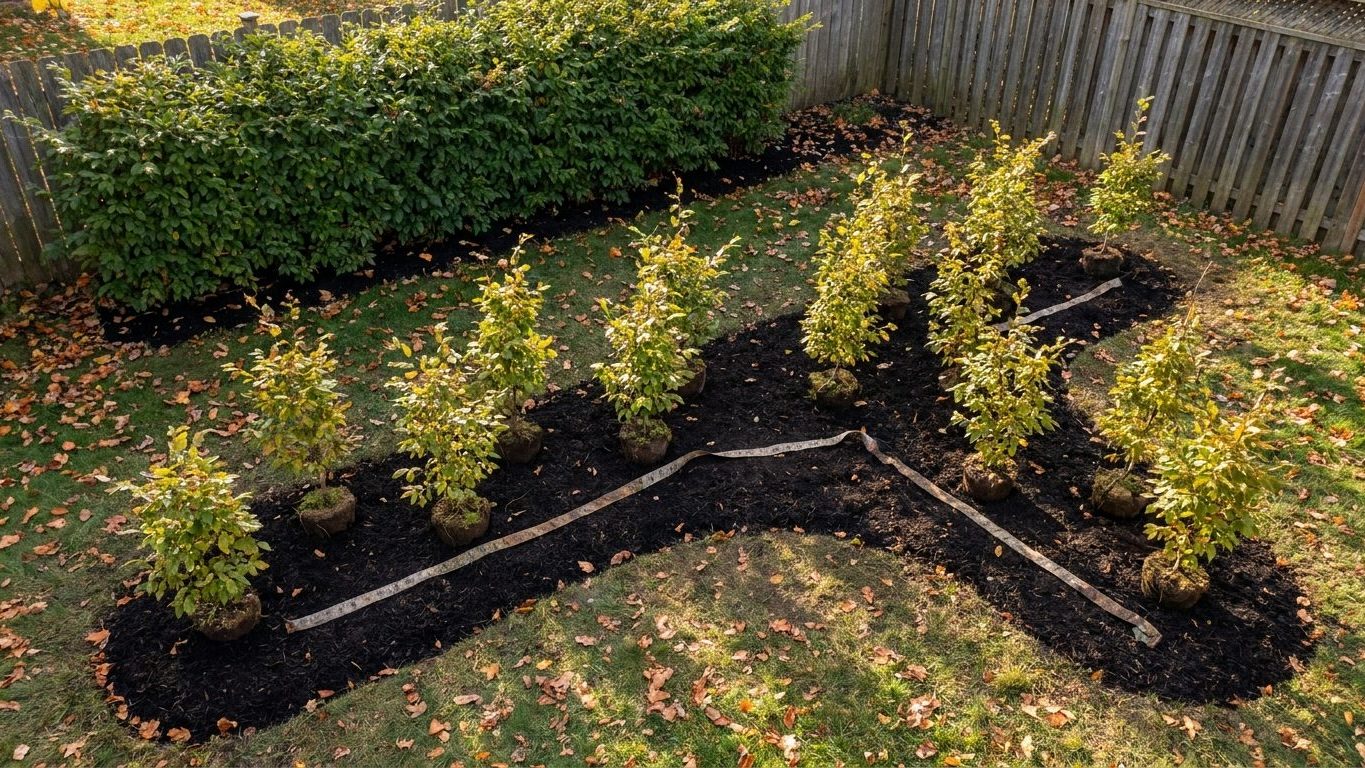

Plant American hornbeam at half to two-thirds of the mature width listed on the tag of the specific plant you’re buying, not the wild species width. Space closer for a screen that fills in fast, farther for a hedge that stays healthy for decades. The exact number changes with the cultivar, the site, and how patient you are.
How far apart to plant american hornbeam
The spacing math is simple once you know what number to plug in. Take the mature width printed on the plant’s tag, then multiply it by 0.5 for tight spacing or 0.66 for wider spacing. That range, half to two-thirds of the labeled width, is the spacing distance between plant centers along your row.
Here’s why the label matters more than the species name. Hedges get planted with selected cultivars bred to stay narrower and denser than a wild tree grown out in the open. The type species, American hornbeam, tops out at 20 to 35 feet wide left untrimmed, but almost nobody plants a hedge from an unnamed seedling with that kind of spread. The cultivar in your cart has its own number, and that’s the one that decides your spacing, not the ceiling the species can reach if nobody ever touches it with pruners.
A worked example
Say the tag on your plant reads 15 feet at mature width, a common figure for hornbeam cultivars sold for hedging. Half of that is 7.5 feet. Two-thirds is 10 feet. So you’d space plants somewhere in that window, closer to 7.5 feet if you want the row to close and screen sooner, closer to 10 feet if you’d rather each plant develop a full root system with room to breathe.
Write down 7.5 to 10 feet apart before you head to the nursery, then adjust once you see the actual tag on the plants available. A grower two states over might list a slightly different mature width for the same cultivar name, depending on how it was grown, so treat the tag as the final word over anything printed in a catalog months earlier.
American hornbeam handles USDA zones 3 through 9, so the same spacing formula works whether you’re planting in a short growing season up north or a long one further south. What changes by region isn’t the spacing, it’s how fast the hedge fills in, since the plant adds roughly 12 inches a year regardless of zone.
What planting them closer really buys you
Squeeze plants toward the tight end of that range and the row does close faster, sometimes a full year sooner than wider spacing. That’s real, and for a property line that needs privacy now, it’s tempting to grab. But a hedge planted shoulder to shoulder spends the next twenty years paying for that head start.
Roots compete for the same soil volume from day one. Plants that would otherwise spread evenly instead grow narrow and reach upward, chasing light instead of filling out, which leaves the base of the hedge thin and see-through exactly where you wanted the most coverage. The interior of a crowded row also holds still, damp air long after a rain, air that barely moves even on a windy day, and that stagnant humidity is an opening for canker and blight to take hold in a plant that otherwise shrugs off most problems.
That resistance is worth respecting rather than testing. American hornbeam is a tough plant. Very little kills it outright, and even a hedge left unpruned for years and gone gaunt and gappy can usually be cut back hard, because it carries dormant buds under the bark and regrows readily from bare wood the way many conifers simply cannot. That renovation option is a real safety net.
Still, needing the safety net is not the same as planning to use it. A hedge grown from the start at proper spacing rarely needs the hard-renovation cut at all. What you buy with a little extra patience, waiting the extra year for wider-spaced plants to meet in the middle, is a hedge with **strong, well-lit bases** for its whole life instead of one that goes bare-legged by year ten and needs rescuing. Prune in midsummer, after the first flush of growth has hardened off, and check with your local extension service for the exact window in your area, since it shifts by several weeks from one region to another.
One row or two
A single row is the right call for most home hedges, property lines, and windbreaks along a yard. It’s cheaper to plant, easier to prune from both sides, and at the spacing worked out above, a single row of American hornbeam closes into a solid screen without needing a second line of plants behind it.
A staggered double row earns its keep in two situations: when you need the screen to close faster than a single row would, or when the hedge has to block a sightline that a single row’s inevitable small gaps might not fully cover, like a busy road or a neighbor’s upper-floor window. Staggering the two rows, so each plant in the back row sits opposite a gap in the front row, gives you overlapping coverage almost immediately instead of waiting for individual plants to widen.
That coverage costs space and plants. Using the earlier example of 7.5 to 10 feet of spacing for a single row, a staggered double row needs roughly 15 to 20 feet of bed depth once you account for the gap between the two rows plus the spread each row eventually reaches. Plant count roughly doubles for the same length of run, since you’re now filling two lines instead of one.
Reserve the double row for the spot that genuinely needs it. For a straightforward property-line hedge with no urgent screening deadline, a single row at the wider end of the spacing range gives a healthier hedge for less money and less bed space, and American hornbeam’s habit of holding its dead leaves through winter means it keeps screening even in the off-season, when a double row would be overkill.
Working out how many plants you need
Once you’ve picked a spacing, the plant count is straightforward arithmetic. Divide the total run length by the spacing distance, then add one plant, because you need a plant at both ends of the line, not just at each interval in between.
Take a 50-foot property line and 8-foot spacing as an example. Fifty divided by eight comes to 6.25, which rounds up to 7 intervals along the run. Add the extra plant for the starting end and you land on 8 plants for that stretch.
Two things change that number before you commit it to a shopping list:
- Corners: a hedge that turns a corner needs an extra plant sited right at the bend, since the spacing formula assumes a straight line and a corner effectively counts as the end of one run and the start of another.
- Setback from the boundary: plant far enough from a fence, sidewalk, or property line that the mature width, half of it from the plant’s center, has room to fill out without spilling onto a neighbor’s side or over a walkway. The species can reach 20 to 35 feet wide left completely untrimmed, and while clipping keeps a hedge far narrower than that, giving the roots and base some real setback from day one avoids a fight with the tape measure later.
Run the math for each straight stretch separately, add a plant per corner, and you’ll have a plant count that matches the ground rather than a rough guess scaled up from the total property line length.
Common questions
When should I prune an American hornbeam hedge?
Prune in midsummer, after the first flush of new growth has hardened off, rather than on a fixed calendar date. That window shifts by several weeks depending on where you live, so check with your local extension service for the timing that fits your area’s frost dates.
Can an overgrown American hornbeam hedge be fixed?
Yes. The species carries dormant buds under its bark and regrows reliably from old, bare wood, so a hard renovation cut can bring back a neglected hedge that a conifer would never survive.
What USDA zones support an American hornbeam hedge?
Zones 3 through 9, according to the NC State Extension Gardener Plant Toolbox, which covers most of the continental United States outside the hottest and coldest extremes.
How tall does an American hornbeam hedge get?
Typically 6 to 15 feet as a maintained hedge, growing at roughly 12 inches a year. It also holds onto its dead leaves through winter, which keeps it screening at a time when most deciduous hedges have gone bare.