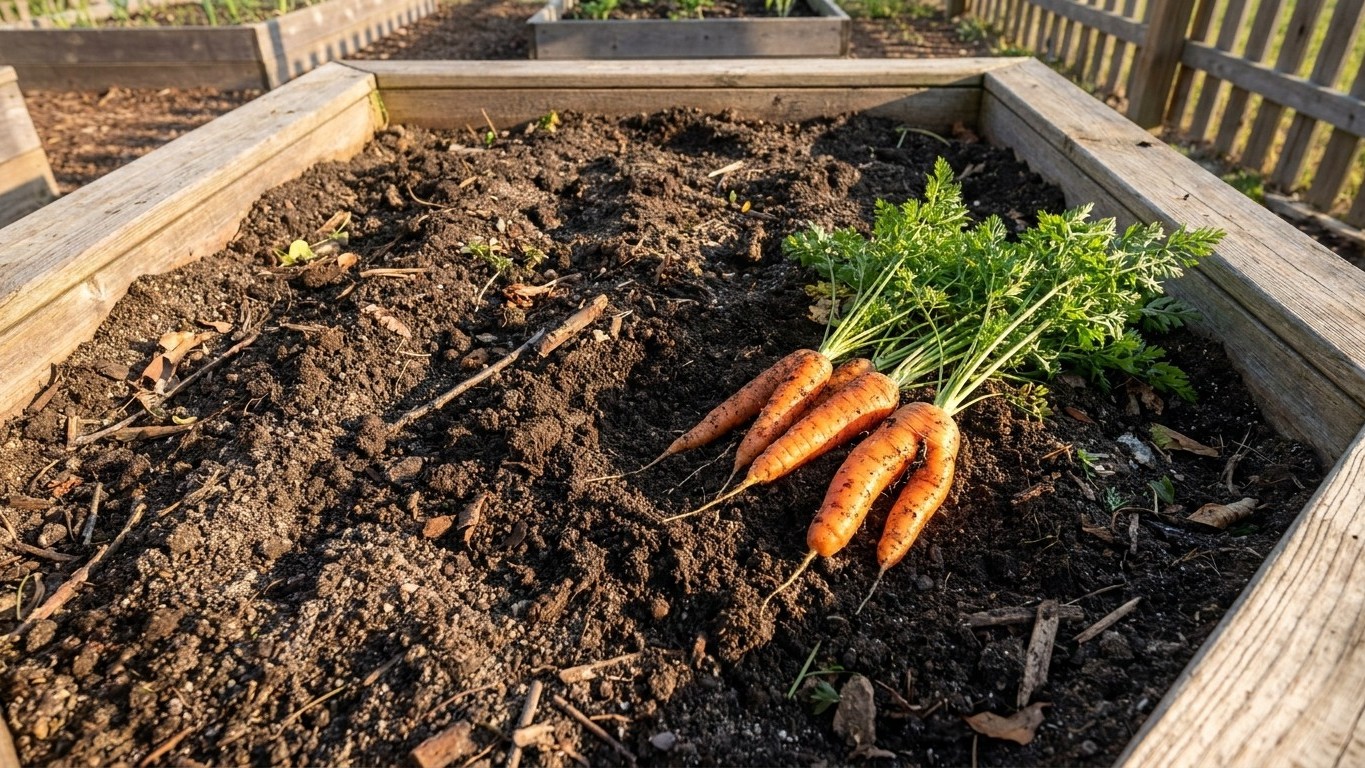

The tops answer the question before the calendar does. Once the foliage stops pushing new growth and the shoulders of the roots start showing at the soil surface, the carrots are ready to come up, and in Ohio that usually falls somewhere in the fall window, not on a fixed date. Pull one to check size before committing to the whole row, then move quickly on storage, because a carrot left in warm soil loses quality fast once it’s mature.
When carrots are ready in Ohio
Two extension sources give two counts, and both matter more than any single date on a calendar. Utah State University Extension puts carrots at 70 to 100 days from seeding to harvest, counted from the day the seed goes into the ground, since carrots are sown directly and never transplanted. Clemson Cooperative Extension gives a tighter figure, 65 to 75 days after planting. The gap between the two isn’t a contradiction. It reflects variety, soil temperature at sowing, and how much summer heat the roots caught along the way. In practice, that means a gardener who seeded in late spring should start checking roots by late summer, and one who seeded a fall crop in mid-summer should expect the window to land in autumn.
The signal that actually tells you it’s time has nothing to do with the calendar. Brush back an inch of soil at the base of a few plants and look at the shoulder, the widest part of the root just under the crown. If it’s filled out to a size you’d want to eat, pull one and taste it. If it’s still pencil-thin, give the row another week or two and check again. This beats guessing from a planting date, because soil temperature and rainfall shift the clock every year, and no single day works for every garden even within the same county.
Heavy or compacted ground changes this timeline too. Utah State Extension is specific that rocky or heavy soil makes the root fork instead of growing straight down, which means the plant spends energy building a tangle of forks rather than one clean taproot. A forked carrot isn’t necessarily behind schedule, but it’s a sign the bed needs loosening before the next planting, not a sign to pull early. Where the ground runs heavy, work in compost and double-dig the row before sowing again, rather than trying to fix it mid-season.
Once several roots in a row hit a usable size, pull the whole bed within a few days of each other. Carrots left in the ground past their window don’t spoil overnight, but they do get woody and can crack if a heavy rain follows a dry spell, so there’s little upside to waiting once the shoulders look ready.
Keeping them, and for how long
Clemson Cooperative Extension’s Home & Garden Information Center is direct about post-harvest handling: store carrots at 33 °F and high humidity to prevent wilting. That’s the number to write down, and it’s worth sitting with for a second, because it’s not a typical refrigerator setting and it’s nowhere close to a root cellar that runs in the 50s. It’s just barely above freezing, cold enough that carelessness in either direction, too warm or actually frozen, costs you the harvest.
The same source draws a sharp line between two ways of storing the crop. Bunched carrots, meaning roots that still have their leafy tops attached, keep for about 10 to 14 days. That’s it. The tops are the problem: leaves keep pulling moisture out of the root long after the plant is out of the ground, which is why bunched storage runs out fast no matter how cold the space is. Cut the tops off close to the crown right after harvest, leaving maybe an inch of stem, and that draw stops. Trimmed roots hold up far longer in the same cold, humid conditions than bunched ones ever will.
None of these figures are a promise. Clemson’s numbers describe what’s possible under 33 °F and high humidity held steady, which is a specific and fairly narrow set of conditions. A basement that swings ten degrees warmer on sunny days, or a storage bin that dries out because nobody’s checking on it, will shorten those windows regardless of what the fact sheet says. Treat the durations as a ceiling, not a guarantee, and check the stored roots every couple of weeks for soft spots or sprouting, especially early in the season while you’re still learning how a given storage spot behaves.
High humidity matters as much as the temperature number, and it’s the part people skip. Carrots stored in a dry space, even a cold one, wilt and go rubbery well before any rot sets in. Packing roots in slightly damp sand, or storing them in a perforated plastic bag, holds moisture around the root without trapping so much that mold takes hold.
Where in the house that actually is
A domestic refrigerator crisper drawer is the closest most Ohio households get to 33 °F and high humidity without building anything new. Most home fridges actually run between 35 and 40 °F in the main compartment, colder in the back and warmer near the door, which is why the crisper drawer, built to trap humidity, tends to run closer to the target than the open shelves. It’s still not exact, and it’s worth checking with an actual appliance thermometer rather than trusting the dial, since the two rarely match.
A heated living space is the wrong direction entirely. Room temperature sits 30 to 40 degrees above what carrots need, and at that range the roots soften and sprout within days, not weeks. An unheated basement or root cellar, where Ohio homes still have them, usually runs cooler and more humid than the rest of the house, but rarely gets all the way down to 33 °F unless it’s partly below grade and well insulated from the furnace above it.
The garage is the trickiest option in this climate, and also the most common one people reach for. It swings with the outdoor weather in a way a basement doesn’t. On a mild fall afternoon it might sit close to the target range; during an Ohio cold snap in January, an unheated garage can drop well below freezing overnight, which is colder than carrots can take. Checking the actual temperature with a thermometer, morning and night for a few days before committing a whole harvest to that space, costs almost nothing and saves the crop from freezing solid the first hard freeze of the season.
If none of the rooms in the house land close to 33 °F, a simple root cellar substitute, a cooler or insulated bin buried partway in an unheated garage or shed and packed with damp sand, gets closer to the target than any indoor room will.
What goes wrong here
Ohio’s cold winters make freezing the most common failure for anyone storing carrots outside the refrigerator. An unheated garage or an exposed cellar corner can drop below freezing on the coldest nights of the season, and a frozen carrot turns soft and watery the moment it thaws, with no way to recover it. The fix is checking the storage space’s actual low temperature before trusting it with the whole harvest, and moving carrots to an insulated bin or the refrigerator once overnight lows start threatening the freezing line.
A damp, mild fall, which Ohio gets its share of, creates the opposite problem in the garden itself. Roots left in soggy ground past their window are prone to cracking and rot before they’re even pulled, especially after a dry spell breaks with heavy rain. Pulling carrots promptly once the shoulders reach a usable size, rather than leaving them “just a little longer” through a wet stretch, avoids losing part of the crop before storage even starts.
The state’s representative soil, the Miamian series that USDA lists for Ohio, runs as a silt loam with roughly 20 percent clay and is well drained overall, but that’s a statewide average, not a description of any one garden. A yard with heavier, more compacted clay than that mapped average will produce more forked, stubby roots, the exact failure Utah State University Extension attributes to heavy or rocky ground. A basic soil test settles whether a bed needs loosening with compost and deeper digging, rather than guessing based on how the neighbor’s garden performs.
The last common failure isn’t climate at all, it’s math: sowing one long row all at once and harvesting all of it in the same week, more roots than one household eats before they soften. Staggering sowing dates a few weeks apart spreads the harvest out and keeps the storage bin from filling faster than it empties.
Common questions
Can carrots stay in the ground longer if the weather stays mild?
A mild stretch buys a little time, but roots left past their window get woody and are more prone to cracking if rain follows dry weather. Once the shoulders show a usable size, pulling promptly beats waiting for perfect weather.
Do the tops on the carrots need to come off right away?
Yes. Clemson Cooperative Extension notes that carrots with their tops still on keep only 10 to 14 days, because the leaves continue drawing moisture from the root. Trimming the tops close to the crown right after harvest stops that draw and lets the roots hold up far longer in cold storage.
Is a refrigerator good enough, or does it need to be a root cellar?
A refrigerator crisper drawer gets closer to the 33 °F and high humidity that Clemson recommends than most rooms in the house, including a heated basement corner. A traditional root cellar can work too, but only if it’s checked with a thermometer, since many run warmer than the target.
Why did some of my carrots come out forked or stubby instead of straight?
Utah State University Extension attributes forking directly to heavy or rocky soil. Ohio’s representative soil runs as a silt loam with meaningful clay content, and a garden bed that’s heavier or more compacted than average will fork more. Working in compost and digging deeper before the next sowing addresses it; a soil test confirms whether that’s the actual cause in a specific yard.