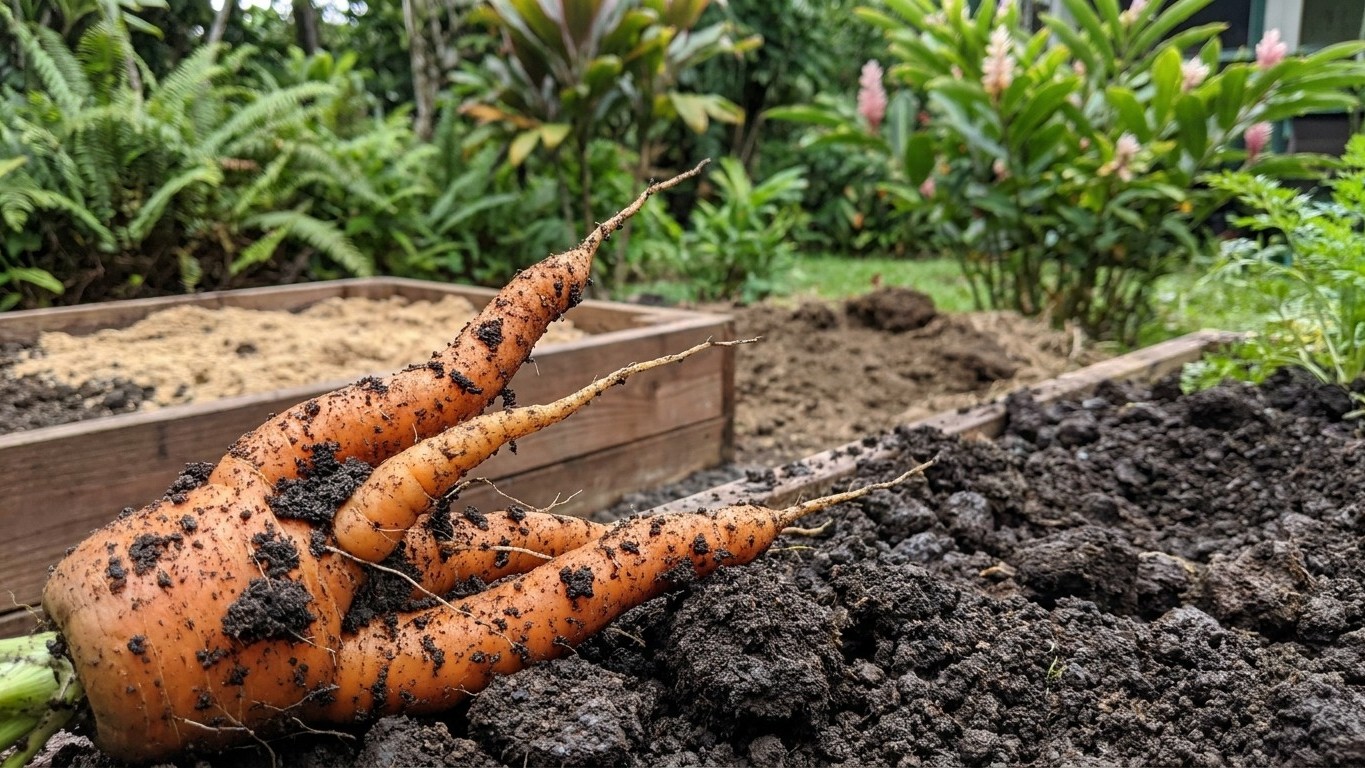

Before anything with teeth reaches an Ohio carrot, the ground has often done some damage of its own. Forked, stunted, split and patchy roots are among the most common ways a home crop goes wrong, and each has a cause and a season. The verified figures here include no pest-by-pest calendar, so none is invented.
The short answer
What Ohio’s state soil looks like on paper
Ohio’s state soil is the Miamian series, an Alfisol. That is a forest soil of moderate fertility that holds nutrients reasonably well. USDA NRCS Soil Data Access, which records representative values for the surface horizon of the series’ major components (401 of them), lists it as loam to silt: 26 percent sand, 20 percent clay and 53 percent silt. Organic matter sits at about 2.0 percent, and the surface pH is about 6.5, slightly acid. The drainage class is well drained.
Silt is the biggest slice by far. Clay, at 20 percent, is a minority. Water moves through this ground at a reasonable pace instead of pooling on top of it.
Will a carrot fork in it?
Utah State University Extension describes the ideal as deep, sandy, well-drained soil rich in organic matter, and says heavy or rocky soil makes the root fork. Set Miamian beside that list. The drainage matches. The texture is not sandy, but it is not heavy clay either, so on paper a carrot has a fair shot at growing straight. The weak spot is organic matter. About 2.0 percent is modest, and a silty surface with that little organic material can pack down after rain and dry into a crust.
Where the ground is heavy, the Extension advice is plain: work in plenty of compost and double dig. Where digging deeper will not fix it (shallow soil, buried rubble, or a spot that stays wet), a raised bed is the answer. A different variety is not. No variety is fork-proof.
One caution matters more than all the percentages. A state spans hundreds of soil series, and Miamian is a starting point, not a diagnosis. River bottoms, hill country and any lot a builder has scraped or filled can differ completely. These figures are the surface values USDA records for the mapped series, not a measurement of a worked garden bed, and the pH is not your pH. The test in the next section settles what your own ground will do.
Carrots are sown in place, so the roots you plant are the roots you get. There is no transplanting to reset a bad start. Counting the 70 to 100 days from seeding, the first weeks decide a lot. For timing, see When to Sow Carrots in Ohio: Counting Back From the Last Frost, and for a closer look at the ground, Will Carrots Fork in Ohio Soil?
The test that settles it in your own garden
Your bed is not the state’s representative soil. An afternoon with a spade tells you more than any map, and none of it needs equipment.
- Dig a hole as deep as the carrot you hope to grow is long. Do it in the spot you plan to sow, not at the edge of the lawn where the soil is easy.
- Look at the walls of the hole. Note where the dark topsoil ends and the paler layer begins. A hard, tight layer just under the surface is where roots bend and split.
- Count the stones and look for rubble. A forking root stops at an obstacle and goes around it, so rocks, clods and buried construction debris all show up later as twisted carrots.
- Squeeze a handful of moist soil. Gritty and falling apart suggests sand. Smooth and silky suggests silt. Slick, sticky and holding a firm shape suggests clay. Rub it between your fingers, because your hand is the test.
- Fill the hole with water and let it drain, then fill it again. Watch the second fill. Water that vanishes steadily says the bed drains. Water that sits there says the ground is holding it, and that is the case for a raised bed.
- Check how the surface behaves after a rain and a dry day. A crust you can lift off in plates will block tiny carrot seedlings.
- Send a sample for a lab soil test. The pH and organic matter figures for your garden are the ones that count, and your county extension office can point you to a lab.
Read the results against the Extension description: deep, loose, well drained, rich in organic matter. If your hole passes, sow. If it fails on depth or stones, fix those first. If it fails on drainage or heaviness, bring in compost and double dig, or build up the bed.
What goes wrong here
These are the failures that Ohio ground and weather cause, with the fix beside each.
- Forked and stubby roots. Heavy, compacted or rocky soil is the cause, and Utah State University Extension says so directly. Dig deep, pull out the stones, and work in plenty of compost. On heavy ground, double dig. If the spot stays wet or the subsoil is hard, build a raised bed. Adding compost to the surface only, without loosening what is below, leaves the problem in place.
- Crusted surface and patchy germination. Silty ground with modest organic matter can seal over after a hard rain, and a hot spell dries that seal into a lid. Seedlings that were fine on Monday never break through. The fix is steady moisture on the seed row and a light covering of fine compost over the seed, which stays looser than the native soil.
- Splitting from uneven water. A dry stretch followed by a soaking rain makes a root swell faster than its skin can stretch. The skin cracks lengthwise. Water on a regular schedule, and mulch the bed to even out the swings. The compost that helps with forking also helps here, because it holds moisture longer.
- Wilting and softening after harvest. Not a garden failure, but where many crops are lost. Clemson Cooperative Extension says to store carrots at 33 °F and high humidity to prevent wilting. That is just above freezing, far colder than a basement or garage in most Ohio homes. Cut the tops off first. The leaves keep drawing moisture out of the root, which is why bunched carrots, with the tops on, keep only about 10 to 14 days.
For the wider picture on this crop in the state, start with Growing Carrots in Ohio.
Common questions
Will carrots fork in Ohio soil?
It depends on the bed. Miamian, the state soil, is well drained and loam to silt (26 percent sand, 20 percent clay, 53 percent silt), which is not the heavy ground that forks a root. A garden with rocks, compaction or a clay layer can still produce twisted carrots. Dig and test your own spot.
What actually eats carrots in Ohio, and when?
Your county extension office can tell you which pests are active near you and in which weeks. Forking, crusting and splitting cost most home gardeners roots before any animal does.
Do I need a raised bed?
Only if your own test says so. A bed that drains well, has depth and is free of stones can grow carrots in the ground. Heavy soil that holds water is the case for a raised bed or double digging with plenty of compost, as Utah State University Extension advises.
How should I store carrots after harvest?
Cut the tops off first, because the leaves keep pulling moisture from the root. Clemson Cooperative Extension says to store carrots at 33 °F and high humidity to prevent wilting, and that bunched carrots with the tops still on keep about 10 to 14 days. Trimmed roots keep far longer, in the range of months.