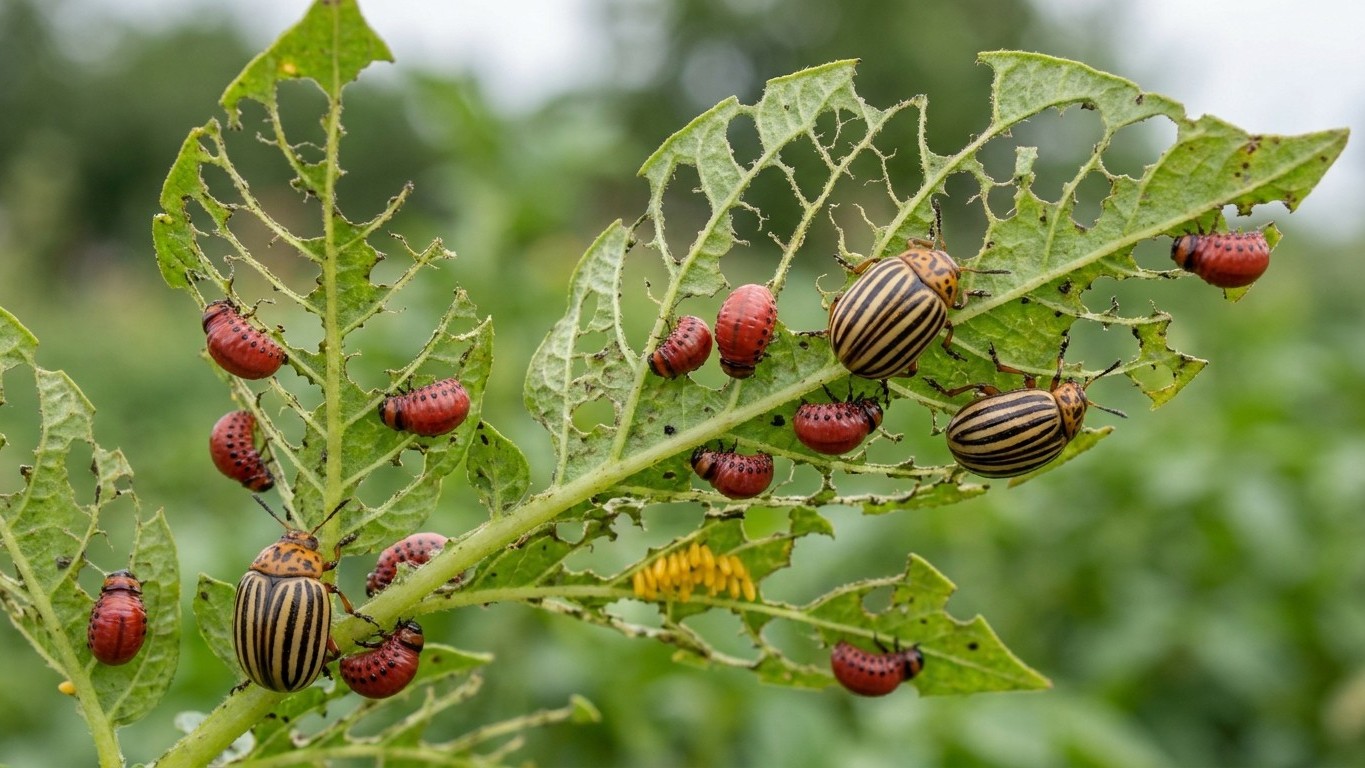

Two insects in the regional pest record actually feed on potato: the Colorado potato beetle and the three-lined potato beetle. Both appear in documentation from NDSU Extension and University of Minnesota Extension, the two neighboring services that track pest activity for this part of the country. Everything else on that same regional list targets orchards, brassicas, cucurbits, or shade trees, not the potato patch. The window to watch runs from a few weeks after the ground warms through midsummer, anchored to the region’s frost-free stretch rather than a fixed date on a calendar.
Which pests attack potato in Manitoba

NDSU Extension and University of Minnesota Extension document fifteen species for this region: apple maggot, boxelder bug, cabbage maggot (Delia radicum), Colorado potato beetle, corn earworm, emerald ash borer, Japanese beetle (Popillia japonica), onion maggot (Delia antiqua), spotted wing drosophila (Drosophila suzukii), squash bug, squash vine borer, striped cucumber beetle, swede midge, three-lined potato beetle, and yellowheaded spruce sawfly. That’s the full documented list for the area. Only two of them belong in a conversation about potato.
The rest have a home elsewhere in the yard or the orchard, not in the potato hills. Apple maggot targets apple and other tree fruit, not potato foliage or tubers. Boxelder bug feeds on boxelder and maple seed, and rarely bothers vegetable leaves at all. Cabbage maggot works the roots of cabbage-family crops, a different root system entirely. Corn earworm goes after corn ears and tomato fruit, leaving potato plants alone. Emerald ash borer bores exclusively into ash trees and has no reason to cross into a vegetable bed. Japanese beetle skeletonizes leaves on a wide range of plants, but the regional record ties it to turf, tree fruit, and ornamentals, not potato. Onion maggot attacks onion and related bulb crops. Spotted wing drosophila lays eggs in soft-skinned fruit like raspberries and cherries. Squash bug and squash vine borer both stay on squash and pumpkin vines. Striped cucumber beetle sticks to cucumber-family plants. Swede midge distorts the growing points of brassicas. Yellowheaded spruce sawfly feeds on spruce needles, a forestry and landscape pest with no crossover into a vegetable garden.
That leaves Colorado potato beetle and three-lined potato beetle as the only two names on this list with a genuine claim on the potato crop. A pest absent from this documented list has no track record on potato here, and treating an unfamiliar bug as one of these two without checking is the most common misstep gardeners make. Both beetles are recognizable once you know what to look for, and both follow a predictable pattern tied to how the season warms up, which is the next thing worth knowing.
When each one shows up, and what it does first
Timing here follows soil and air temperature, not a page on the calendar. The one fixed reference point available for this region is the mean last spring frost, recorded at **on average May 23** by Environment and Climate Change Canada’s Canadian Climate Normals for the Winnipeg Richardson International Airport station. That figure is a midpoint, not a promise: in half the years on record, frost arrived after that date, and gardens north or upland of Winnipeg typically lag weeks behind it. Insect activity tracks the same warming curve.
Colorado potato beetle adults spend the cold months buried in the soil and become active only once that soil warms following the mean last-frost mark, not before. The first sign is usually ragged, irregular holes chewed into young leaves near the top of the plant. Look closer and you’ll find the adults themselves: hard-shelled, cream and black striped, moving slowly across foliage. Soon after, clusters of bright orange-yellow eggs show up stuck to the undersides of leaves, laid in tight rows. Left alone, those eggs hatch into humpbacked, brick-red larvae that do the heaviest feeding of the whole cycle.
Three-lined potato beetle follows a similar arc but announces itself differently. Adults carry three dark stripes running the length of a yellowish wing cover, and their early feeding leaves a papery, window-pane look on leaves where they’ve scraped away the surface layer without punching all the way through. The larvae are the stranger sign: soft, yellowish grubs that pile their own dark excrement on their backs as they feed, a defense that makes them look more like a smear of dirt than an insect. That fecal shield is the fastest way to tell three-lined potato beetle larvae from anything else chewing on the same plant.
Both insects build their populations as the frost-free stretch lengthens, which means early scouting, done in the weeks right after planting and again as plants bulk up, catches the first generation before it multiplies.
Telling the damage apart from everything else
Chewed leaves and yellowing plants don’t always mean an insect is responsible. Potato foliage reacts to drought stress, nutrient shortages, and disease in ways that can look similar to early insect feeding at a glance, and mechanical damage from hail, hoeing, or animal traffic adds another layer of confusion. The single habit that prevents a wrong diagnosis is checking the underside of the leaf before assuming an insect caused what you’re seeing. Egg clusters, larvae, fecal shields, and adult beetles all show up there first, while deficiency and disease symptoms usually don’t.
| Symptom | Possible cause | What distinguishes it |
|---|---|---|
| Ragged holes in leaves, adults present | Colorado potato beetle | Striped, hard-shelled adults visible on the plant; orange egg clusters underneath |
| Window-pane scraping, dark-coated larvae | Three-lined potato beetle | Larvae carry a visible shield of dark excrement on their backs |
| Uniform yellowing between leaf veins | Nutrient deficiency | No chewing pattern, no insects present, spreads evenly across the plant |
| Wilting despite moist soil | Root or vascular disease | No feeding marks on leaves; wilting often starts on one side of the plant |
| Torn or shredded leaf edges after a storm | Mechanical or hail damage | Damage appears suddenly, matches wind direction, and shows no insects or eggs |
None of these substitutes for a direct look. When a plant shows a symptom that doesn’t fit cleanly into one of these categories, a sample brought to a local extension office beats a guess made from a photo or a search result.
What actually works here, and what is a waste of time
A short growing season rewards timing over intervention. Rotating potatoes away from the previous year’s plot is the single decision that does the most work, because Colorado potato beetle adults overwinter in the soil where last season’s crop stood and walk, rather than fly, to find new plants in spring. Moving the bed even a modest distance breaks that walk and delays the first wave of feeding. Row covers put in place at planting, and removed once flowering starts and pollinators need access, physically block adults from reaching young foliage during the highest-risk weeks.
Hand removal still earns its keep on a garden scale. Checking the undersides of leaves and crushing egg clusters before they hatch removes an entire generation before it starts feeding, and it costs nothing but a few minutes during a walk through the rows. The same applies to knocking adult beetles into a container of soapy water early in the morning, when they’re sluggish and slow to fly.
What wastes time is treating after the damage is already visible and heavy, or applying anything without knowing what’s approved for use on food crops in this location. This site doesn’t recommend specific products or active ingredients, because what’s registered for use changes by jurisdiction and by crop, and only the local extension service keeps that list current. Spraying on a fixed date regardless of what’s actually present on the plant is another common miss. Beetles that haven’t emerged yet aren’t affected by anything applied too early, and a treatment aimed at adults does little against larvae already inside the foliage.
Where to check this for your own county
NDSU Extension and University of Minnesota Extension are the two services behind the pest documentation used on this page, and both maintain current, region-specific guidance that goes well beyond what fits in a general overview. A pest documented at the regional level doesn’t mean it’s present in any one garden, and confirming what’s actually on your plants matters more than matching a description online. Local extension offices and agricultural representatives are set up to look at samples, confirm identifications, and speak to conditions in a specific area rather than an entire province or state.
Pest pressure inside one region is rarely even. Soil type, how close a garden sits to windbreaks or wooded edges, and how far north or south it falls all shift what shows up and when, sometimes by weeks compared to a reference weather station. The frost-free window used earlier in this page comes from one recording station; a garden even a short distance away, particularly one at higher elevation or farther north, can run behind that mark by a noticeable margin most years.
The next useful step isn’t reading further, it’s collecting a sample. A few affected leaves, or an adult beetle in a sealed container, taken to a local extension or agricultural office gives a faster and more reliable answer than any general description can.
Common questions
Does the Colorado potato beetle survive winter in this region?
Yes. Adults burrow into the soil in fall and emerge the following season once the ground warms, which is why they’re active early relative to other insects on the same plot.
Can three-lined potato beetle damage tubers, or only leaves?
The documented feeding from this species targets foliage. Heavy leaf loss over a season can reduce a plant’s ability to bulk up tubers, even without direct feeding on the tubers themselves.
How early should I start checking plants for these beetles?
Start scouting soon after plants emerge from the ground, checking the undersides of leaves for eggs and young larvae before populations have a chance to build.
Are these two pests found in every garden across the region?
No. Documentation at the regional level shows where a pest has an established presence somewhere in the area, not that it’s present in every yard. Confirming what’s actually on a given plant is a local extension office’s job, not something a general list can settle.