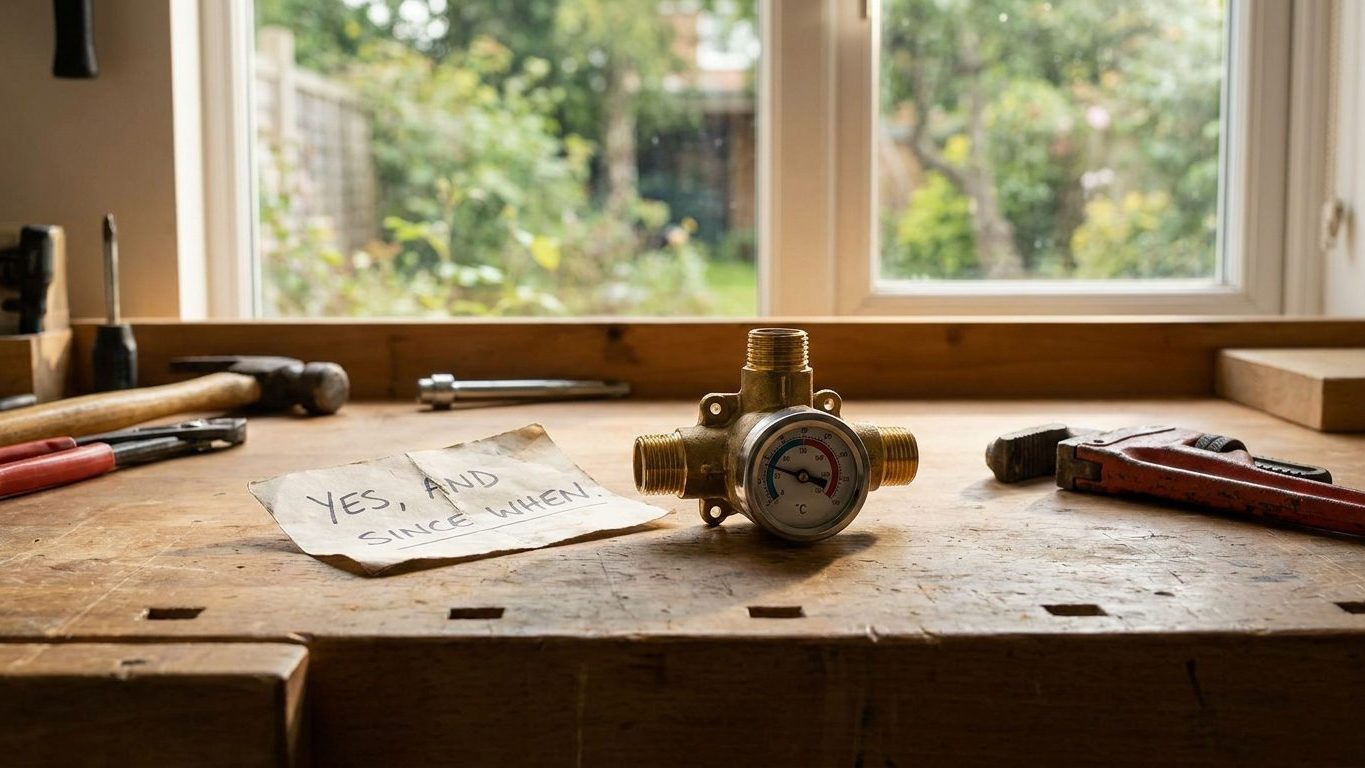

That mixing cartridge hidden behind your shower’s trim plate is the part that actually decides whether a toilet flush down the hall turns your shower scalding. The answer to whether you need one is yes: it’s required on every new or replaced shower valve under the code most cities have adopted, and has been for a while now. Pull the trim plate and look at the valve body itself, not the dial on your water heater, before you decide you’re already covered.
What the code requires on every shower valve

Every shower and tub-shower valve must be a pressure-balancing, thermostatic, or combination pressure-balancing/thermostatic type, and the water leaving it can’t exceed 120°F. Both requirements sit in the same line of the 2021 International Residential Code, section P2708.4, which is the model code most local building departments start from when they write their own amendments.
The 120°F figure isn’t a target for your water heater. It’s a hard ceiling measured at the valve’s outlet, the point where mixed hot and cold water leaves the valve body on its way up to the showerhead. A water heater can run well above that number for the sake of the dishwasher or the laundry, and the valve is what’s supposed to bring the shower water back down before it ever reaches your skin.
This is where people misread the rule. They turn the water heater down to a number that feels safe and assume that satisfies the code, skipping the valve entirely. It doesn’t. The IRC language names a valve type and an outlet limit, not a tank temperature upstream of it. A conventional two-handle valve with no pressure-balancing spool or thermostatic cartridge doesn’t meet section P2708.4 no matter what the water heater reads, because nothing inside that valve reacts to a sudden pressure or temperature swing on the supply lines.
The requirement applies to new construction and to any shower or tub-shower valve replaced as part of permitted work. It doesn’t retroactively force a code upgrade on a valve nobody is touching. That distinction matters in older houses, where the valve behind the tile might predate this requirement by decades and the code doesn’t force you to open the wall and swap it out unless you’re already doing the work.
Pressure-balancing and thermostatic are not the same protection
A pressure-balancing valve doesn’t measure temperature at all. It measures pressure. Inside the valve body sits a piston or diaphragm that reacts to the ratio of hot-side pressure to cold-side pressure. When someone flushes a toilet or starts a washing machine, the cold line loses pressure for a second or two. Without a balancing spool, the shower would suddenly run almost pure hot. The piston shifts to throttle the hot side back down, holding the mix roughly steady even though it never reads a number in degrees.
A thermostatic valve works differently. It has a wax or bimetal sensing element sitting right in the mixed-water stream, and that element expands or contracts as the actual outlet temperature moves, adjusting the hot and cold ports to hold a set point. It reacts to changes in supply temperature, not just supply pressure. That matters when a water heater’s incoming cold water drifts through the day, or when a tank is most of the way through recovery and delivering water a few degrees cooler than usual. A pressure-balancing valve alone doesn’t catch that kind of drift, because the pressure ratio between hot and cold hasn’t changed even though the actual temperature has.
Picture a shower with a plain two-handle valve, no balancing spool, no thermostatic cartridge. Someone starts a load of dishes downstairs, the cold supply pressure drops, and the ratio at the showerhead swings hot immediately with nothing inside the valve to correct it. That’s the exact event the pressure-balancing requirement is written to stop, and it’s why the code names a valve mechanism instead of just capping the temperature and leaving the method up to chance.
A combination valve carries both mechanisms in one body, covering the widest range of failure, from a sudden pressure drop to a slow temperature drift. The 2021 IRC’s section P2708.4 accepts all three types, pressure-balancing, thermostatic, or combination, as long as the outlet still tops out at 120°F. The code sets the floor and leaves the mechanism to the valve.
120 °F at the valve, not on the water heater dial
The 120°F limit in the 2021 International Residential Code, section P2708.4, is set at the valve, not at the water heater tank. The ASSE 1016-2017 standard the valve is tested against confirms the same point: the outlet cap is a property of the valve itself, tested and certified before it’s ever installed. A water heater thermostat set to 120°F doesn’t satisfy this requirement on its own, because nothing at the tank reacts to a pressure change on the supply lines the way a pressure-balancing or thermostatic valve does.
The model code itself doesn’t carry an exception to this outlet limit for shower and tub-shower valves. If your area allows something different, that comes from a local amendment adopted by your city or county, not from the IRC text itself. Adoption of the IRC is local. A jurisdiction can adopt the 2021 edition wholesale, keep an earlier edition still in force, or adopt it with amendments that change specific sections. The only way to know which edition and which amendments apply to your address is to ask your local building or permitting department directly, since the answer varies from one county to the next even within the same state.
This also means a valve legal when it was installed under an older code edition isn’t automatically required to be swapped out. Code changes typically apply going forward, to new work and permitted replacements, not backward to work that was compliant when it was done. Anyone renovating a bathroom enough to open the wall, including work like deciding where a shower niche sits, is a natural point to have the valve itself checked against current requirements, since the wall is already open anyway.
Identifying the valve you already have behind the trim

You don’t need to cut into the wall to get a look at the valve. Most trim plates, the round or square cover around the shower handle, are held on with one or two screws or a friction fit, and come off with a screwdriver in a few minutes.
What to check once the trim is off
- Look at the valve body itself for a stamped marking, not the trim kit’s plastic sleeve, since an ASSE 1016 listing is stamped on the valve, not the decorative trim.
- Note whether there’s a single handle with a rotating stop, typical of a pressure-balancing cartridge, or a separate temperature dial plus a volume control, typical of a thermostatic setup.
- Check for a small high-limit stop screw near the handle stem, a feature many pressure-balancing valves use to cap the hottest position the handle can reach.
- Photograph any visible markings before the trim goes back on, since the stamp is often small and easy to misread in poor bathroom lighting.
The most common measuring mistake is reading the trim kit’s box or manual instead of the valve body. Trim kits are often sold separately from the valve and can be swapped for a style update years after the original rough-in, so the box in the linen closet may not match what’s actually plumbed into the wall.
None of this tells you whether your specific installation currently meets code. A stamp on the valve body tells you what standard it was built to, not whether it was installed correctly or whether local amendments add anything beyond the model code. For that answer, bring what you find, including any stamped numbers, to your local building department or a licensed plumber.
The scald that a mixing valve was there to prevent
Skip this requirement and the failure shows up in one of three places. At inspection, a permitted bathroom remodel with a valve that isn’t pressure-balancing, thermostatic, or combination type, or that doesn’t hold to 120°F at the outlet, gets flagged, and the work doesn’t pass until the valve is corrected. That’s the cheapest place for this to go wrong, because it’s caught before anyone showers under it.
In use, the failure is a temperature spike delivered straight to someone standing in the shower with nowhere to step back to. A toilet flush or a dishwasher cycle draws down the cold supply, and without a pressure-balancing mechanism reacting to that drop, the water at the showerhead swings hot fast enough that a child, an older adult, or anyone with slower reflexes doesn’t have time to react before contact.
Years later, the failure shows up at resale or at claim time. A valve that never met section P2708.4 is the kind of detail a home inspector or an appraiser can flag during a sale, and it’s the kind of detail that surfaces if an injury in that shower is ever looked into afterward. None of that requires a dramatic failure. It just requires the valve nobody replaced.
If you’re already planning bathroom work extensive enough to touch plumbing, from the shower valve itself to fixtures elsewhere like sizing out a double vanity, loop in a licensed plumber for the valve and your local building department for whatever permit and inspection that work triggers. Neither one is optional once the wall’s open, and skipping either is how a straightforward valve swap turns into a redo.
Common questions
Does a single-handle shower valve automatically mean it’s pressure-balancing?
Not necessarily. Single-handle valves are common on pressure-balancing cartridges, but some single-handle valves are just simple mixing valves with no balancing spool at all. The only reliable way to know is the stamp on the valve body itself, not the handle style.
Can I just turn my water heater down to 120°F instead of installing a valve?
No. The 2021 IRC’s section P2708.4 sets the limit at the shower valve’s outlet, and the ASSE 1016-2017 standard the valve is tested to has nothing to do with the water heater’s thermostat. A lower tank setting helps overall but doesn’t satisfy this requirement or protect against a sudden pressure swing mid-shower.
Does this requirement apply to my existing shower if I’m not remodeling?
The code applies to new construction and to valves replaced as part of permitted work, not retroactively to an untouched existing valve. Ask your local building department whether any local amendment in your jurisdiction extends the requirement further, since adoption and amendments vary by city and county.
What’s the difference between an ASSE 1016 valve and one that just says “anti-scald” on the box?
ASSE 1016-2017 is a specific tested standard with a listing stamped on the valve body, not a marketing phrase. A box labeled “anti-scald” without that listing hasn’t necessarily been tested to the standard the code and most building departments look for, so check the valve itself rather than the packaging language.