
Winter Squash in Iowa goes into the ground once the soil itself has warmed, usually the last week of May, and it needs to finish ripening on the vine before the first hard freeze arrives in mid-October. Between those two points, the length of the season and the weather inside it decide which type of squash actually has a chance to cure properly before frost ends the year.
When the soil is warm enough in Iowa

The number gardeners actually want is a soil temperature, not a calendar date, but frost dates are the closest public data gets to a starting line. For the reference station used by NOAA (Des Moines, station USW00014933), the last spring freeze falls somewhere between April 12 and April 24, based on the 1991-2020 Climate Normals. That’s a 30-70% probability band, not a guarantee. Half the years, frost shows up outside that window on one side or the other.
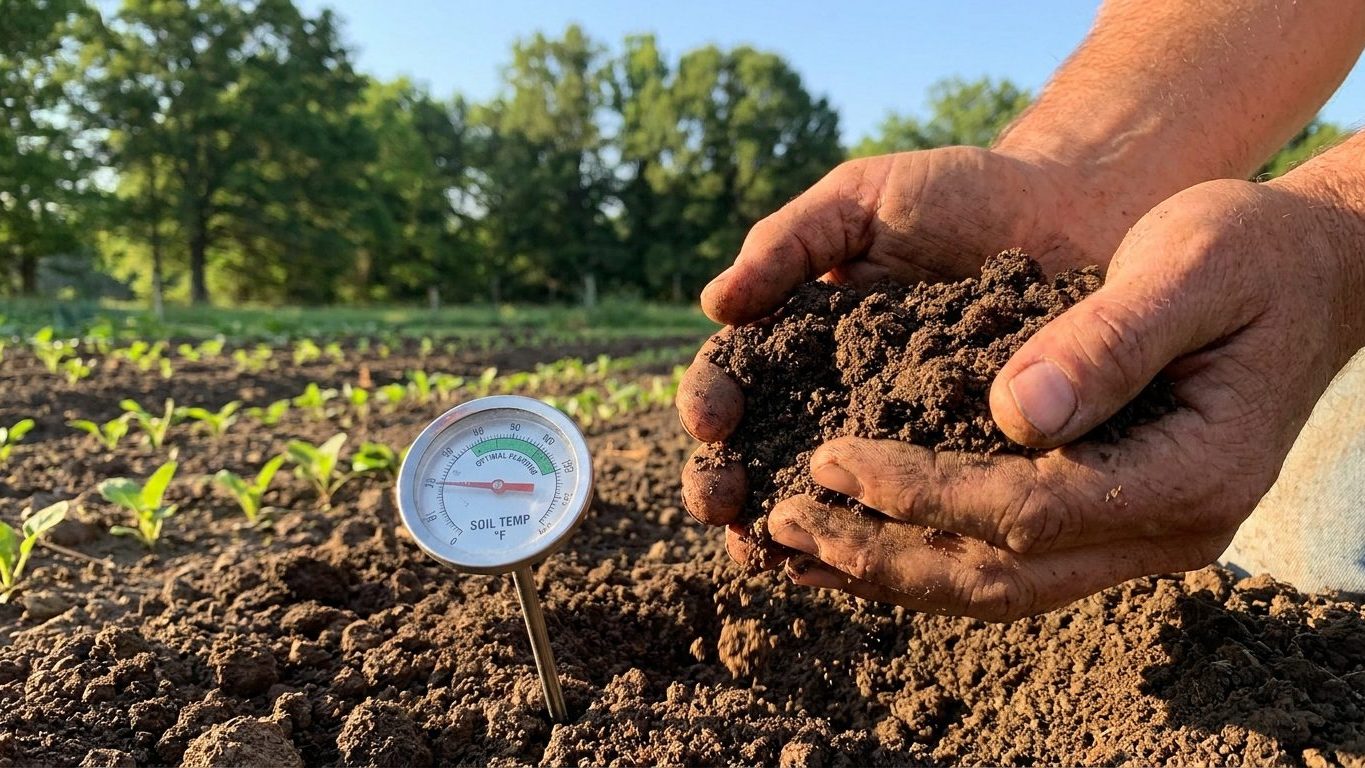
Soil warms on its own schedule, and it lags behind the air. A frost-free date tells you the risk of a killing freeze has dropped into an acceptable range; it says nothing about whether the ground six inches down has reached the temperature winter squash seeds actually need to germinate reliably, which sits well above 60°F. In practice that pushes direct seeding or transplanting into the very end of May for most of the state, a good week or two after the last frost date on paper.
One caution matters here: Iowa State Extension’s county-level data, built from 1950-2021 records, runs about four days later in spring than the airport station cited above. That means the April 12-24 window is the optimistic end of the range. A gardener working from county-specific numbers should expect the safe planting date to land closer to late April at the earliest, not the earlier edge of that band. Iowa also spans USDA hardiness zones 4b to 6a, a range built on winter minimum temperatures rather than summer planting dates, but it’s a reminder that a single reference station can’t speak for the whole state. The southern counties warm up days ahead of the northern ones.
None of this changes with technique tricks. Black plastic mulch and floating row covers both nudge soil temperature up a few degrees and can buy a week, but they don’t override a cold snap. The safer approach is checking soil temperature directly with a simple probe thermometer before committing seed to ground, and treating the frost date as the outer boundary of possibility rather than the actual planting instruction.
How long the season lasts here
Subtracting the spring frost window from the fall one gives the frost-free season, and because both dates come from the same NOAA source, the math holds. At the earliest combination (last spring frost April 24, first fall frost October 14), the frost-free stretch runs about 173 days. At the latest combination (April 12 to October 25), it runs closer to 196 days.
| Scenario | Last spring frost | First fall frost | Approx. frost-free days |
|---|---|---|---|
| Earliest end | April 24 | October 14 | 173 |
| Latest end | April 12 | October 25 | 196 |
That’s a wide swing, roughly three weeks, and it matters more than it looks. A season landing near 196 days gives winter squash room to breathe: one planting in late May, full development through summer, and enough margin in September that a slow-finishing fruit still cures before frost. A season closer to 173 days is tighter. There’s still enough time for winter squash generally, but the margin for error shrinks, and a late start from a wet spring or a delayed transplant can push harvest right up against the first freeze.
What this length allows, and doesn’t, is the real question for a gardener planning the year. A long window like Iowa’s upper range supports thinking about succession sowing, staggering plantings so not everything ripens at once, though winter squash is less forgiving of this than quick crops like lettuce or beans because it needs the whole season to fill out. On the shorter end of Iowa’s range, one well-timed planting is usually the only realistic option, which makes the initial planting date and cultivar maturity length the two decisions that actually matter. Readers weighing whether a second sowing makes sense for their own plot should check the site’s succession sowing guide, which walks through how to judge that trade-off crop by crop.
Heat and water in Iowa

Des Moines averages 18.4 days a year at or above 90°F, based on the 1991-2020 Climate Normals. That’s a moderate heat load, real summer heat but nowhere near the extended stretches seen further south and west. Squash plants tolerate that level of heat without much drama, though a run of 90-degree days during flowering can still slow pollination and stress young fruit if soil moisture drops at the same time.
Rainfall is the more interesting number here. Summer totals around 13.2 inches across June, July, and August, but it isn’t spread evenly: June averages 5.26 inches, July drops to 3.82, and August climbs back to 4.17. July is the driest month of the growing season, and it also tends to be one of the hottest, which is exactly the combination that stresses squash during fruit set and early filling.
That rainfall figure never reads alone, though. The same 3.82 inches in July behaves completely differently depending on the soil under it. On sandy ground it drains through within a day or two, leaving the root zone dry again quickly; on heavier clay it can sit for a week, which cuts water demand but raises the risk of standing moisture around the crown. And a single thunderstorm dumping an inch of rain in twenty minutes mostly runs off rather than soaking in, so the monthly total can overstate what the plant actually receives. A rain gauge on the actual plot, checked through July, tells a gardener more than any regional average.
Iowa isn’t a hot, dry state where irrigation carries the crop through the season on its own, and it isn’t a cool, damp one where mildew and slow ripening are the dominant risk either. It sits in between: enough heat to move the crop along, enough summer rain in most years to avoid constant watering, but a dry July stretch common enough that a gardener who skips supplemental watering during fruit fill can still lose size and quality on the vine. Watching soil moisture through July, rather than assuming June’s rain carries over, is the practical takeaway.
Which winter squash suit Iowa
None of this points to a single variety, and it shouldn’t. This page can describe the climate a squash plant has to survive in Iowa, but it can’t tell a gardener which specific cultivar performed best in a university trial plot last season, because that data changes year to year and Iowa State University Extension is the body that actually runs those trials.
What the climate data does support is reasoning by type. A season on the shorter end of Iowa’s 173-to-196-day range favors earlier-maturing types of winter squash, the kind bred to finish before a tight fall deadline rather than the longer-season types that need every one of those 196 days to cure properly. A gardener working from the county-level frost dates, which run later in spring and earlier in fall than the airport figures above, should lean toward that earlier-maturing category as the safer default.
The rainfall pattern argues for disease resistance as a real selection criterion, not an afterthought. June’s wetter conditions followed by a hot, drier July create exactly the swing that stresses foliage and invites powdery mildew late in the season, so types bred with better resistance to common vine diseases hold their leaves longer, which matters because a squash plant that loses its foliage early stops feeding the fruit before it’s fully cured. Airflow around the base of the plant, achieved through spacing rather than any spray, helps more here than in a drier climate where mildew pressure is lower to begin with.
The honest next step is the state’s own extension service, at extension.iastate.edu, where county-level frost data, current disease-resistant trial results, and locally adapted variety lists are updated in a way a general climate page never can be. Refusing to name a cultivar here isn’t a gap in the research; it’s the accurate answer, because the varieties that actually perform well in Story County aren’t necessarily the same ones that perform well two hundred miles south, and a name picked at random would be worse than no name at all.