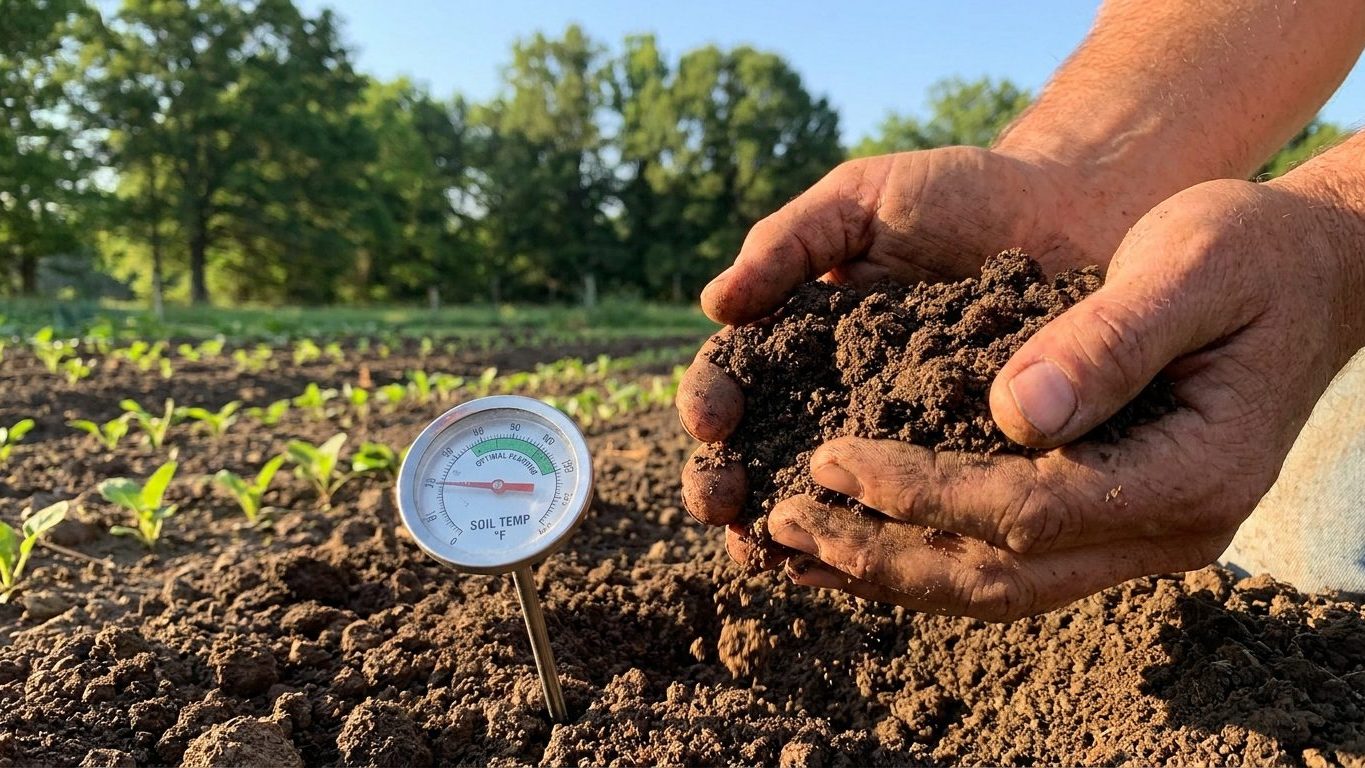

New Mexico gardeners can Plant Winter Squash once soil temperatures hold steady in the 60s, roughly two to three weeks after the average last spring frost. The state’s short-to-moderate frost-free window, intense summer heat, and thin monsoon rainfall together decide which types of squash actually mature before the first fall frost arrives.
When the soil is warm enough in New Mexico

At the Albuquerque reference station, the average last spring frost falls between March 31 and April 12 (NOAA NCEI U.S. Climate Normals 1991-2020, 32F freeze probabilities). That date range is useful, but it answers the wrong question for winter squash. Frost tells you when the air stops freezing. Squash seeds and roots care about something slower to change: soil temperature. Cold soil rots seed before it sprouts and stalls transplant roots even when the air feels warm enough for a t-shirt.
The gap between “frost is over” and “soil is warm” typically runs two to three weeks in this climate, because New Mexico’s high desert air warms fast in the sun but the ground underneath, especially if it’s shaded or holds moisture, lags behind. Direct-seeding into soil that’s still in the 50s is the single most common reason a squash bed sits bare for a week longer than a neighbor’s.
One frost date, one caution worth repeating: this is a probability drawn from a 30-year average at one airport station, not a promise for any specific yard. Elevation changes everything in New Mexico. Gardens up in the foothills or in a mountain valley often see frost linger a week or two past the Albuquerque numbers, while low desert pockets near the Rio Grande can warm earlier. The NOAA figure is a starting reference, not a local guarantee, and checking your own county’s frost history through your local extension office is the more precise move.
What actually tells you it’s time
Rather than counting days off a calendar, gardeners here do better watching two things directly: soil temperature at planting depth, and the trend, not just the reading. A single warm afternoon spikes the number without meaning the ground has truly turned. A run of several consecutive warm days, air and soil both, is the more reliable signal.
Because a late cold snap can still slide in after that average date, and because winter squash roots don’t forgive a chill once they’re growing, most gardeners in this region treat the last-frost window as the earliest possible boundary, not the ideal one, and lean a few days later rather than a few days earlier.
How long the season lasts here
Subtracting the two NOAA figures gives the frame: from a last spring frost of March 31 to April 12, to a first fall frost of October 29 to November 9, the frost-free window at the reference station runs somewhere around 200 to 223 days. That’s a long season by national standards, and it’s the fact that shapes almost every planting decision that follows.
A window this long does more than just give winter squash time to mature. It allows something many shorter-season gardeners never get to consider: a second sowing. Winter squash from an early-season planting can finish well before the fall frost arrives, which opens the door to a follow-up sowing timed so the second crop also has enough days to mature and cure before cold shuts things down. That’s not automatic math, though; it depends on which type is chosen and how many weeks it actually needs on the vine, which is exactly the kind of detail your state extension trial data will confirm for the varieties grown locally.
This window length also changes whether transplanting is worth the trouble. In a short-season territory, transplants exist to buy back weeks the calendar won’t give. In a long-season state like New Mexico, direct-seeding is a perfectly reasonable default for winter squash, since there’s enough runway to let seed sprout in its own time. Transplants still have a role, mainly for gardeners who want a head start on a second succession planting or who are working a smaller bed and want tighter control over spacing from day one, but they’re a convenience here rather than a necessity.
The real planning tool at this point isn’t the frost date itself, it’s the succession calendar built around it. For the exact spacing and timing logic behind a second sowing, the succession sowing guide on this site walks through how to stagger plantings so a long window like New Mexico’s gets used fully instead of wasted on a single early crop that finishes with two months of good weather left unclaimed.
None of this holds if the local frost dates run different from the reference station, which is common at elevation. A gardener in a higher, cooler part of the state should treat this 200-plus day figure as an upper bound, not a default, and verify against county-level data before betting a second sowing on it.
Heat and water in New Mexico

Winter squash is unusually exposed to season length as a risk, because the fruit has to finish fully on the vine before frost. An immature squash doesn’t ripen in storage and doesn’t cure properly, it just sits there soft and short-lived. In a state where the frost-free window runs long, as New Mexico’s does, that particular risk is smaller than it is further north. What replaces it here is a different set of pressures: heat load and dry air.
At the Albuquerque reference station, the average year brings 42.5 days at or above 90F. That’s a meaningful heat load, and it’s the figure that drives water demand and heat stress far more than the average summer temperature does. Squash plants under that kind of sustained heat lose water fast through their broad leaves, and a vine that’s short on water during fruit set drops blossoms or produces fruit that stalls partway through sizing up.
Rainfall doesn’t make up the difference. Summer rain across June, July and August totals only about 3.5 inches at the reference station, with June the driest month at just 0.57 inches, July at 1.64, and August at 1.31 (NOAA NCEI Monthly Climate Normals 1991-2020). That’s a fraction of what a squash vine pulls out of the soil during a 90-plus-degree stretch, and monsoon rain in New Mexico often arrives as a short, intense thunderstorm that runs off a dry, sunbaked surface rather than soaking down to root depth.
Put those two figures together and the practical read is straightforward: in a hot, dry territory like this one, irrigation is what carries winter squash fruit through its filling stage, not rainfall. Consistent watering scheduled around the heat, rather than around whatever rain happens to fall, is the difference between a vine that fills its fruit and one that stalls halfway through summer.
None of that means every garden behaves the same way. The 42.5-day heat count and the 3.5-inch summer rainfall figure are both reference-station averages, and how they play out depends on the soil underneath. A sandy garden bed drains that occasional thunderstorm within a day, pushing water needs even higher between rains, while a clay-heavy bed holds moisture longer and buys a squash vine a bit more slack. A rain gauge and a soil check on the actual plot in question settle the question a regional average can’t.
| Factor | Reference-station figure | What it means for winter squash |
|---|---|---|
| Frost-free window | ~200-223 days | Long enough for a second sowing in many years |
| Days at or above 90F | 42.5 days/year | High water demand, heat stress risk during fruit set |
| Summer rainfall (Jun-Aug) | ~3.5 inches | Not enough alone; irrigation needed through fruit fill |
Which winter squash suit New Mexico
The honest answer here is a type, not a variety name. New Mexico’s long frost-free window means the earliest-maturing types aren’t a strict requirement the way they’d be in a short-season northern state, but the combination of heavy summer heat and thin monsoon rain shifts the priority elsewhere: toward types and growing setups that tolerate sustained 90-plus-degree stretches without dropping blossoms, and that can be kept productive with irrigation rather than depending on rain that mostly runs off before it soaks in.
In practice, that points gardeners toward giving vines airflow and some shade at the root zone during the hottest weeks, since New Mexico’s heat load (42.5 days a year at or above 90F) is high enough to stress squash roots sitting in bare, sun-baked soil. Mulching and spacing choices that keep root zones cooler matter more here than in a milder-summer state, and they matter more than which specific type is planted.
Disease pressure, by contrast, runs lower than it would in a humid climate. With summer rainfall this thin, mildew and the fungal issues that thrive in damp, still air are less of a default concern here than they are in wetter regions, which means resistance to those diseases isn’t the first filter New Mexico gardeners need to apply when picking a type, the way it would be in a humid southeastern state.
This page won’t name a specific cultivar, and that’s a deliberate choice rather than an oversight. Variety trial results, the kind that tell you which named squash actually performed well in New Mexico’s heat and dryness over multiple seasons, come from New Mexico State University’s extension service, not from a general climate article. Naming a cultivar without that local trial data behind it is a guess dressed up as advice, and it’s the kind of guess an experienced gardener spots immediately.
New Mexico State University’s Aces extension program, at aces.nmsu.edu, maintains the region-specific variety recommendations and trial results that this page can’t substitute for. That’s the resource that turns “a heat-tolerant type with good airflow around the roots” into an actual named squash worth planting this season, matched to conditions in your specific county rather than a statewide average.