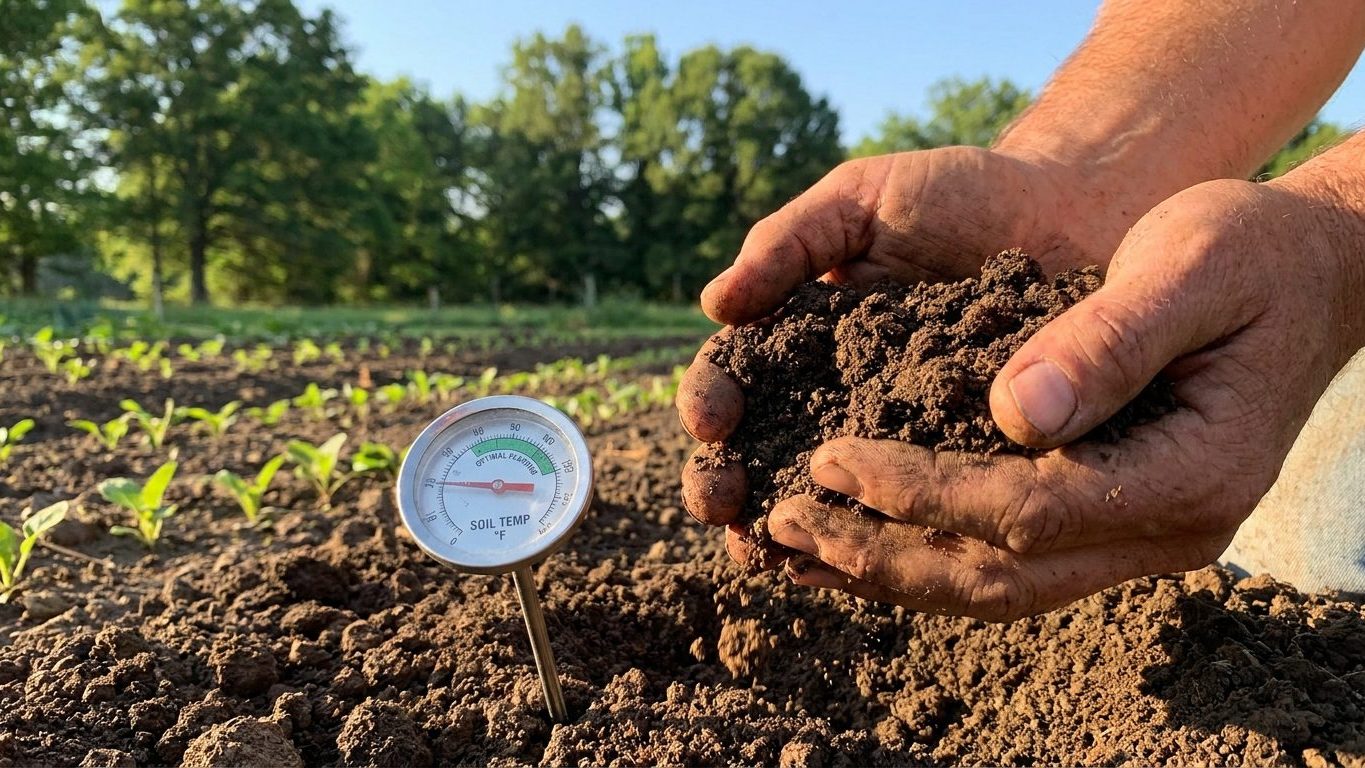

North Carolina’s growing conditions depend heavily on where in the state you garden. In the Piedmont, anchored by Charlotte’s climate data, soil is usually warm enough for winter squash by late April into May, and a frost-free season stretching into early November gives most of the state plenty of time to bring fruit to full maturity before cold arrives.
When the soil is warm enough in North Carolina

The question every gardener asks first is when to put seed or transplant in the ground. For the Piedmont, using Charlotte as the reference point, NOAA’s 1991-2020 climate normals put the last spring frost between March 23 and April 5. That’s the 30-70% probability band, not a guarantee, and it matters that you read it that way: it’s the window during which a freeze becomes progressively less likely, not a date circled on a calendar after which frost simply stops.
Winter squash doesn’t actually care about frost risk directly. It cares about soil temperature, and soil temperature lags behind the disappearance of frost risk by a couple of weeks in most years. A frost-free morning in late March or early April doesn’t mean the ground four inches down has shaken off winter. Squash seed sown into cold, wet soil tends to rot before it germinates, and transplants set into cool ground simply sit there, stalled, vulnerable to the fungal problems that come with slow growth. The practical result: most Piedmont gardeners wait until well into April, sometimes early May, before soil has reliably warmed enough for direct seeding or transplanting.
Geography changes this picture substantially. Charlotte sits in the Piedmont, but North Carolina’s hardiness zones run from 5b in the high mountains to 8b along the coast, according to the USDA Plant Hardiness Zone Map. The coastal plain, generally milder, tends to warm earlier than the Piedmont figure suggests. The Blue Ridge Mountains to the west run weeks later in spring, sometimes not shaking off frost risk until mid-May, and a gardener there planting on the Piedmont’s schedule is planting into ground still too cold to matter.
None of this points to a single fixed planting day, and that’s on purpose. The safest approach is watching the soil itself rather than the calendar, using a simple soil thermometer if precision matters to you, and treating the frost date as a starting point for that observation rather than a substitute for it. For the specific types trialled and timed for your county, North Carolina Cooperative Extension is the resource built for exactly this, and it’s worth consulting before you commit seed to ground.
How long the season lasts here
Take the two frost dates together and you get the real number that matters for winter squash: how many frost-free days you’re working with. Charlotte’s last spring frost falls between March 23 and April 5, and the first fall frost arrives between October 30 and November 8. Doing that subtraction honestly, using only figures the NOAA normals actually provide, gives a frost-free window running somewhere between roughly 208 and 230 days depending on which end of each range you land on in a given year.
That’s a long season by national standards, and it changes what’s worth attempting in the garden. A window over 200 days doesn’t just cover the maturation period of most winter squash types with room to spare, it opens the door to a second sowing for shorter-season types, planted after an early crop is pulled or alongside it in a different bed. Gardeners in regions with a tight 100 to 120 day window rarely have that luxury; the first sowing has to be the only one, and every week of delay in spring is a week stolen from ripening in fall. North Carolina’s Piedmont gardener, by contrast, has enough slack to experiment with staggered plantings without gambling the whole harvest on one sowing date.
This also affects the transplant-versus-direct-seed decision more than people expect. With a shorter window, transplanting buys precious early weeks and is almost always worth the root disturbance risk. With over 200 frost-free days on the table, the calculation shifts: direct seeding, which avoids transplant shock and produces a plant with an undisturbed root system, becomes a reasonable default for a first sowing, while transplants might be reserved for a second, later planting where getting ahead of the calendar actually matters again as fall frost draws closer.
For gardeners wanting to work through the mechanics of timing a second sowing, including how to count backward from the first fall frost to know the last safe planting date for a given type, the site’s succession sowing guide walks through that calculation in detail. It’s the natural next step once the season-length math above makes sense for your specific spot.
Heat and water in North Carolina

Season length answers when to plant. Heat and water answer whether the plant thrives once it’s in the ground, and this is where North Carolina’s Piedmont climate reveals its particular character. Charlotte averages 35.0 days a year at or above 90°F, according to NOAA’s 1991-2020 normals. That’s a moderate heat load, not the punishing stretch of 60-plus days a Southwest or Deep South garden might see, but enough to stress squash plants during July and August if water isn’t managed.
Rainfall tells a more complicated story than the total suggests. Summer rain across June, July and August averages about 12.1 inches at the reference station, broken down as 3.99 inches in June, 3.74 in July, and 4.35 in August. July, the driest of the three and often the hottest, is exactly when a squash plant is filling fruit and demanding the most consistent soil moisture. On paper, 12 inches over three months sounds like plenty. In practice, North Carolina’s summer rain tends to arrive as thunderstorms, heavy bursts that run off a clay-heavy Piedmont surface rather than soaking in evenly, followed by dry stretches that coincide with the year’s hottest days.
That combination, moderate heat plus rain concentrated in downpours rather than steady soaking, doesn’t produce the dry-climate problem of a plant simply running out of water. It produces a wetter, more humid problem: foliage that stays damp longer after a storm, soil that alternates between soggy and parched, and the fungal pressure that follows both. Powdery mildew and downy mildew are the practical result of North Carolina summers more often than outright drought stress, and they spread fastest exactly when humidity lingers after a thunderstorm followed by a hot, still afternoon.
The response isn’t complicated, but it does mean a different set of priorities than a hot, dry climate would demand. Drip irrigation or soaker hoses that keep foliage dry while delivering water to the root zone address both problems at once: they cover the gap during a dry July without adding to the moisture sitting on leaves. Spacing plants generously for airflow, and watering in the morning rather than evening so foliage dries before nightfall, does more for a North Carolina squash patch than any amount of extra water poured on during a heat spell.
Which winter squash suit North Carolina
Given a frost-free window over 200 days, moderate heat, and humid, storm-driven summer rain, the type of winter squash that suits this climate is shaped more by disease pressure than by season length alone. A long growing season means nearly every winter squash type, from the earliest to the longest-maturing, has time to reach full maturity on the vine here. The exception is the western mountain counties, where the season shortens considerably and earlier-maturing types make more sense simply because frost risk returns sooner.
For most of the Piedmont and points east, disease resistance becomes the first thing worth checking rather than an afterthought. Given the mildew pressure that comes with humid summers and thunderstorm rainfall, types bred or selected for resistance to powdery and downy mildew hold their foliage later into the season, which matters directly: a plant that loses its leaves to mildew in August stops filling fruit, regardless of how much growing season remains on the calendar. Airflow-friendly growth habits and generous spacing help every type perform better here, but they matter most for types with denser foliage that trap humidity around the base of the plant.
This page won’t name specific varieties, and that’s a deliberate choice rather than an oversight. Variety trials run by university extension programs test dozens of named cultivars against local disease pressure, local soil, and local pest populations every single season, and the results shift as new resistant varieties are released and older ones fall out of favor. A name printed here today could be outperformed by something released next year, and this page has no way to verify performance on your specific soil regardless. North Carolina Cooperative Extension maintains exactly that kind of current, locally-tested guidance, broken down by county where local agents track what performs best in their specific conditions.
The useful takeaway isn’t a shopping list, it’s a set of criteria to bring to that conversation: ask about disease resistance first, ask about relative days-to-maturity second if you’re gardening in the mountains or considering a second sowing, and let your local extension agent match those criteria to what’s actually been tested in your county’s soil and summers.