
The short answer: wait until soil temperatures hold steady, generally not before late May in most of Nova Scotia, and count on roughly five months to bring a winter squash from seed to a cured, storable fruit before the first hard frost returns in fall. Everything else, from variety choice to watering, follows from that window.
When the soil is warm enough in Nova Scotia

Gardeners ask for a date, so here it is: the average last spring frost at Halifax Stanfield Int’l A, the reference station for the province, falls on May 7, according to Environment and Climate Change Canada’s 1981-2010 Climate Normals. That number is a mean, not a guarantee. In roughly one year out of two, frost arrives later than May 7, sometimes by a week, sometimes by more. Treat it as the midpoint of a risk window, not a safe planting day.
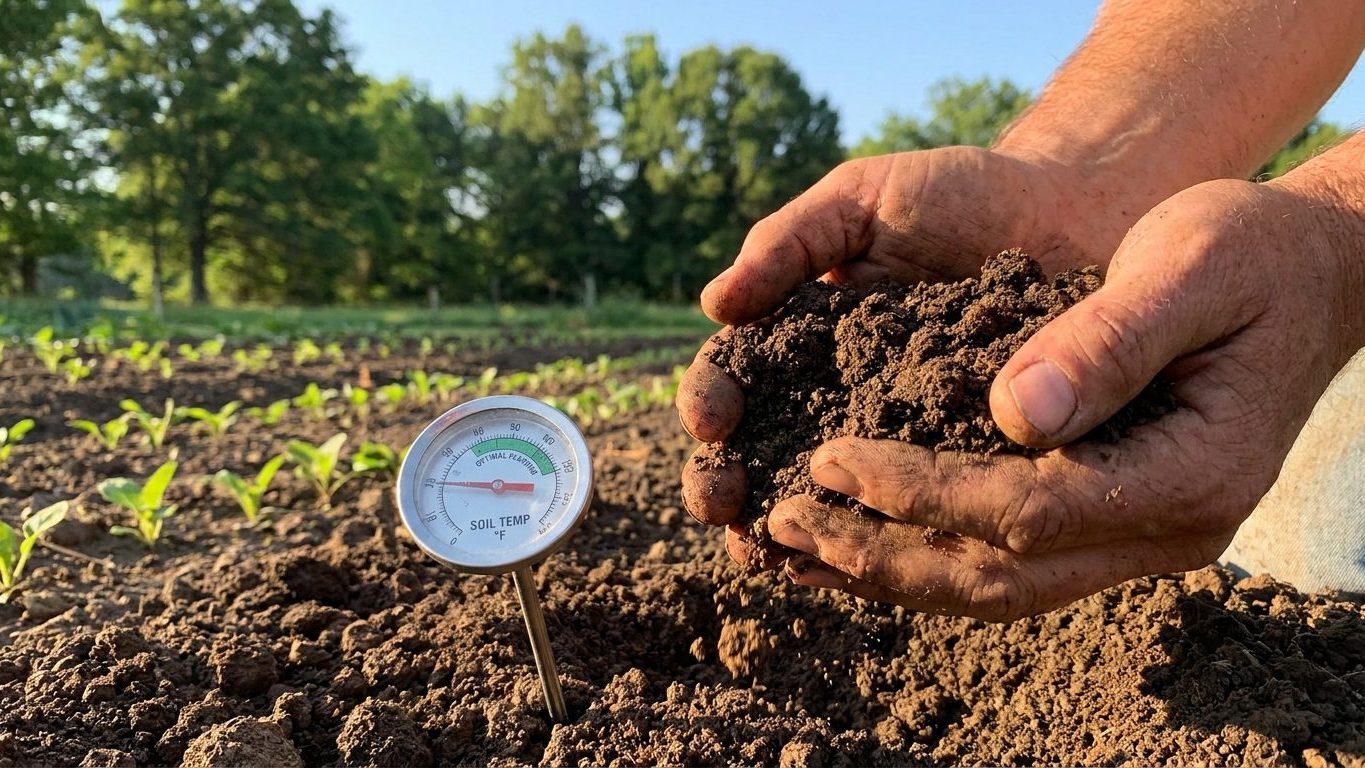
Frost itself is also the wrong thing to plant by. Winter squash doesn’t care whether the air dipped below freezing last week; it cares whether the soil has actually warmed. Squash seed germinates poorly in cold, wet ground, and transplants sulk or rot at the root when soil temperatures sit in the 50s. Soil lags behind air temperature by two to three weeks in spring, which means the practical window for direct-seeding or transplanting Winter Squash in most of Nova Scotia opens in late May to early June, after the frost risk has mostly passed and the ground has had time to catch up.
This matters more in a province where geography does a lot of the talking. The Halifax Stanfield station sits in a moderated coastal zone; inland valleys and the Annapolis Valley often run warmer and earlier in spring, while upland districts in Cape Breton or the northern mainland lag well behind. Nova Scotia’s Canadian hardiness zone, as published by Natural Resources Canada for the reference city, is 6b — a rating built from seven climate variables, not the single-factor USDA scale used elsewhere on this site. The two systems don’t convert, so don’t try to match Nova Scotia’s 6b against a USDA zone number from a different territory; it isn’t the same measurement.
What this means for planting decisions
In practice, growers here have two workable paths. Direct-seed once the soil has warmed and the frost window has clearly passed, usually a few weeks after the average May 7 date. Or start transplants indoors three to four weeks earlier and harden them off, which buys extra maturing time for a crop that needs every warm day it can get. Either way, resist the urge to plant to the calendar alone. A soil thermometer, or simply watching whether volunteer weeds have started germinating in the bed, tells you more than the date on a seed packet.
How long the season lasts here
Subtract the two mean frost dates and the frost-free window in Nova Scotia runs about 164 days, from the average May 7 last spring frost to the average October 18 first fall frost, both from Environment and Climate Change Canada’s Halifax Stanfield normals. That’s the number to build a squash season around, and it’s tighter than it looks once you account for the slow soil warm-up in spring.
A 164-day average window is workable for winter squash, but it isn’t generous. Winter squash types typically need a long, unbroken stretch of warm weather to size up, ripen the rind, and cure properly before storage, and because the true planting date usually slides past the mean frost date rather than sitting right on it, the effective growing period most seasons is shorter than the full 164 days on paper. That has a direct consequence: in Nova Scotia, the first sowing or transplanting is usually the only sowing that matters for winter squash. There’s rarely enough calendar left after harvest to squeeze in a second crop of the same type before fall frost shuts things down, the way a grower further south might.
This is also why transplanting versus direct-seeding is a real decision here rather than a matter of preference. Transplants give squash a two-to-three-week head start on the clock, which in a season this length can be the difference between a fruit that finishes curing on the vine and one pulled green ahead of frost. The trade-off is transplant shock: winter squash roots dislike disturbance, so starting seedlings in larger cells and checking the root ball before it circles the pot matters more in a short-season territory than in a long one, where a setback can simply be absorbed by extra weeks of growing time.
Growers weighing whether a second, faster crop fits after squash comes out, or whether to stagger plantings of something else around it, will get more out of this site’s general succession sowing guide than out of any Nova Scotia-specific number, since the timing principles carry across territories even where the dates don’t.
Heat and water in Nova Scotia

Here’s the number that separates Nova Scotia from a lot of the winter squash-growing map: 0.0 days a year above 90°F at the Halifax reference station, per the 1981-2010 Canadian Climate Normals. Effectively zero. Winter squash grown in this province almost never faces heat stress, sunscald, or the kind of evaporative water demand that pushes gardeners in warmer territories toward daily irrigation. That’s a genuine advantage for a crop that can struggle with blossom drop and pollen sterility in extreme heat.
It’s also a trade-off, not a free pass. Squash sets and fills fruit efficiently in the 70s and low 80s, and Nova Scotia’s summers sit comfortably in that range without the extremes that stress the plant elsewhere. But the same coastal, moderate climate that keeps temperatures down also keeps humidity up, and that changes the list of problems a grower here actually deals with. Instead of heat stress, the risks are slower fruit sizing on a cool, cloudy stretch, and disease pressure from powdery mildew or downy mildew taking hold in damp foliage that doesn’t dry out quickly between rains.
Rainfall reinforces that picture rather than complicating it. Summer rainfall across June, July, and August averages about 11.2 inches, with June at 3.79 inches, July at 3.76 inches, and August, the driest of the three, still delivering 3.68 inches, according to Environment and Climate Change Canada’s Halifax Stanfield normals for 1981-2010. That’s a fairly even, unspectacular distribution, not a wet-season, dry-season pattern. Combined with zero days of extreme heat, it means Nova Scotia gardeners are rarely fighting drought stress on winter squash. The more common task is managing excess moisture at the leaf and soil surface: spacing plants for airflow, avoiding overhead watering late in the day, and keeping vines off wet ground with mulch so fruit doesn’t sit in standing damp.
None of this is a forecast for any single backyard. A slope, a windbreak, or a low spot that holds water will shift these averages in either direction, and a rain gauge on the actual plot tells a grower more about a given season than any normal on this page.
Which winter squash suit Nova Scotia
Three facts from this province point toward the same conclusion: a growing window averaging around 164 days that’s shorter in practice, essentially no extreme heat, and summers damp enough to favor mildew over drought. Together they suggest that Nova Scotia gardeners should prioritize the earliest-maturing types of winter squash available, and put disease resistance ahead of heat tolerance when comparing options, since heat tolerance is a problem this province mostly doesn’t have.
Airflow and leaf dryness matter more here than shade or root cooling, which are the priorities in a hot, dry territory. Wider spacing than a seed packet might suggest, trellising where the growing habit allows it, and avoiding wet-foliage watering all do more for a Nova Scotia squash crop than any drought-proofing measure would. Where a short season is the binding constraint, the earliest types within a category will consistently outperform larger, later ones that need more of that 164-day window than the province reliably offers.
What this page won’t do is name a specific variety. That’s a deliberate choice, not an oversight. Cultivar performance for days-to-maturity, disease resistance, and fruit quality is trialled locally by provincial and university extension programs, and those trial results are the only recommendation that actually reflects growing conditions in Nova Scotia rather than a generic seed catalog description written for a national market. A variety that performs well in a trial plot in one province can behave differently under Nova Scotia’s specific combination of cool summers and damp air.
For that reason, the right next step for a Nova Scotia gardener choosing a specific squash to plant is the Nova Scotia Department of Agriculture, which publishes locally trialled variety information and current guidance on managing squash diseases without relying on any single product name or fixed application rate. General principles like early types, good airflow, and dry foliage travel well across a whole territory; the specific cultivar that performs best in a given county is a question only local extension trials can answer honestly.