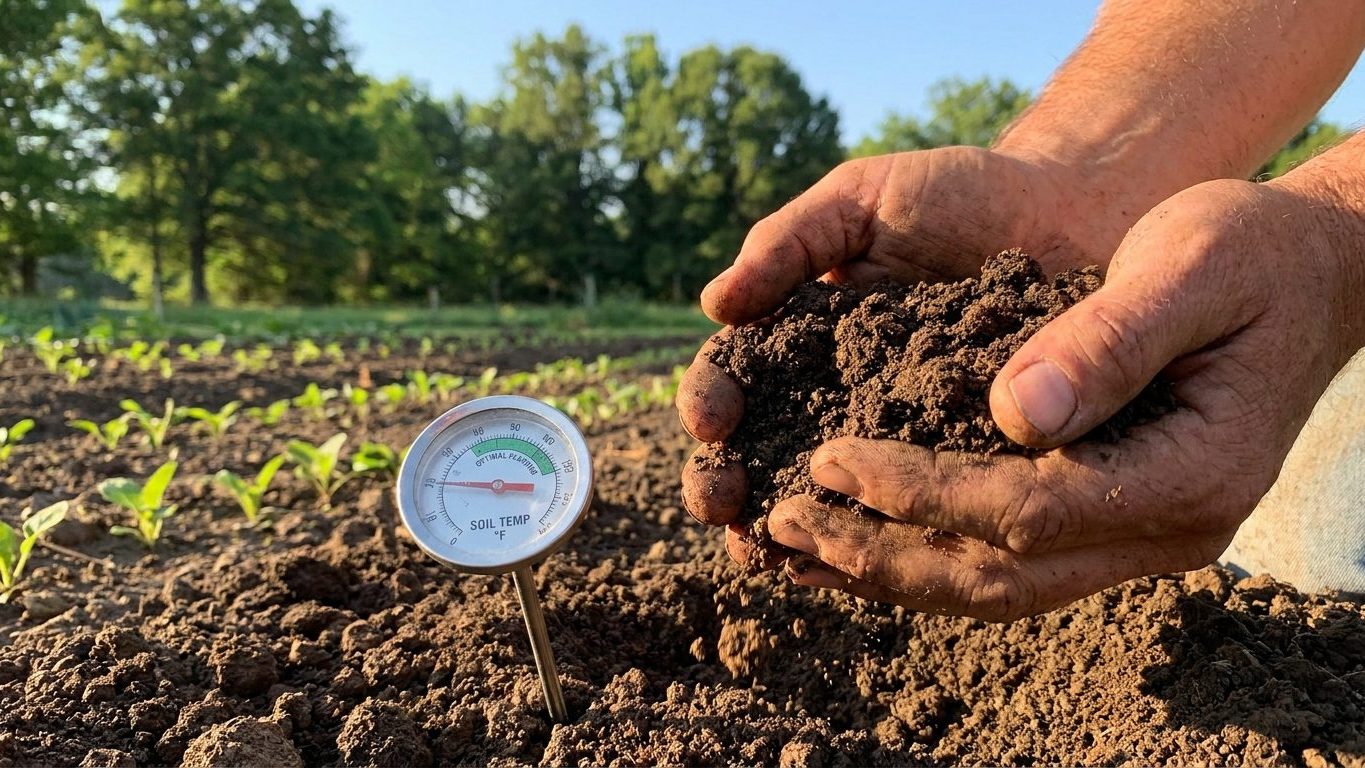

Oklahoma gardeners can set winter squash transplants or direct-sow seed once soil temperatures hold steady and frost risk has passed, typically mid-to-late April at the reference station near Oklahoma City. But the real window runs longer than that single planting date suggests, and heat, not cold, ends up being the bigger factor in how the crop finishes.
When the soil is warm enough in Oklahoma

The last spring frost at the reference station (Oklahoma City, station USW00013967) falls between March 28 and April 10, according to NOAA’s 1991-2020 Climate Normals, which track the 30-70% probability band for a 32F freeze. That’s a wide window, and it’s worth sitting with for a second: it means there’s real spread in when the cold actually lets go, even at one station, in one dataset.
Frost date is a proxy, not the answer itself. Winter squash seed doesn’t germinate reliably in cold soil, and transplants set into ground that’s still chilly just sit there, sulking, sometimes rotting at the root before they ever put on growth. Soil warms up after the frost risk clears, not the moment it does. In practice, that means waiting a week or two past the last-frost window before putting squash in the ground, letting the top few inches of soil actually warm through rather than racing the calendar.
There’s a caveat baked into the frost data itself. These figures come from an airport weather station, and airports tend to run warmer than the surrounding countryside, thanks to pavement, wind exposure and lack of tree cover. Suburban yards and rural gardens across Oklahoma typically see their last spring frost later than what the station reports, sometimes by a week or two, and more if the property sits at higher elevation or in a low spot where cold air pools. A frost date is a probability, not a promise, so treat late March as too early for anyone gardening outside the immediate metro, and push toward mid-April as a safer default.
Soil temperature, more than the calendar, is what winter squash responds to. Gardeners without a soil thermometer can use a rough substitute: if the ground feels cool to bare skin in the early morning, squash roots will read it the same way. Oklahoma’s hardiness zones run from 6a to 8a under the USDA Plant Hardiness Zone Map (based on 1991-2020 average extreme minimum temperatures), a range wide enough that a gardener in the Panhandle and one in the far southeast are working with genuinely different springs. That zone map measures winter cold, not spring warm-up speed, so it’s a starting point for frost risk, not a substitute for watching your own soil.
For the specific varieties trialled at Oklahoma test sites and updated planting guidance by region, the Oklahoma State University Extension service keeps current recommendations that account for local conditions this page can’t.
How long the season lasts here
Subtracting the two frost windows gives a frost-free season running from roughly March 28-April 10 to October 29-November 8, both figures from the same NOAA station near Oklahoma City. Depending on where in those bands the actual frosts fall in a given year, that’s somewhere in the neighborhood of 200 to 225 days, a season long enough to matter for how a gardener plans the year.
That length changes the math on succession sowing. A frost-free stretch approaching seven months gives room for more than one planting cycle for many crops, though winter squash itself is a slow grower that typically needs most of a summer to mature its fruit fully before frost. A long window like Oklahoma’s makes it realistic to stagger plantings a few weeks apart to spread harvest, or to replant if an early sowing fails to germinate or gets hit by a late pest problem, without running out of season. In a shorter-window territory, that first planting is often the only shot, and losing it means losing the crop for the year.
The length also affects whether transplanting makes sense over direct seeding. Winter squash resents root disturbance, and gardeners often skip transplants altogether in favor of sowing seed straight into the garden once soil has warmed. But a generous season, like the one Oklahoma’s frost dates describe, gives more slack to start seedlings indoors or in a cold frame a few weeks early, get a jump on the calendar, and still have time to recover if the transplant check sets growth back briefly. In a tighter window, that transplant shock is riskier because there’s less season left to make up for it.
The fall side of the equation matters just as much as the spring side, and it’s easy to overlook. The first fall frost window, October 29 to November 8 at the reference station, is also likely to arrive earlier in rural and elevated parts of the state than the airport data shows, for the same reasons spring frost tends to linger there. That trims the usable season from the back end, which matters for a slow-maturing crop that needs to finish on the vine before cold arrives. For a fuller look at staggering plantings across a season this long, the site’s succession sowing guide walks through timing crops against a given frost-free window.
Heat and water in Oklahoma

Oklahoma City’s reference station logs an average of 70.7 days a year at or above 90F, per NOAA’s 1991-2020 Climate Normals. That’s not an average summer temperature, it’s a count of how many days push into genuine heat stress territory, and 70-plus days is substantial. It’s the kind of number that turns “does this crop need watering” into “how often, and how much.”
Winter squash is unusual among garden vegetables in that the calendar itself is the limiting factor: the fruit has to mature and cure on the vine before frost ends the season, and a squash pulled green never ripens properly in storage the way a tomato might finish on a windowsill. In a territory with a short frost-free window, the type of squash chosen matters more than any trellising trick or feeding schedule, because there’s simply no recovering lost weeks. Oklahoma’s long season takes some of that pressure off. The bigger challenge here isn’t running out of time, it’s getting the plant through 70-plus days of 90-degree heat without the fruit stalling or the vine collapsing under water stress.
That’s where rainfall comes in, and Oklahoma’s summer numbers are middling rather than generous. The reference station shows about 11.7 inches of rain across June, July and August, out of 36.4 inches for the full year, with July the driest month at 3.59 inches (June comes in at 4.49, August at 3.6). Spread across three months of peak heat, that’s not abundant, and it doesn’t arrive evenly. Summer rain in this part of the country tends to fall as thunderstorms, meaning a lot of it runs off hard-baked or clay soil rather than soaking in where roots can use it.
Heat and rainfall interact rather than acting alone. Days above 90F drive fast evaporation from both soil and leaf surfaces, so even a decent rainfall total can leave soil moisture short if it arrives all at once and then nothing follows for two weeks. On clay soil, water lingers longer near the surface after a storm; on sandy soil it drains through within a day, meaning two gardens a few miles apart, with the same rainfall, can need completely different watering schedules. A rain gauge on the actual plot, tracked against how quickly the topsoil dries, tells a gardener far more than the regional average does. In practice, that usually means irrigating winter squash through July and August rather than counting on the sky to carry it, since that’s the driest stretch layered directly over the hottest one.
Which winter squash suit Oklahoma
Nothing here points to hunting down an exotic cultivar. Oklahoma’s frost-free season, running from late March or April into late October or November, gives enough length that maturity time isn’t the tight constraint it would be farther north, so the type of squash matters less for beating frost and more for handling the heat and moisture pattern the state actually delivers.
Given more than 70 days a year above 90F, types that tolerate heat stress without dropping blossoms or stalling fruit set have an advantage here, and giving plants airflow (adequate spacing, avoiding dense overcrowding) plus consistent moisture at the root zone helps carry fruit through the hottest stretch of summer. Given a rainfall pattern that arrives in bursts rather than steady soaking, and humidity that can follow a thunderstorm even in a dry month, disease resistance, particularly to powdery mildew and vine-decline issues that show up in humid, high-heat conditions, is worth weighing as a first criterion rather than an afterthought.
This page won’t name a specific variety, and that’s a deliberate choice rather than an omission. Squash varieties are bred and selected for particular combinations of heat tolerance, disease resistance and maturity length, and what performs well in trials at one research station may underperform a few hundred miles away under different soil and humidity. Oklahoma’s own hardiness zones span 6a to 8a, a range wide enough that a variety suited to the Panhandle’s drier climate may struggle in the more humid southeastern corner of the state. Naming one variety here would mean guessing at conditions this page has no way to verify for any individual reader’s yard.
The Oklahoma State University Extension service runs the variety trials that actually mean something for this state, testing squash types against local heat, humidity and pest pressure across different counties. That’s the resource built to answer “which variety” with real local data behind it, and it’s the natural next step for a gardener ready to move from planning the season to picking seed.