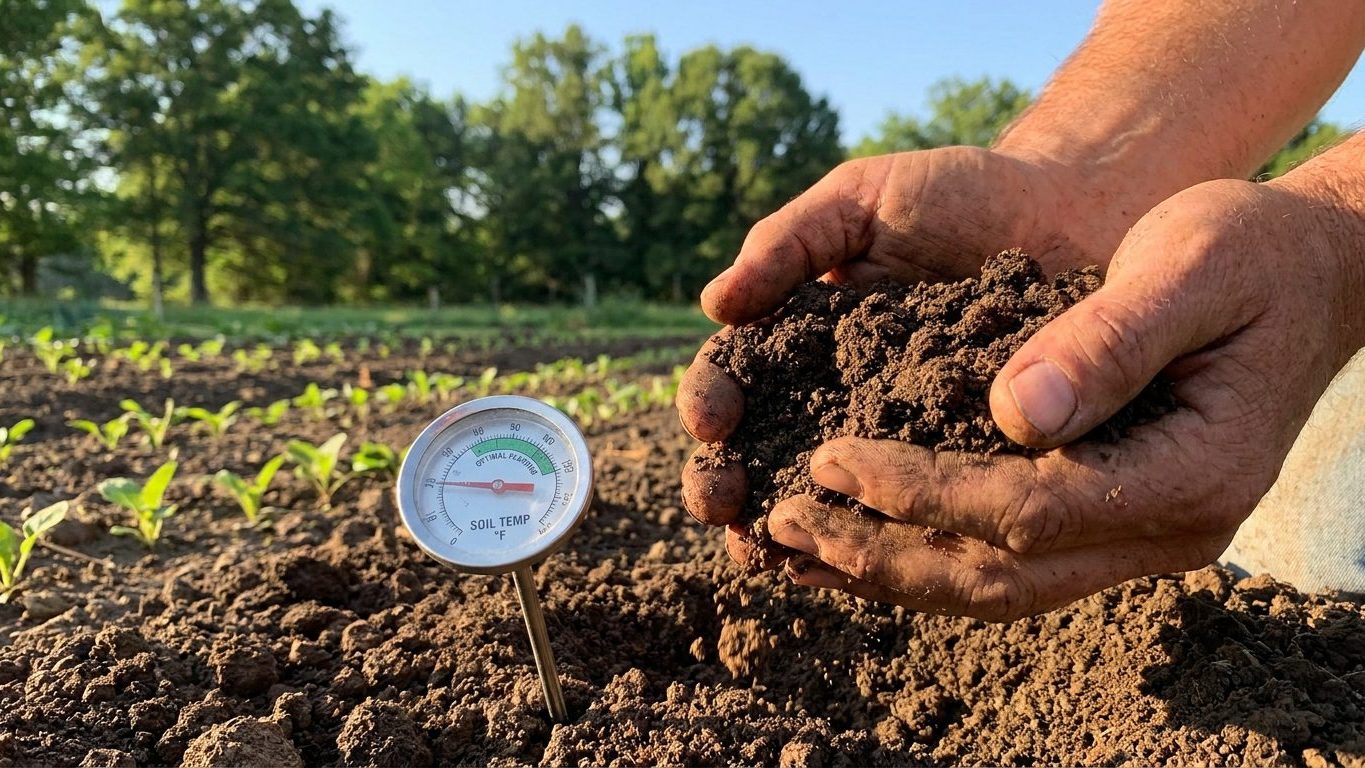

Winter squash goes into Georgia ground once the soil itself has warmed, not simply once a calendar frost date has passed. Across the state’s USDA zones 6a to 9b, that window opens anywhere from mid-March in the coastal plain to well into April in the mountains, and the reliable signal is the ground, not the forecast.
When the soil is warm enough in Georgia

The frost date gets all the attention, but it’s really a stand-in for soil temperature. NOAA’s 1991-2020 Climate Normals for station USW00013874 put Georgia’s last spring frost, the point where 32°F freeze risk falls into the 30-70% probability band, somewhere between March 11 and March 29. That’s an 18-day spread just for the “typical” year, and it says nothing about the ground itself.
Soil warms on its own schedule, lagging behind the air by days or weeks depending on sun exposure, mulch, and how much clay sits under the topsoil. Winter squash seed dropped into cold, wet ground doesn’t die outright so much as it sulks: slow germination, uneven stands, seedlings that never catch up to a sowing made two weeks later into warmer soil. A frost date marks when killing cold becomes unlikely. It does not mark when soil is ready to push seed into active growth.
Treat that March 11 to March 29 range as a probability, not a promise. At a site tucked in a low spot where cold air pools, the real safe date can run later than even the top of that band. Waiting a week or two past the calendar frost date, and checking the ground with a hand rather than a date book, is the cheaper habit.
Location changes the answer more than the date does
The reference station behind these numbers sits at an urban airport, and Atlanta’s pavement holds heat that a garden forty miles out in the country doesn’t have. That single fact reshuffles the picture across the state:
| Region | Spring frost pattern | What that means for sowing |
|---|---|---|
| North Georgia / mountains | Several weeks earlier in fall, later to clear in spring than the Atlanta reference | Wait longer past the stated range; watch for cold pockets in valleys |
| Piedmont / metro Atlanta | Matches the March 11 to March 29 normal closely | The stated window applies fairly directly here |
| Coastal plain | Runs milder in both spring and fall | Often safe to start earlier than the stated range |
Rather than lean on one date for the whole state, a call to the University of Georgia Cooperative Extension office for your county is worth the ten minutes. They track local frost patterns and can tell you how your specific area compares to the Atlanta reference station used here.
How long the season lasts here
With a last spring frost of March 11 to March 29 and a first fall frost of November 13 to December 1 (same station, same NOAA 1991-2020 Normals), the frost-free window in Georgia runs somewhere between roughly 229 days on the short end and 265 days on the long end, depending on where in each range a given year and a given spot land. That’s between about seven and a half and nearly nine months without a killing freeze, one of the longer growing seasons on this site’s territory list.
That length changes what’s worth attempting, not just what’s possible. A season this long allows a second sowing of a fast-maturing type in early summer, timed to finish curing before the first fall frost arrives, rather than treating the spring planting as the only shot of the year. It also gives real margin: a spring sowing that gets delayed by a wet, cold March, or wiped out by a late cutworm hit, still has room to be replanted without running out the clock before November.
A shorter frost-free stretch, closer to the 229-day end of the range, tightens that math. It still leaves a season long enough for most winter squash types to mature and cure, but it narrows the room for error and makes the timing of that one sowing matter more. In those conditions, transplanting from cell packs instead of direct-seeding can buy two to three weeks, though winter squash roots resent disturbance, so it’s worth checking the specific type’s tolerance for root disruption before choosing that route over direct seeding.
Where the season runs long, a staggered planting schedule turns one harvest window into two, and spreads the curing and storage work over a longer stretch of fall instead of dumping it all at once. For the mechanics of spacing those sowings correctly, the succession sowing guide on this site walks through timing a second planting so it still has enough season left to finish.
Heat and water in Georgia

Winter squash is the crop where season length decides everything. The fruit has to mature fully on the vine before frost; an immature squash doesn’t cure properly and doesn’t keep in storage, no matter how it looks when it’s picked. That makes heat and rainfall during the growing months the two variables that determine whether a planting actually finishes, not just whether it survives.
At the Atlanta reference station, NOAA’s 1991-2020 Climate Normals put the average count of days reaching 90°F or higher at 35.8 per year. That’s a real heat load, not extreme by Deep South standards, but enough to push evaporation rates up hard through the middle of the growing season. Vines set fruit and then have to fill it through July and August, exactly the stretch where that heat count concentrates and where soil moisture disappears fastest.
Summer rainfall doesn’t quite cover that demand on its own. The same station shows about 13.6 inches across June, July and August combined, with June at 4.54 inches, July at 4.75 inches, and August, the driest of the three, at just 4.3 inches. August is precisely when fruit is sizing and filling, which means the driest month of summer lands on the highest-demand stage of the crop. A single thunderstorm dropping an inch in twenty minutes mostly runs off a hardened summer soil surface rather than soaking down to root depth, so the monthly total looks more generous on paper than it behaves in the ground.
In practice, that combination argues for supplemental irrigation through July and August rather than relying on rainfall to carry fruit fill, especially on sandy soils that drain fast. Deep, infrequent watering aimed at the root zone, paired with mulch to slow evaporation, does more good than frequent light watering. It’s also worth keeping water off the foliage where possible: Georgia’s summer humidity, combined with warm nights, is exactly the kind of setup that lets powdery mildew and other fungal issues take hold on squash leaves, and wet foliage overnight speeds that along.
Which winter squash suit Georgia
None of this points to a single named variety, and that’s deliberate. Georgia’s growing conditions vary too much within the state for one recommendation to hold from the mountains to the coastal plain, and the varieties that perform well in University of Georgia trial plots change from year to year as new disease-resistant lines come through. Naming one here would be a guess dressed up as advice.
What the territory’s own numbers do support is choosing by type. Where the frost-free window runs closer to the shorter end of the state’s range, an earlier-maturing type gives more margin against an early fall frost catching fruit before it’s fully cured. Where summer heat is the bigger constraint, the deciding factor becomes airflow and root shading rather than the calendar: vines that get some relief from direct root-zone heat, whether from mulch or plant spacing that allows air movement through the foliage, tend to hold up better through the hottest stretch of July and August. In the state’s more humid pockets, particularly where morning dew lingers late and summer storms keep foliage wet, disease resistance becomes the first thing to check rather than an afterthought, given how readily powdery mildew and downy mildew move through a squash patch once night temperatures stay warm.
The University of Georgia Cooperative Extension Service, at extension.uga.edu, publishes the variety trial results that actually matter for this decision: which types held up against local disease pressure, which matured reliably within the local frost-free window, and which struggled. That’s the recommendation this page can’t responsibly replace with a name pulled from a seed catalog. Checking with a county extension agent, who knows the specific microclimate of a given garden rather than the state average, is the step that turns a general type into a real choice.