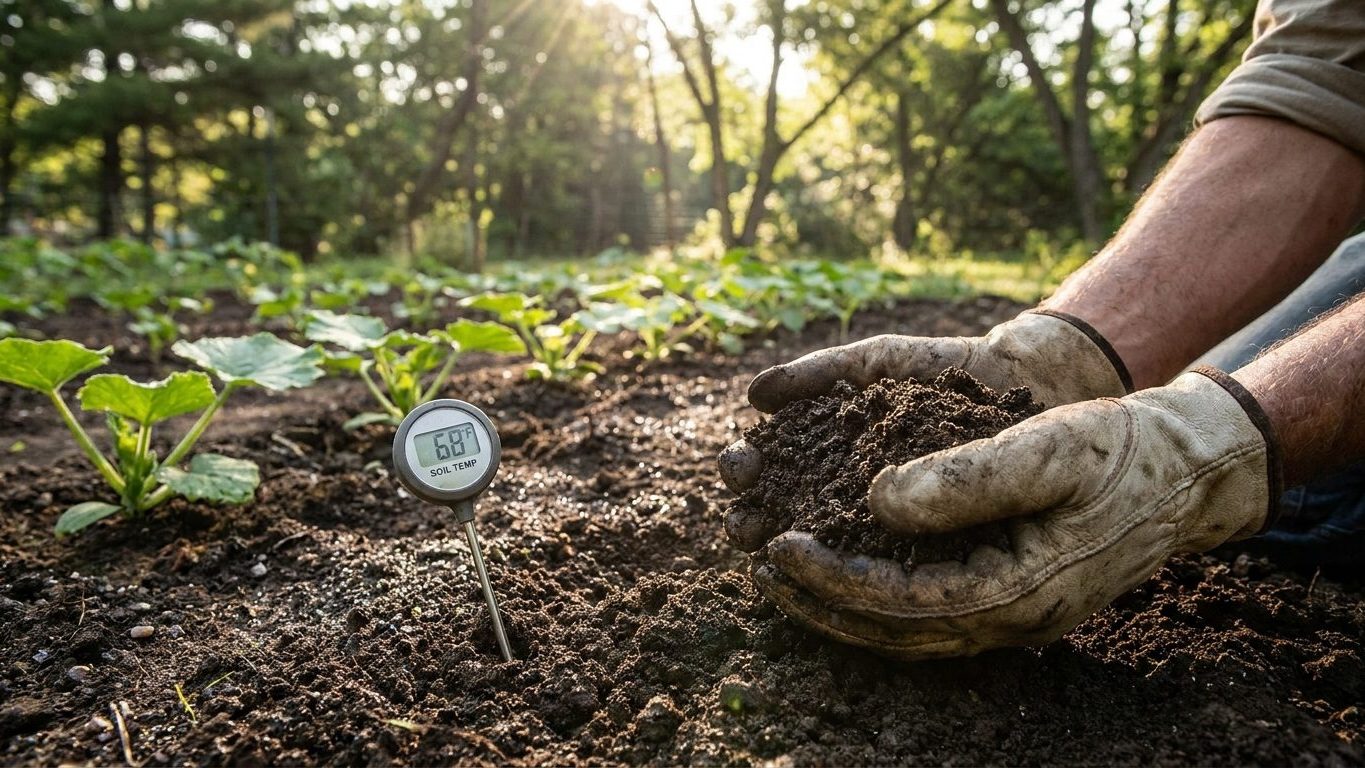

Winter squash goes into the ground outdoors in coastal British Columbia from mid-May through early June, once soil has warmed well past the mean last frost. That mean, March 18, is a probability marker, not a safe date, and the province’s real growing season varies far more than a single Vancouver-area figure suggests.
The short answer for British Columbia
At the reference station used for this page, Vancouver Int’l A, the mean last spring frost falls on March 18 and the mean first fall frost on November 10. On paper that’s a 237-day frost-free stretch, which sounds generous for any winter squash variety, including the slower 100- to 110-day types like hubbard. But two things stand between that number and a sowing date.
First, those dates are means from Environment and Climate Change Canada’s 1981-2010 normals, not guaranteed cutoffs. A mean last frost means frost arrives later than March 18 in roughly half of all years at that station. Treat it as the middle of a window, not the edge of safety.
Second, winter squash doesn’t care about frost risk so much as soil temperature. Seed sown into soil below about 60F germinates slowly, rots, or simply sits. Cold spring soil, even weeks after the mean frost date has passed, still stalls squash. That’s why the realistic outdoor sowing window in the coastal lowlands runs from mid-May to early June, direct-seeded or set out as three- to four-week-old transplants, regardless of what the calendar says about frost.
That window still leaves comfortable room. Counting back from the November 10 mean fall frost, even a June 1 sowing gives a 100-day variety until roughly mid-September to finish fruiting, with several more weeks of mild fall weather at the coast to cure the harvest on the vine before frost forces the issue. The season length at this reference station is not the limiting factor for winter squash. Soil temperature and summer moisture are.
This page speaks for the reference conditions named in these facts. It cannot tell an individual gardener in Kelowna, Prince George, or the Kootenays that their own last frost matches Vancouver’s. Those readers need their own local numbers, not a borrowed coastal date, and the sections below explain why and where to find them.
What will not work here

Two specific numbers from this reference station rule out two common assumptions, and both catch gardeners who Plant Winter Squash the way they would in a drier or hotter region.
Relying on rainfall through summer
Summer rain at the reference station totals about 5.0 inches across June, July, and August, with July, the driest month, bringing just 1.4 inches. A squash bed in active fruit development wants closer to 1 to 2 inches of water a week. Even in the wettest of those three summer months, June, at 2.12 inches, natural rainfall covers barely half that demand, and July covers a fraction of it. A gardener who plants winter squash and assumes “rainy BC” will do the watering is going to watch vines wilt and fruit stall through the driest stretch of the year. Irrigation here isn’t a backup plan for a dry spell. It’s the main water source for the entire fruiting period.
Counting on high heat for fruit set and flavor
The reference station records an average of 0.0 days a year at or above 90F. That’s not a rounding error, it’s a real absence of the kind of heat load that drives fast vine growth, aggressive pollinator activity, and the sugar concentration some winter squash varieties are bred to produce under hot, dry conditions. Varieties selected for interior or prairie heat, where 90F days are routine, can underperform here: slower fruit set, less pronounced sweetness, longer curing needed to reach full flavor. This doesn’t rule out winter squash on the coast. It rules out choosing a variety on the assumption that a hot summer will show up to finish the job.
Neither of these is a season-length problem. The frost-free window at this station is long. The failure mode here is watering on a schedule built for a wetter month, or picking a squash bred for a climate that never gets hot at all at this reference point.
What changes across British Columbia
British Columbia is not one climate. The hardiness zone fact available for this page, 9a in the Canadian system, applies specifically to Vancouver, the reference city named in these facts. That’s already a mild reading by Canadian standards, and it says nothing about the rest of the province.
Two things matter about that number. The Canadian zone system is built from seven climate variables, not the single-variable USDA system, so it cannot be lined up on the same scale as a US zone number. And it belongs to one city on the south coast. Natural Resources Canada’s own mapping shows Canadian zones spanning from the mild coastal strip down near 8b and 9a to zones several full numbers colder across the interior plateau, the northern regions, and higher elevations, where frost-free windows run weeks shorter on both ends of the season.
A reader gardening in the Fraser Valley or on southern Vancouver Island is working with something close to the reference conditions on this page. A reader in the Okanagan, the Cariboo, the Peace region, or anywhere at meaningful elevation is not, and should expect a later effective last frost, an earlier first fall frost, and a shorter practical window for the slower winter squash varieties. This page gives no single number for those readers because no single number covers a province this size.
The right move for anyone outside the south coast lowlands is to check their own zone directly rather than adjust the Vancouver figures by guesswork. Natural Resources Canada’s Plant Hardiness site (planthardiness.gc.ca) lets a reader look up the zone for their own municipality rather than borrow one from a station hundreds of kilometers away.
Where to check this for your own county
This page is the provincial version of the answer, built from a single reference station near Vancouver. That’s useful as a starting point and useless as a final word for anyone gardening outside the immediate south coast. British Columbia doesn’t organize agricultural guidance by county the way many US states do, but the province’s agriculture ministry publishes regional growing information that gets far closer to a given garden than a Vancouver Int’l A frost normal ever will.
The provincial resource is the BC Ministry of Agriculture and Food, at www2.gov.bc.ca/gov/content/industry/agriculture-seafood. What’s worth looking for there is specific: any regional planting guidance for the reader’s part of the province, and any variety trial information showing which winter squash cultivars have actually been grown and evaluated in a climate similar to their own, whether that’s the Okanagan’s hot dry interior, the coast’s mild wet summers, or the shorter seasons further north.
A regional recommendation beats a provincial one every time, for the same reason a local frost date beats a station average two hundred kilometers away. This page can only reason from the facts tied to one reference point. A reader’s own regional resource reasons from conditions much closer to their actual soil, and that’s the resource worth bookmarking once the general timing here has done its job.
Checking this against your own garden
Every date on this page is a normal, a long-run average built from decades of station data. A reader’s own garden this year isn’t obligated to follow it, and three simple observations tell a gardener more than any calendar entry.
- Soil warmth by feel: push a finger a couple of inches into the planting bed in the morning. If it feels cool and slightly damp rather than a bit of warmth returning by midday, the soil hasn’t caught up to the season yet, whatever the frost date says.
- The first flush of male flowers: winter squash typically opens several male flowers before any female ones appear. Their arrival signals the vine has settled in and is investing in growth rather than just surviving. Female flowers, with the small swelling behind the petals, follow within a week or two once conditions suit the plant.
- The first true leaves: the rounded seed leaves that emerge first don’t tell much. It’s the following set, the lobed, more deeply veined true leaves, that show the plant has moved past germination stress and into active growth. Slow true-leaf development after a normal germination time usually points to soil that’s still cooler than it looks.
None of these need a thermometer or any tool beyond attention. Taken together, they tell a gardener whether their particular patch of BC is running ahead of, behind, or roughly on pace with the reference dates this page is built on, which is exactly the calibration a provincial average can’t provide on its own.
If you follow the almanac, here is when to plant winter squash by the moon. It is a tradition, not a proven method.