
Winter squash goes into Georgia ground once the last-frost risk has passed, typically from late March through mid-July depending on variety and location. The state’s long frost-free stretch, which can top 250 days around Atlanta, gives more flexibility than most planting calendars admit. But the real constraints here aren’t cold. They’re summer heat, humidity, and exactly where in Georgia you’re standing.
The short answer for Georgia
Sow winter squash directly into the garden any time from late March through mid-April, once the 30-70% probability window for the last spring frost (March 11 to March 29, per NOAA’s 1991-2020 Climate Normals for station USW00013874) has closed. That date range isn’t a guarantee against frost. It’s a probability band: by March 29, most years in the Atlanta area have already seen their last 32F freeze, but some haven’t, and a squash seedling with true leaves out in a cold snap will die.
The reason the calendar has room to breathe is season length. Run the math from the same station: last spring frost lands as late as March 29, first fall frost arrives as early as November 13. Even taking the narrowest read, that’s still roughly 230 days of frost-free growing, stretching to closer to 265 days on the mild end. Winter squash varieties run anywhere from about 80 days (acorn, delicata) to 100-110 days (butternut, hubbard, some large pumpkins). None of them come close to using up that window if planted right after frost risk clears.
That surplus is why Georgia gardeners get a second sowing window that colder states simply don’t have. A planting anywhere from June 1 through mid-July will still mature well before the first fall frost, even for a slow 110-day butternut. This isn’t a hedge against a failed spring crop, though it works for that too. It’s a genuine second window, useful for gardeners who want a fall harvest timed closer to curing weather, or who lost early plants to squash vine borers and want a clean restart.
What the calendar does not answer is which window suits your soil and your pest pressure. An early-April planting escapes the worst of summer’s disease load but sits in cooler soil that can slow germination. A June planting germinates fast in warm soil but runs straight into peak heat and peak vine borer activity during flowering. Neither is wrong.
What will not work here
Planting before the frost window closes is the most common failure, and it’s a completely avoidable one. Squash seed sown into cold soil in early March, ahead of that March 11-29 last-frost band, either rots before it germinates or comes up into a freeze. Waiting until the probability of frost has genuinely dropped costs a gardener maybe two or three weeks. Losing the whole planting to one cold night costs a full restart.
The bigger trap is treating Georgia’s long season as forgiving on water. With 35.8 days a year reaching 90F or higher at the Atlanta reference station, this isn’t a climate where a weekly watering schedule holds up once squash vines are sprawling and setting fruit. Summer rainfall averages about 13.6 inches across June, July and August, but that number is deceptive on its own. It arrives as thunderstorms, not steady soaking rain, and August, the driest of the three months at 4.3 inches, often lines up with the exact stretch when fruit is sizing and demand for water peaks. A garden watered once a week on the assumption that “it rains all summer here” routinely comes up short in a dry August stretch, especially on sandy soil that drains within a day of a storm.
Humidity does the opposite kind of damage. The same summer rainfall that fails to keep soil consistently moist is more than enough, combined with Georgia’s heat, to build the wet, still air that powdery mildew and downy mildew need on squash leaves. Close spacing that might be fine in a drier climate becomes a liability here: vines packed tight don’t dry off between storms, and mildew moves through a planting fast once it starts. Wider spacing than a seed packet from a Northern seed company recommends, with real airflow between plants, is not optional in a Georgia summer garden.
Season length itself is almost never the failure point here, which sets Georgia apart from much of the northern half of the country. A 110-day hubbard squash that would be a gamble in a short-season state is a routine planting in Georgia’s 230-plus day window. The mistakes that sink a Georgia squash crop are heat, water timing and disease pressure, not the calendar running out.
What changes across Georgia
Georgia is not one growing season. The USDA hardiness zone map (2023 edition, built from 1991-2020 normals) places the state anywhere from 6a to 9b, a spread built entirely on average annual extreme minimum winter temperature. That’s a five-and-a-half-zone range inside one state’s borders, which is a wider swing than many entire multi-state regions. There is no single planting date that fits all of it, and treating the Atlanta-area frost dates as valid statewide would be a mistake.
The cooler end of that range sits in the north Georgia mountains, where elevation pushes both the last spring frost later and the first fall frost earlier than the Atlanta averages cited above. A gardener working at altitude in the north should expect to push spring sowing back and plan the fall harvest sooner, shrinking that comfortable 230-day cushion considerably. The warmer end sits in the coastal plain of south Georgia, where frost risk clears earlier in spring and holds off later into fall, stretching the frost-free window well past what the Atlanta station records.
Rainfall and heat load shift with that same geography, even though the specific figures come from one reference station. South Georgia’s coastal plain tends to run hotter and more humid through summer than the mountains, which changes the disease-pressure calculus discussed above: a spacing and airflow plan that works in the north may still need loosening further south.
None of this means a reader should guess at their own zone from a regional description. It means the spread is real and wide, and the next step is finding out exactly where a specific piece of ground falls on that 6a-9b range before treating any date as final.
Where to check this for your own county
The University of Georgia Cooperative Extension is the source built for exactly this gap. The figures come from statewide climate normals at a single reference station. Extension offices work county by county, with data and field trials specific to local conditions, which is a different and more reliable resource for an actual planting decision.
Two things are worth looking for once there. First, a county-level or regional planting calendar, which will reflect the local frost pattern rather than the Atlanta-area figures. A county in the mountains or on the coast will see real differences from what’s written here, and the extension office covering that county has already done the adjustment. Second, look for winter squash varieties that have actually been trialled in that county or region. Extension agents track which varieties held up against local disease pressure and which struggled, information that a seed catalog or a national gardening site simply doesn’t have.
A county recommendation beats a state one every time. The frost dates, heat days and rainfall figures cited here describe a broad Georgia average built from one weather station’s normals. They’re a reasonable starting point for someone with no other information, but they are not a substitute for what a local extension office knows about a specific county’s soil, elevation and microclimate. Anyone serious about timing a winter squash crop precisely should treat a statewide average as the first stop, not the last one.
The Moon calendar is a separate, older custom: see when to plant winter squash by the moon, written as tradition rather than fact.
Checking this against your own garden
No planting calendar, county-level or statewide, replaces what the actual garden shows on a given day. Three simple checks matter more than any calendar date for winter squash.
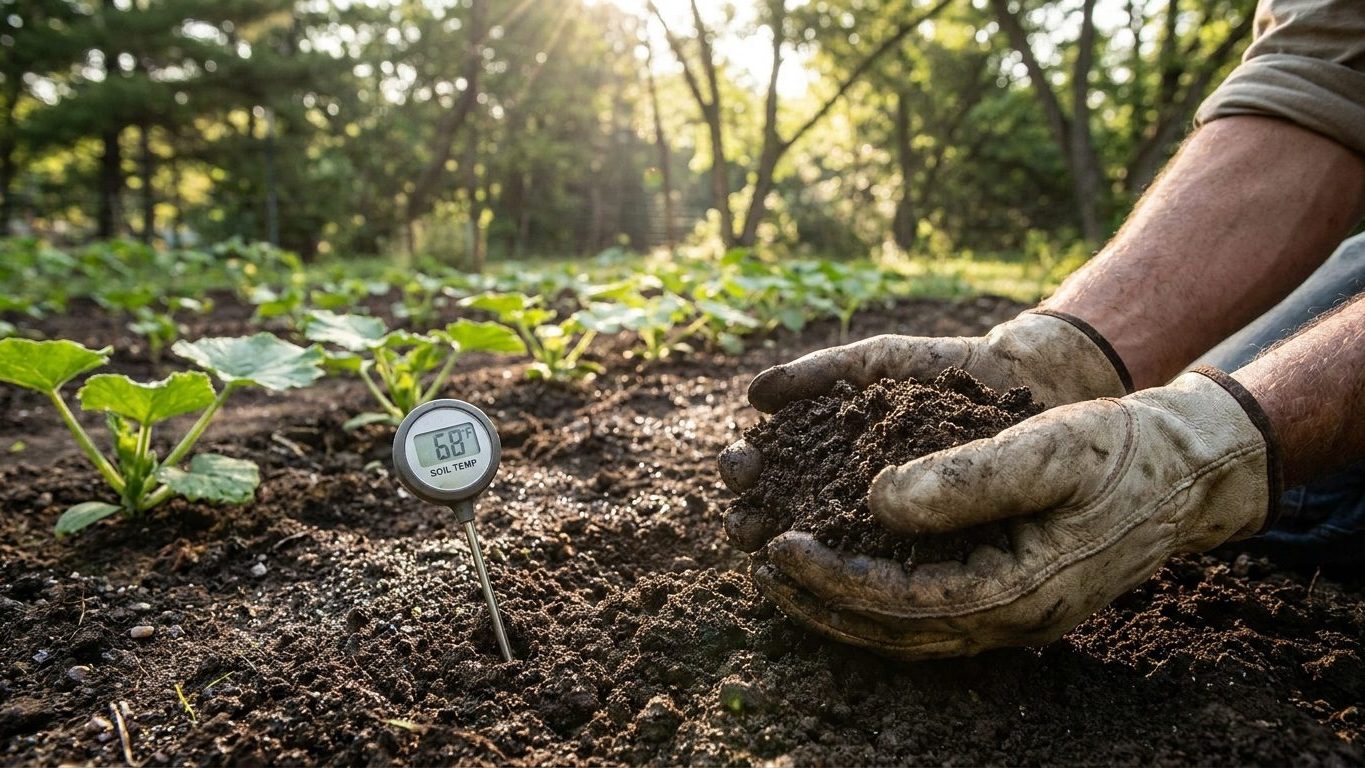
Soil warmth by feel comes first. Winter squash seed germinates poorly in cold soil regardless of what the frost date says. Push a hand a few inches into the planting bed in mid-morning; soil that still feels cold and damp, even well after the local frost window has closed, is telling the gardener to wait, especially in shaded or heavy clay ground that warms slower than the surrounding area.
The first flush of male flowers is the second signal, and it arrives before the female flowers that actually set fruit. Male flowers showing up early and in good number means the plant is tracking normally toward fruit set; a long gap with no male flowers at all past the point where a variety’s seed packet says flowering should start suggests stress, usually heat or uneven watering, worth correcting before fruit set is expected.
The first true leaves, the ones that follow the two rounded seedling leaves and actually look like squash foliage, mark the point where a plant has moved past its most frost-vulnerable stage but is still tender enough that a late cold snap or a hard afternoon wilt will set it back weeks. Watching how fast true leaves appear after germination gives a rough read on how warm and how fertile a specific bed actually is, which is a better guide to timing the next planting than any calendar date.