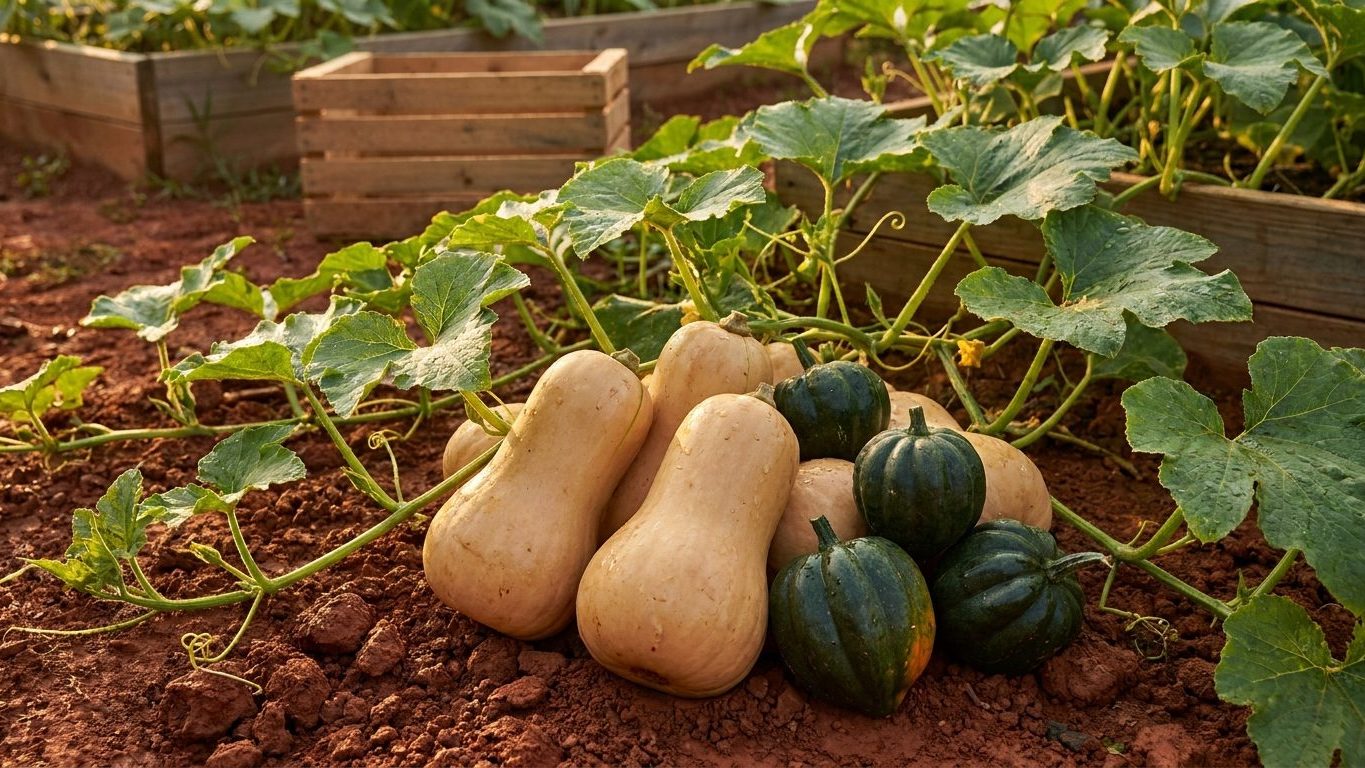

Butternut and other Cucurbita moschata varieties are the safest winter squash bet across Georgia, thanks to their resistance to squash vine borer and their tolerance for hot, humid summers. Acorn and delicata do fine in the northern part of the state. Hubbard and other maxima types struggle almost everywhere in Georgia.
The short answer for Georgia
Season length is not the problem here. Using the last spring frost window of March 11 to March 29 and the first fall frost window of November 13 to December 1, even the latest of those spring dates and the earliest of those fall dates leaves a frost-free stretch well over 200 days. Almost any winter squash, no matter how long it needs to mature, has time to finish in a Georgia garden. That fact changes the whole question. In a short-season state, the decision is about which variety ripens fastest. In Georgia, the decision is about which variety survives the heat and the pests that come with it.
The reference station’s climate normals show 35.8 days a year at or above 90F. That’s more than a month of extreme heat load spread across the growing season, and it does two things to squash. It stresses blossoms, sometimes causing them to abort before fruit sets, and it favors squash vine borer, a moth whose larvae tunnel into stems and whose populations build fastest in warm climates. That single pest does more to sort Georgia’s winter squash options than frost dates ever will.
Cucurbita moschata, the species that includes butternut and most spaghetti squash, has a solid stem that resists borer tunneling far better than the hollow stems of Cucurbita pepo (acorn, delicata) or Cucurbita maxima (Hubbard, buttercup, kabocha). Combine that resistance with genuine heat tolerance, and butternut becomes the default recommendation for a Georgia garden, north or south.
| Type | Species | Heat & humidity tolerance | Vine borer resistance | Best fit in Georgia |
|---|---|---|---|---|
| Butternut | C. moschata | High | High | Statewide, first choice |
| Spaghetti squash | Mostly C. pepo, some moschata types | Moderate to high | Varies by variety | Good statewide, check the species on the seed packet |
| Acorn | C. pepo | Moderate | Low | North Georgia, watch for borers |
| Delicata | C. pepo | Moderate | Low | North Georgia, short specialty run |
| Hubbard / Kabocha | C. maxima | Low | Low | Risky, cooler mountain sites only |
What will not work here

Hubbard squash and its maxima relatives are the clearest failure pattern in a Georgia garden. This species was bred largely in cooler climates and sets fruit poorly once nights stay warm through a long humid summer. Combine that with a hollow stem that squash vine borer larvae tunnel through easily, and a Hubbard planted in most of Georgia has two separate ways to fail before it ever reaches the vine-ripening stage that winter squash need.
Weekly watering schedules are another common mistake, and the summer rainfall numbers explain why. The reference station averages about 13.6 inches of rain across June, July and August, but that rain arrives unevenly, often as single thunderstorms that run off rather than soak in, especially once soil has baked under 35.8 average days of 90F-plus heat. August, the driest of the three summer months at 4.3 inches, is also the stretch when winter squash are sizing fruit and need the steadiest soil moisture. A rigid once-a-week schedule built for a cooler, wetter climate leaves Georgia squash short on water exactly when they need it most.
Tight spacing is a third failure point, and it’s a humidity problem rather than a heat problem. Powdery mildew and downy mildew both thrive when squash leaves stay wet or crowded, and Georgia’s summer humidity keeps foliage damp longer after rain or dew than it would in a drier state. Vine crops packed close together, the way a shorter-season garden might plant them to save space, trap that moisture against the leaves. Wider spacing and airflow between plants matter more here than they would in an arid climate, and skipping that step is one of the fastest ways to lose a squash patch to fungal disease before the fruit even matures.
What changes across Georgia
Georgia spans hardiness zones 6a to 9b under the USDA Plant Hardiness Zone Map, and that is not a narrow range. It runs from the cold pockets of the north Georgia mountains through the Piedmont around Atlanta down to the warm coastal plain near the Florida line. A squash recommendation built for one end of that range can be wrong for the other, so there is no single answer for “Georgia” beyond the general species guidance above. There is only a spread, and where a reader’s garden falls inside it changes some of the details.
Gardeners toward the cooler, higher end of that zone range, in the mountains and upper Piedmont, get a shorter effective growing season and somewhat lower summer humidity than the rest of the state. That’s the part of Georgia where acorn and delicata, the faster-maturing pepo types, have the best odds, and where Hubbard and other maxima squash stand their best (if still modest) chance of setting fruit before summer heat peaks.
Gardeners toward the warmer, lower end of the range, across the coastal plain and far south Georgia, face more days of extreme heat and often higher humidity off the coast. That favors butternut and other moschata types even more strongly, and it raises squash vine borer pressure, since the moth’s populations tend to build faster and produce more generations in warmer regions. A second, later planting of a fast-maturing variety can sometimes dodge the worst of the first borer generation there, something less necessary in the cooler mountain counties.
None of this replaces knowing which zone applies to a specific piece of land. The state’s zone range only marks the outer edges; the map itself is what places any one garden inside it.
Where to check this for your own county
The University of Georgia Cooperative Extension, at extension.uga.edu, is the source built to close that gap. A state-level page like this one can only describe a range of conditions from the mountains to the coast. A county extension office works with one set of local soils, one local frost pattern, and years of variety trials specific to that county.
Two things are worth looking for once there. First, the local planting calendar for winter squash, which will translate the frost windows into planting dates adjusted for that county’s actual microclimate, something especially useful for north Georgia counties that often freeze weeks earlier than the Atlanta-area reference station used for the statewide normals. Second, any list of squash varieties the local office has trialled or recommends by name, since county agents often track which specific butternut, acorn or spaghetti squash varieties have performed well against local squash vine borer pressure and local disease history, information a statewide page simply doesn’t have.
A county-level recommendation from a local extension office will always beat a state-level one. Georgia runs from zone 6a mountains to zone 9b coastal plain, and that width means real detail gets smoothed out. A county office deals with one climate, not a spread of them, and that’s a meaningful difference for a crop as sensitive to heat and humidity timing as winter squash.
Checking this against your own garden
Frost dates and zone maps describe averages built from decades of weather data. A reader’s own soil, on a given afternoon, tells them something no chart can: whether it’s actually ready for squash seed. Three simple checks, all doable by feel or by eye, outrank any calendar date.
- Soil warmth by feel: squash seed wants soil that feels warm to a bare hand a few inches down, not just frost-free air. Cold, damp soil that still feels chilly against the skin, even weeks after the last frost date has passed, means germination will be slow and uneven regardless of what the calendar says.
- The first flush of male flowers: squash plants typically open several rounds of male flowers before the first female flowers, recognizable by the tiny swollen bulb at their base, appear. A garden showing plenty of male flowers but no females yet is still building toward fruit set, not stalled, and that timing shifts from one yard to the next depending on heat and daylight in that specific spot.
- The first true leaves: the rounded seed leaves that emerge first aren’t the plant’s real foliage. The jagged, more squash-shaped true leaves that follow are the better sign that a seedling has settled into that soil and is growing on its own terms, not just running on stored seed energy.
None of these require a thermometer or any tool beyond attention. Together they tell a gardener more about their own particular patch of Georgia, whether it runs a little warmer or damper than the county average, than any regional planting date ever could.