
In the Boise area, the safe window to set out winter squash starts once the last spring frost has cleared, typically by mid-May, and closes when the first fall frost arrives in early-to-mid October. That window comes from probability bands, not fixed calendar days, and it only describes one reference point in a very tall, very varied state.
The short answer for Idaho
At the Boise reference station (USW00024131), NOAA’s 1991-2020 Climate Normals put the last spring frost somewhere between April 23 and May 7, and the first fall frost somewhere between October 7 and October 21. Those two date ranges are each a 30-70% probability band for a 32F freeze, meaning there’s still a real chance of frost on either side of them. They are not promises. A gardener who plants winter squash on April 24 in the Boise valley is betting against odds that are still meaningfully in the frost’s favor.
Stretch those two windows to their widest, and Boise’s frost-free season runs from late April to late October, a stretch of roughly five to six months depending on which end of each band you use. That’s enough time for nearly every winter squash type sold in seed catalogs, since most mature somewhere between 80 and 110 days from seed.
| Frost event | Date range (Boise station) | What it means |
|---|---|---|
| Last spring frost | April 23 to May 7 | 30-70% chance of 32F on any given day in this window; squash seed and seedlings can’t take a hit below this |
| First fall frost | October 7 to October 21 | Same probability band, but for the season’s end; vines and fruit skins soften fast once this hits |
Practically, that means direct-seeding or transplanting winter squash outdoors in the second week of May gives a comfortable margin past the riskiest part of the spring frost band, while still leaving well over four months to bring fruit to full maturity before the fall band opens. Frost data exists only for the Boise reference station. It does not have separate frost dates for the rest of Idaho, and borrowing Boise’s numbers for a mountain valley or a higher bench would be a mistake, for reasons the next section covers.
What will not work here
Planting the longest-season squash varieties as if Boise’s climate applied statewide is the single most common way this fails. Hubbard and some banana squash types push toward 110 days or more to reach full maturity, and even in Boise’s own five-to-six-month window that leaves little slack if a cool, wet spring delays germination or a frost arrives at the early edge of the fall band. Push that same variety into a higher-elevation county, where the season runs shorter than Boise’s on both ends, and the vines can be caught by frost with fruit still hardening on the vine, unable to cure properly in storage.
The other failure point is water, and it’s a numbers problem more than a technique problem. Boise’s reference station averages 47.5 days a year at or above 90F, a heavy heat load that drives fast evaporation from both soil and leaf surface. Set against that heat, summer rainfall totals only about 1.1 inches across June, July, and August combined, and August itself, right when fruit is sizing up, averages just 0.17 inches. A gardener who waters once a week, assuming that’s “enough for squash,” is watering on a schedule built for a wetter climate. In Boise’s heat and near-absence of summer rain, that weekly habit shows up as blossom drop, small or misshapen fruit, and vines that wilt hard by early afternoon even when the soil isn’t fully dry.
Relying on rainfall to carry a squash bed through summer simply doesn’t work here, since the total contribution from the sky over three full months is barely more than one inch. Squash roots run deep and wide once established, but they still need consistent moisture at the surface during flowering and fruit set, and Idaho’s summer sky isn’t going to supply it. Deep, infrequent watering aimed at replacing what the heat and dry air are pulling out, rather than a fixed weekly ritual, is the adjustment this climate calls for.
What changes across Idaho
Idaho’s USDA Plant Hardiness Zones span 3b to 7b, built on the average annual extreme minimum temperature at a given location. That’s one of the widest zone spreads of any state, and it means there is no single Idaho planting date, only a range anchored at one end by low valleys like Boise and at the other by high mountain basins and elevated benches where winter cold runs far more extreme.
A zone spread that wide changes more than just the coldest night of the year. Colder zones generally carry a later last spring frost, an earlier first fall frost, and therefore a shorter overall window to get a winter squash from seed to a cured, storable fruit. A gardener working in the northern part of the state or at meaningfully higher elevation than Boise should expect to push the outdoor planting date later than the Boise window given above, and to favor squash varieties on the shorter end of the maturity scale, closer to 80-90 days than 100-110, simply because the season itself is shorter no matter how it’s managed.
Zone boundaries in mountainous terrain shift with elevation, slope, and even how close a property sits to a valley floor that pools cold air on clear nights. The right move is to check the current USDA Plant Hardiness Zone Map for the specific address, rather than assuming Boise’s zone describes a garden somewhere else in the state.
Where to check this for your own county
The University of Idaho Extension is the right next stop for anyone trying to pin down an actual planting date rather than a statewide range. County-level extension offices work from trials and observations specific to their own soils, elevation, and microclimate, and that specificity is exactly what a state-level page like this one can’t offer.
Two things are worth looking for once there. First, a local or regional planting calendar, if the county office publishes one, since it will reflect the actual frost pattern and season length of that specific area rather than the Boise valley numbers used above. Second, a list of winter squash varieties that have actually been trialled in that county or a nearby one, since extension offices often track which varieties held up, cured well, and stored through winter under local conditions, information that no statewide page can generalize accurately.
A county recommendation will beat a state one every time, because it’s built on the actual conditions of that ground rather than a single reference station hundreds of feet lower, or higher, than a given reader’s own yard. The county office gives the number that actually applies.
Some gardeners also time this by the Moon: when to plant winter squash by the moon, as almanac tradition rather than fact.
Checking this against your own garden
No date on any calendar outranks what a garden itself is showing on a given spring. Three simple checks, all done by hand and eye, tell a gardener more about their own microclimate than any frost-date table can.
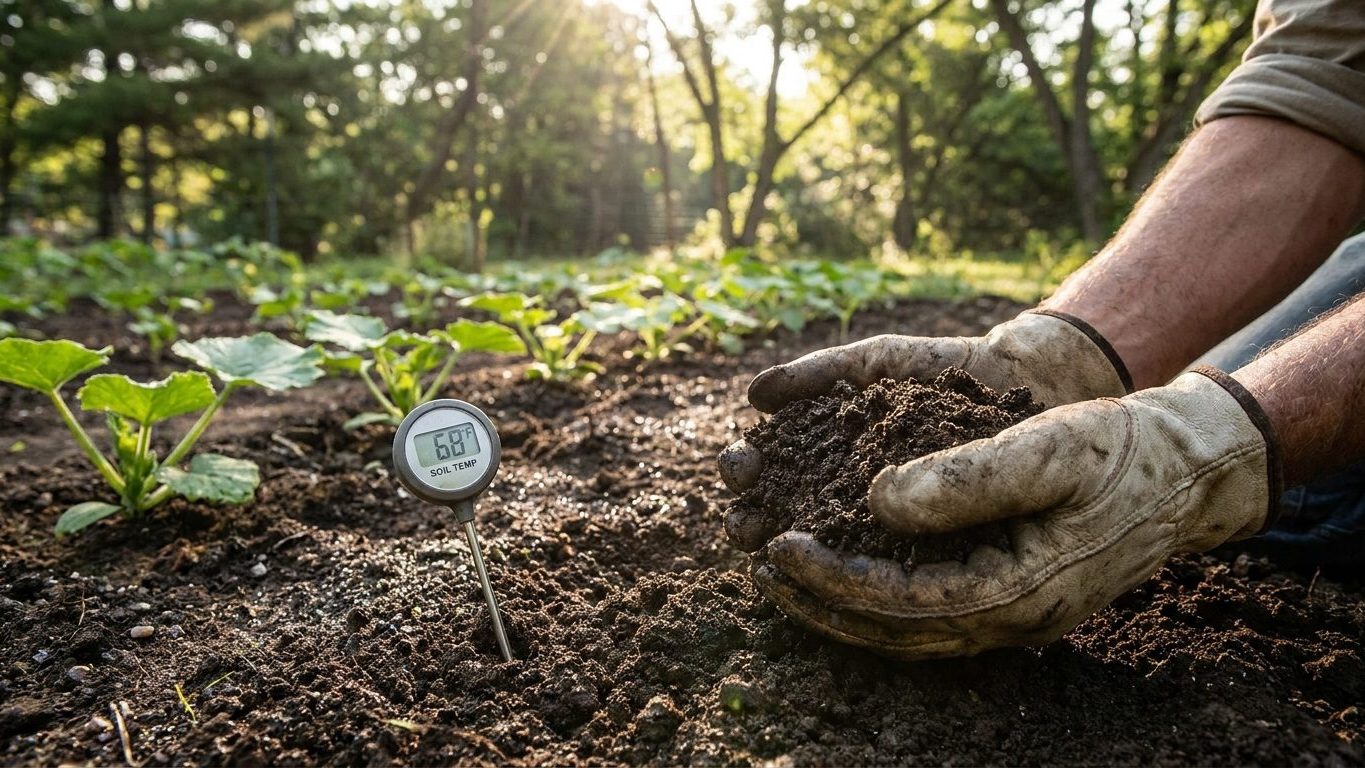
- Soil warmth by feel: winter squash seed wants soil that feels warm to the wrist a few inches down, not just above-freezing. Cold, damp soil that still feels chilly to the touch usually rots seed before it sprouts, regardless of the calendar date.
- The first flush of male flowers: squash plants typically produce male blossoms before the female ones that actually set fruit. Their early appearance signals the plant has settled in and started reproductive growth, a sign the local season has genuinely warmed up around that particular bed.
- The first true leaves: the rounder, more deeply lobed leaves that follow the seedling’s first small starter leaves show the plant has moved past the fragile establishment phase. Slow or stunted true leaves after a normal-looking start often point to soil that’s still cooler than it looks, a common story on a north-facing slope or in heavier ground that holds spring chill longer than the surrounding yard.
Any one of these running noticeably later than expected, given the frost windows and season length discussed above, is worth taking seriously. It usually means a particular yard sits a little colder, a little slower to warm, or a little shadier than the broader county pattern, and that the next season’s planting date should shift to match what the garden itself is actually saying.