
Direct-seed Winter Squash in Illinois after the last spring frost has passed, which the reference climate station places between April 11 and April 22, and finish harvest before the first fall frost, expected between October 24 and November 3. That gives most of the state roughly five to six months of frost-free growing, enough for the great majority of winter squash varieties if you don’t wait too long to get seeds in the ground.
The short answer for Illinois
Those frost dates aren’t guarantees. They come from NOAA’s 1991-2020 Climate Normals and mark the window where the odds of a 32°F freeze drop from 30% to 70%, measured at one airport weather station. That means even inside the stated range, there’s meaningful frost risk on either end. Winter squash is frost-tender at every stage, from seedling to fruit, so the safer read is to treat April 22 as the earliest sensible direct-seeding date for most gardens, not the average one.
Work backward from the fall side, too. Winter squash varieties commonly need 80 to 110 days from seed to harvest, depending on the type (acorn and delicata run shorter, butternut and hubbard longer). If the first fall frost lands as early as October 24, a squash planted in late April has about 185 days of frost-free time to work with, which comfortably covers even the slower varieties. That cushion is the reason Illinois gardeners have more flexibility on planting date than growers in shorter-season states: you don’t need to rush seed into cold soil to beat the calendar.
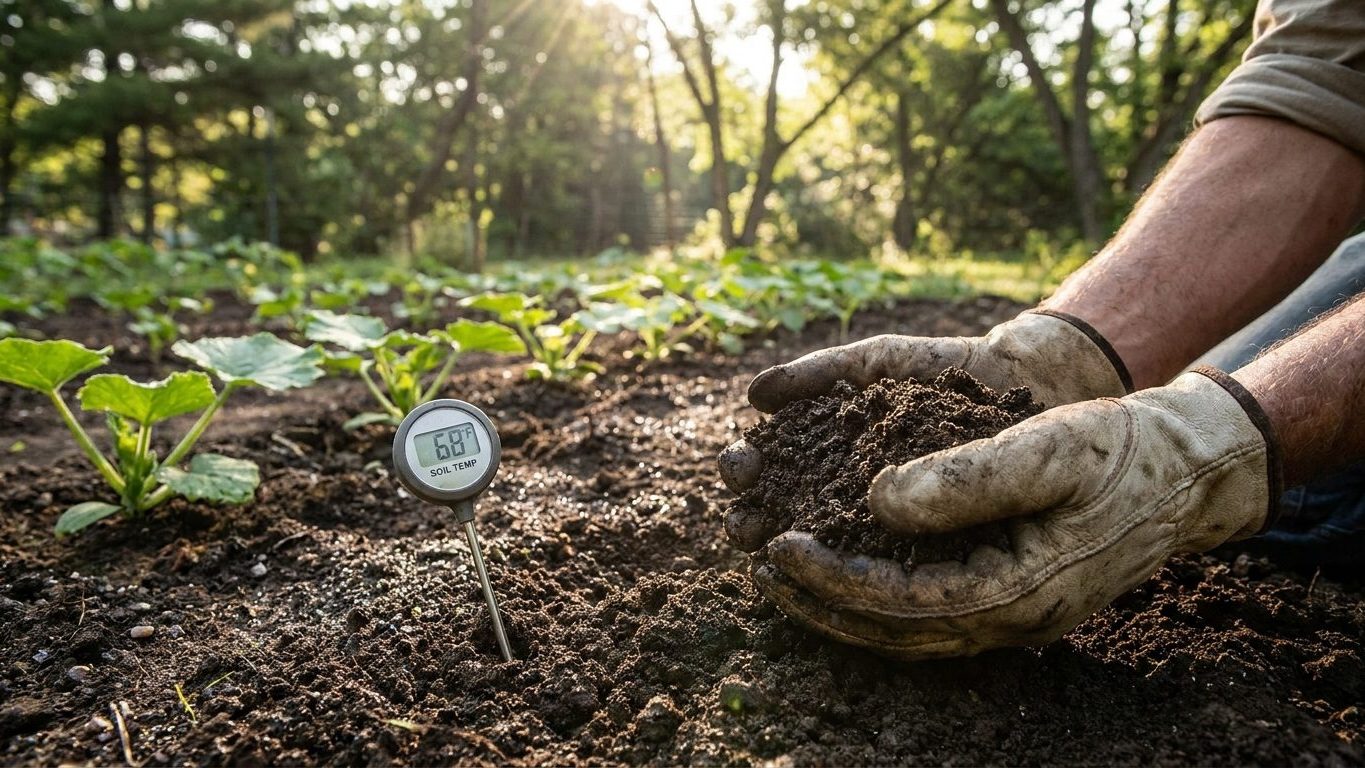
Soil temperature matters more than the calendar date, though. Squash seed germinates poorly below roughly 60°F, and soil that’s still cold from a wet spring will simply sit there and rot rather than sprout, whether or not the frost risk has passed. In practice, that pushes many Illinois gardeners toward late April through mid-May as the realistic direct-seeding window, especially in years when spring stays cool and damp. Waiting one to two extra weeks past the stated last-frost date costs little against a 185-day cushion, and it removes most of the guesswork around cold, slow-to-warm soil.
If you’re transplanting started seedlings instead of direct-seeding, the calculus shifts slightly: you can start seed indoors two to three weeks before your expected set-out date and move plants out once the soil has clearly warmed, rather than waiting on both air and soil at once. Either way, the anchor points stay the same: don’t rely on a race against the fall frost in Illinois, since the season is long enough that late April to mid-May plantings almost always finish in time.
What will not work here
The Illinois growing season isn’t the limiting factor here, so the usual failure mode of “ran out of days” is rare. What actually derails Winter Squash in this state is moisture, not length of season. Summer rainfall averages about 12.1 inches across June, July and August, with June the wettest month at 4.1 inches and July the driest at 3.71. That’s a fairly humid pattern by national standards, and it’s the setup that favors powdery mildew and other foliar disease on winter squash, especially once vines sprawl and leaves stay damp overnight.
Tight spacing is the specific mistake that turns that humidity into a real problem. Winter squash vines need room, both for airflow and for the leaf canopy to dry out between rain events. In a state with 12+ inches of summer rain rather than a dry, low-humidity climate, crowding plants the way you might get away with in an arid region invites mildew that can defoliate a planting by late summer, right when fruit should be sizing up and curing.
Early planting into cold, wet soil is the other common failure. June alone averages 4.1 inches of rain, and a spring that runs wet on top of a late frost risk creates exactly the conditions where direct-seeded squash rots before it germinates. Gardeners who push planting into early April, ahead of even the stated frost window, are usually fighting cold, saturated soil more than they’re fighting frost itself.
Heat stress, by contrast, is a minor concern here. The reference station averages just 14.0 days a year at or above 90°F, a modest heat load compared to states further south or west. Winter squash tolerates that easily, so watering schedules built around beating extreme heat aren’t the priority in Illinois the way they’d be in a hotter, drier climate. The trade-off is real: less risk of scorched fruit and stressed vines, more risk of fungal disease from humidity. Garden plans that treat Illinois like a hot, dry state and skimp on spacing to save space will lose more plants to mildew than they’d ever lose to heat.
What changes across Illinois
Illinois isn’t one climate. The USDA Plant Hardiness Zone Map places the state across zones 5a to 7b, a spread built on average annual extreme minimum winter temperature. That’s a wide range for one state, and it tracks the state’s long north-south geography: the northern counties near the Wisconsin border sit at the cold end of that range, while the southern tip near the Ohio River sits at the warm end, several zones milder.
That zone spread doesn’t translate directly into a squash planting date on its own, since hardiness zones describe winter cold, not spring warm-up or first fall frost. But it’s a useful signal of how much the state varies. A zone 5a garden in the north is going to see a later last frost and an earlier first fall frost than the reference station numbers here, which come from a station further south in the state’s climate spread. A zone 7b garden in the south will generally warm up earlier in spring and hold off fall frost longer.
The practical takeaway isn’t a specific date shift, since a county’s zone depends on local terrain and microclimate. It’s a reason to treat the April 11-22 and October 24-November 3 windows as a reference point from one station, not a statewide fact. Readers in the northern third of the state should expect to shift their planting window later in spring and their harvest deadline earlier in fall than these numbers suggest. Readers in the southern third should expect the opposite: earlier planting opportunity, more slack before fall frost.
To find out which end of that range applies to a specific county, check the USDA Plant Hardiness Zone Map directly rather than guessing from general geography, since local terrain and microclimate can shift a county’s zone in ways that surprise people.
Where to check this for your own county
Illinois-wide numbers built from one reference weather station are a reasonable starting point but not a substitute for local data. For county-level planting calendars and variety recommendations actually trialled in Illinois growing conditions, the University of Illinois Extension is the source to check.
Two things are worth looking for once there. First, a local planting calendar for your specific county or region, since Extension offices often publish frost-date and planting-window guidance adjusted for local conditions rather than a single airport station. Second, variety trial results or recommendation lists for winter squash, since Extension horticulturists test cultivars under Illinois conditions and can flag which varieties handle the state’s humid summers better, a detail no statewide climate normal can capture.
A county recommendation will always beat a state-level one, for a simple reason: it accounts for local soil, local microclimate, and local pest and disease pressure in a way that averaged normals from one weather station can’t. The state-level view is useful for understanding the broad pattern across Illinois and for framing expectations before you dig into the specifics. The county-level Extension office is where that broad pattern gets corrected for your actual garden.
If your county doesn’t have its own published calendar, contacting the local Extension office directly is worth the phone call or email. Extension staff typically have local knowledge, built from years of fielding questions from gardeners in that exact area, that never makes it into a formal calendar but answers exactly the kind of timing question a general guide can only approximate.
The Moon calendar is a separate, older custom: see when to plant winter squash by the moon, written as tradition rather than fact.
Checking this against your own garden
Dates on a page, including this one, are a starting estimate. Your own garden will tell you more than any frost calendar, and three simple observations outrank the calculations above.
Soil warmth by feel is the first check. Push a finger a couple of inches into the planting bed in mid to late morning. If it feels cold and clammy rather than cool and slightly moist, the soil isn’t ready for squash seed regardless of what the frost-date window suggests. This matters more in Illinois than in drier states, given how often spring rainfall keeps soil saturated and slow to warm.
The first flush of male flowers is the second signal, useful later in the season. Squash plants typically produce male flowers before female ones, and a strong early flush tells you the plant has settled in and is building energy for fruit set. If male flowers show up unusually late relative to when you planted, that’s a sign your particular spot runs cooler or slower than the general pattern for your area, worth noting for next year’s timing.
The first true leaves are the third. Seedlings that push past their initial round cotyledons into true, lobed squash leaves within a week or two of germination are growing in favorable conditions. A long stall between cotyledons and true leaves usually points to soil that’s still too cold or too wet, exactly the failure mode Illinois’s wet early summers make more common than heat stress does. Each of these observations is specific to the actual patch of ground you’re planting in, which is the one thing no statewide climate normal can tell you.