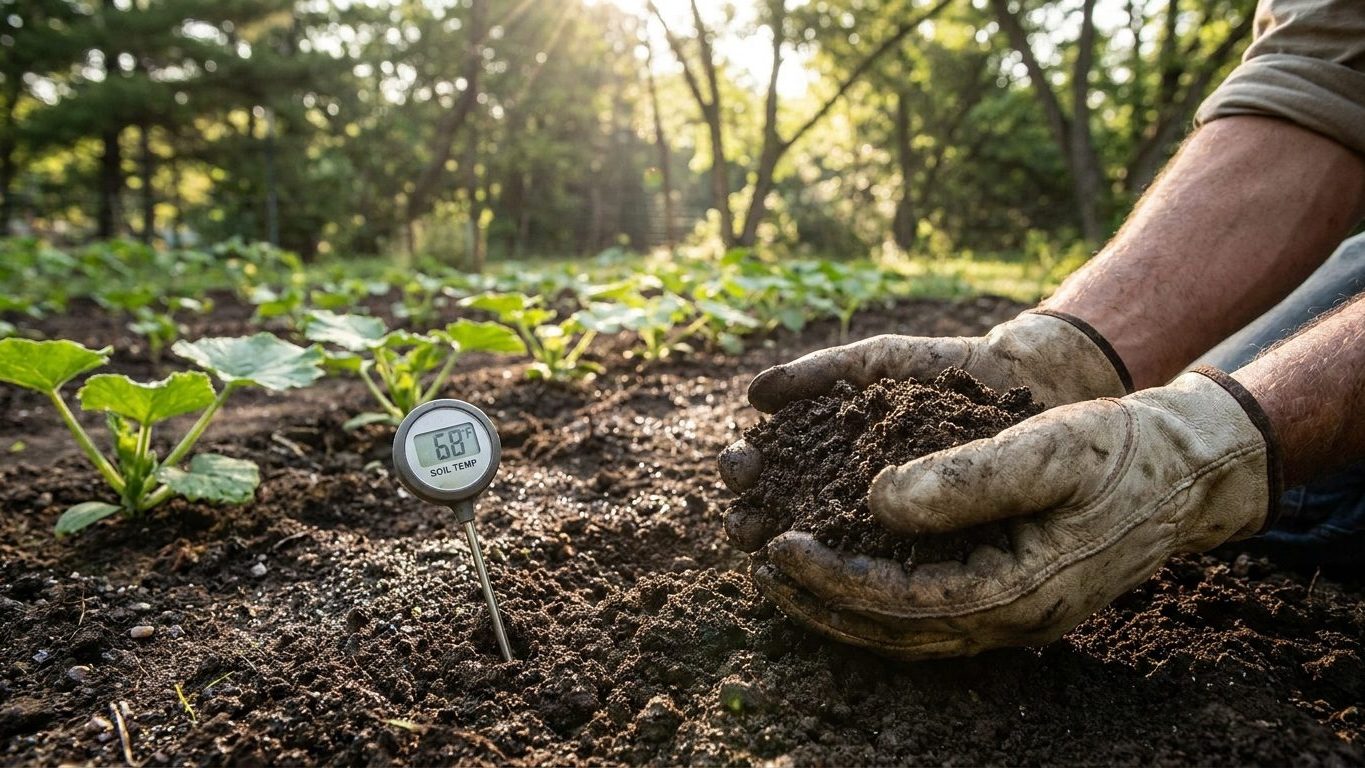

Winter squash goes into Indiana ground after the last spring frost has passed and the soil underneath has actually warmed, which for most of the state means mid-May through the first week of June. Direct seed or set out transplants once nighttime lows hold reliably above 50°F. Wait too long, though, and a slow-maturing variety can run straight into the first fall frost before it finishes sizing up. The window is real, but it shifts depending on where in Indiana you’re standing.
The short answer for Indiana
The frost-free window at the Indianapolis reference station runs from April 9 to April 21 on the early side to October 21 to October 30 on the back end, per NOAA’s 1991-2020 climate normals. Winter squash doesn’t get planted at the start of that window. Squash is a warm-season crop through and through, and seed sitting in soil still cold from winter simply rots before it germinates. The practical planting date sits two to four weeks after the last frost date, once soil temperature has caught up with the calendar.
What the frost dates actually measure
Those April and October dates aren’t a guarantee. They come from a 30-70% probability band for a 32°F freeze, which means even on the later end of the spring range there’s still a real chance of frost. Purdue’s own guidance flags roughly a 10% chance of a freeze event after the published spring date, which is exactly why gardeners who push transplants out on the early edge of that window keep row cover on hand. Nobody plants Winter Squash to beat the frost date. They plant it to beat cold soil, and the frost date is just the earliest point where that conversation even starts.
Counting backward from fall
Most winter squash varieties need somewhere in the range of 80 to 110 days from seed to harvest, depending on type. Counted back from the earlier end of the fall frost window (October 21), a 100-day squash needs to be in the ground by roughly mid-July at the absolute latest, and that’s cutting it close. In practice, the safer target is planting by early June, which gives even a slower variety a comfortable buffer before that first fall freeze shows up. Squash left on the vine when a hard freeze hits doesn’t recover; the vines collapse and unripe fruit stops developing.
What will not work here
Two things sink Winter Squash in Indiana more often than a late frost does: watering on a fixed weekly schedule, and planting too early hoping to squeeze out extra size.
Weekly watering during August
Indianapolis averages about 14.6 days a year at or above 90°F, which isn’t extreme heat by national standards, but it’s enough to push evaporation hard right when rainfall is thinnest. Summer rainfall averages 4.95 inches in June, 4.42 in July, and drops to 3.2 inches in August, the driest month of the growing season. A gardener watering on autopilot once a week runs into trouble precisely when squash vines are setting fruit and need the most consistent moisture. Rain that does fall in August tends to arrive as a single thunderstorm rather than a steady soak, which means a lot of it runs off instead of reaching the root zone. Watering by feel, not by calendar, matters more in Indiana’s August than in its June.
Planting before the soil is ready
Pushing seed into the ground right at the April 9 edge of the frost window is a common mistake. Air temperature clearing 32°F doesn’t mean soil temperature has followed. Squash seed sitting in cold, wet soil for two or three weeks before it germinates is far more likely to rot than to get a head start. The gardeners who plant in mid-April aren’t gaining time; they’re often reseeding in May anyway after the first attempt fails, which puts them behind where they’d have been just waiting.
Crowded rows in a humid summer
Indiana’s summer humidity, paired with that 3-inch-plus monthly rainfall, creates conditions where powdery mildew spreads fast on winter squash foliage. Spacing vines tightly to fit more plants into a small bed cuts off airflow between leaves, and damp leaves that don’t dry out by midday are exactly what mildew needs. Wider spacing costs garden space but buys disease resistance that no fungicide schedule fully replaces.
What changes across Indiana
Indiana isn’t one climate. The state spans USDA hardiness zones 5b to 7a, a genuinely wide range for a state this size, and that spread means there’s no single planting date that applies from the Ohio River to the Michigan line.
North versus south, in practice
Southern Indiana runs both ends of the calendar in its favor: spring frost clears earlier, and fall frost holds off later, by two weeks or more compared with the Indianapolis reference point used throughout this page. Northern Indiana runs the opposite direction, with a shorter frost-free season on both ends. The table below shows the general pattern, though the exact dates for any specific county come from the extension resource in the next section, not this one.
| Region | Relative hardiness zone | Spring frost timing | Fall frost timing |
|---|---|---|---|
| Southern Indiana | Warmer end, near 7a | Earlier than Indianapolis | Later than Indianapolis |
| Central Indiana (reference) | Mid-range | April 9 to April 21 | October 21 to October 30 |
| Northern Indiana | Cooler end, near 5b | Later than Indianapolis | Earlier than Indianapolis |
A gardener in the northern third of the state should treat the Indianapolis dates as an optimistic baseline and expect to push planting a week or two later, while a gardener near the Ohio River can often move a week or two earlier. This page can’t tell an individual reader which zone their own property sits in. The USDA Plant Hardiness Zone Map does that, using average annual extreme minimum temperature as its single measure, and it’s worth checking against a specific address rather than guessing from a county name.
Where to check this for your own county
Everything above comes from a single reference station in Indianapolis, and Indiana is a big enough state that a county-level recommendation will beat this state-level page every time. Purdue Extension is the source to check next, and it’s worth going in with a specific question rather than browsing broadly.
What to actually look for once there
Two things matter most. First, look for a county-specific planting calendar, which will adjust the frost dates used on this page for local microclimate, whether that’s a river valley that runs a bit warmer or a higher elevation pocket that runs cooler. Second, look for variety trial results specific to the region, since Purdue’s county offices track which winter squash varieties actually performed well locally against powdery mildew, squash vine borer, and the wet-then-dry rainfall pattern common across the state. A state-wide page like this one can describe the mechanism (frost timing, heat load, rainfall pattern) but can’t tell you that Butternut outperformed Acorn in your specific county’s trial plots last season. That’s exactly the kind of detail a county extension office keeps track of.
Bringing a soil sample or a photo of a struggling plant to a local extension office visit tends to get a more useful answer than a phone call alone, since local agents are working from the same climate normals but layered with years of on-the-ground observation.
If you follow the almanac, here is when to plant winter squash by the moon. It is a tradition, not a proven method.
Checking this against your own garden
Every date on this page is a normal, built from thirty years of averages at one weather station. A reader’s own garden will diverge from that average in one direction or the other, and three simple observations settle the question better than any calendar.
Three things to watch
Soil warmth by hand tells the real story before any thermometer would. Squash seed wants soil that feels warm to bare skin held a few inches down, not just air that’s stopped frosting. If the soil still feels cool and damp rather than warm and slightly dry at the surface, waiting another week costs nothing and saves a reseeding.
The first flush of male flowers, which squash plants produce before the female flowers that actually set fruit, signals that the plant has moved from vegetative growth into reproductive mode. Seeing males appear early in a cool, wet stretch is a sign the plant is stressed and rushing rather than thriving, which often means the bed needs more consistent watering or better drainage rather than more fertilizer.
First true leaves, the second set that emerges after the initial round of seed leaves, show how fast the plant is actually growing under this particular garden’s conditions, sun exposure, and soil. A slow gap between seed leaves and true leaves in a garden that’s otherwise following the calendar on this page usually points to a specific microclimate issue, shade from a nearby structure, compacted soil, or a low spot that stays wetter than the rest of the yard, worth tracking down before the same bed gets planted again next year.