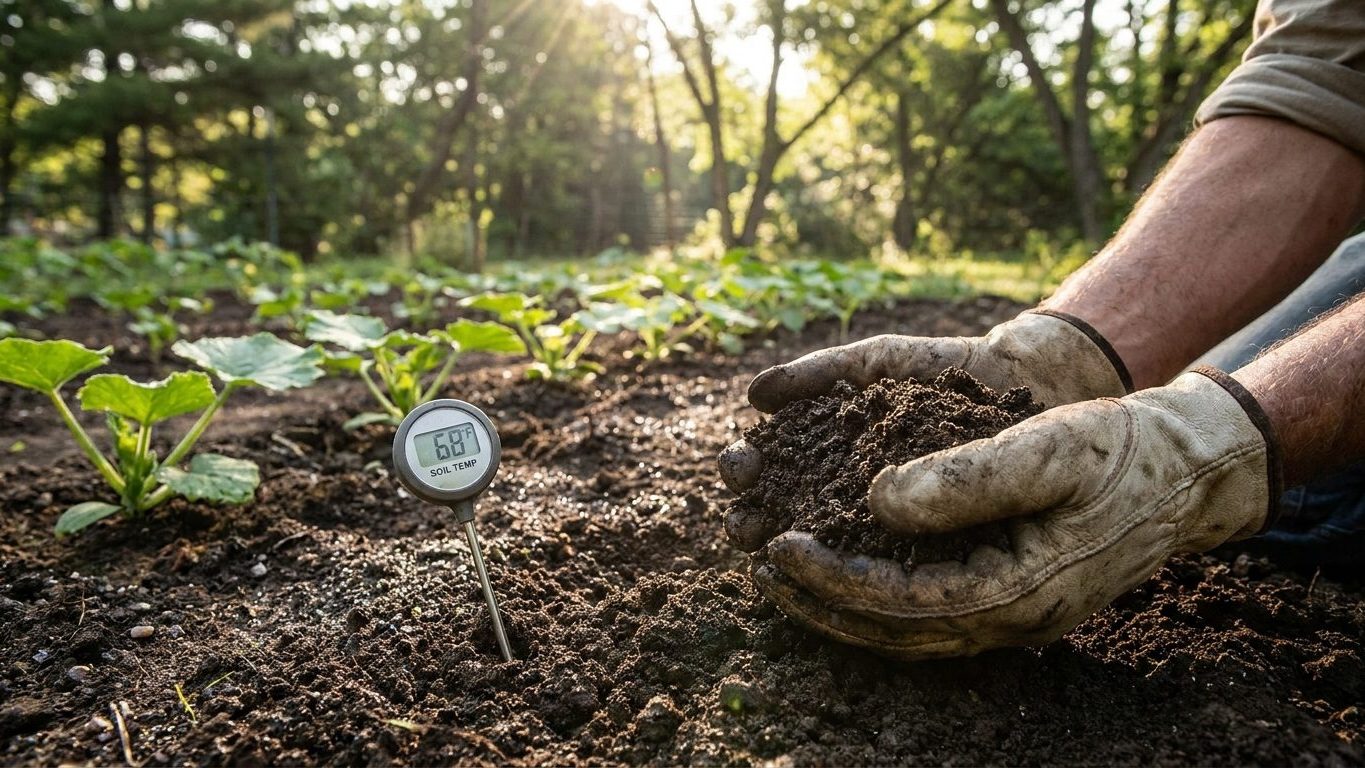

Direct-seed Winter Squash in Kansas once the soil has warmed well past the last spring frost window, generally from late April into May depending on where you garden in the state. Harvest needs to wrap up before the first fall frost lands sometime between October 23 and November 2. Everything else is local detail.
The short answer for Kansas
The last spring frost at the Wichita reference station falls somewhere between April 4 and April 18, based on NOAA’s 1991-2020 climate normals. That range isn’t a hard deadline. It’s a probability band: April 4 marks the point where a 32°F freeze still has roughly a 70% chance of showing up again, and by April 18 the odds have dropped to about 30%. Squash seed doesn’t care about probabilities, though. It cares about soil temperature, and cold, wet ground rots seed before it ever sprouts. That means the practical sowing window sits a little past the frost date itself, usually landing in the first half of May for most of the state, once soil has had a couple of warm, sunny weeks to shake off winter.
On the back end, the first fall frost arrives between October 23 and November 2, same station, same method. That’s also a probability band, not a hard stop, but it’s the number that should anchor your harvest planning. Winter squash needs its skin to cure and harden on the vine before a hard freeze hits, and rinds that haven’t toughened up don’t store. Count backward from late October, not from Halloween, if you want a safety margin.
Stacked together, those two windows give Kansas gardeners something close to six months of frost-free growing at the reference station, plenty of room for winter squash, which doesn’t demand a marathon season the way some tropical crops do. The constraint here isn’t really season length. It’s what happens in the middle of that window, when Kansas summer heat and rainfall patterns start working against the plant. That’s the part the frost dates alone won’t tell you, and it’s the subject of the next section.
One more caution worth repeating: these dates come from a single airport weather station. Suburban yards and rural gardens away from that station typically see later spring frosts and earlier fall frosts, sometimes by one to two weeks, and even more if there’s elevation involved. Treat April 4 to April 18 and October 23 to November 2 as the state’s reference figures, not a guarantee for your particular yard.
What will not work here
Weekly watering is the most common failure point for winter squash grown in Kansas summers. The reference station averages 57.6 days a year at or above 90°F, and that kind of heat load pulls moisture out of soil and leaves fast, especially during pollination and fruit set. A single soaking once a week might carry a squash plant through a mild June, but by the time July’s 3.98 inches of rain (the driest month of the summer stretch) has to compete with nearly two months of 90-degree-plus days, that same schedule leaves plants stressed, dropping blossoms, and producing undersized fruit.
Rainfall totals don’t tell the whole story either. Summer rain across June, July and August adds up to about 13.2 inches, spread unevenly, and a lot of it likely arrives as short, heavy thunderstorms rather than steady soaking rain. Water that falls that way tends to run off rather than sink in, particularly on compacted or clay-heavy Kansas soils, which means the rain gauge can show a decent monthly total while the root zone stays dry underneath. Sandy soils fail differently: they let that same downpour drain through within hours, so a sandy garden in a dry July can need watering every other day even in a summer with average rainfall.
Spacing and disease pressure
Cramming winter squash into tight spacing is another common mistake here. When the concentrated summer storms hit and leave standing humidity behind, close-planted vines don’t dry out fast, and that damp, still air between leaves is exactly what powdery mildew and other fungal problems need to take hold. Wide spacing with real airflow between hills matters more in a state with this rainfall pattern than it would somewhere with steady, gentle summer rain.
Planting too early is the third failure mode. Squash seed sown right at the edge of the April 4 frost date, before soil has genuinely warmed, sits cold and wet and rots more often than it germinates. Waiting an extra week or two into that window costs almost nothing given how much frost-free season the state has to work with, and it dramatically improves germination odds.
What changes across Kansas
Kansas spans USDA hardiness zones 5b through 7a, a span built on one variable: average annual extreme minimum winter temperature. That’s a two-zone gap across a single state, and it means there’s no single planting date that fits Wichita, the high plains of the northwest, and the milder southeast equally well. A zone 5b garden in the northwest corner or at higher elevation is working with a meaningfully colder winter minimum than a zone 7a garden farther south and east, and that difference tends to show up as a later last frost and an earlier first frost in the cooler zone.
Practically, that means a gardener in the cooler, higher-elevation parts of the state should treat the state’s frost windows as a starting point and expect to shift both ends inward: plant later in spring, and plan to harvest earlier in fall, than the Wichita reference dates suggest. A gardener in the milder southeast may find they have a bit more room on both ends of the calendar.
Rather than guess which zone applies to a given backyard, the right move is to check the USDA Plant Hardiness Zone Map directly for the specific location. Zone boundaries in Kansas don’t run in a neat east-west line, and factors like elevation and local terrain can push a property into a different zone than its neighboring county.
Where to check this for your own county
Kansas State Research and Extension, at ksre.k-state.edu, is the place to go for a recommendation built around your specific county rather than the state as a whole. A state-level page like this one can only work from reference-station averages and USDA zone ranges. County extension offices work from local trial data, local frost records, and years of feedback from gardeners in that exact area, which is a different level of precision.
Once there, look specifically for two things. First, the local planting calendar for vegetables, which will translate the general frost-date logic in this article into dates tuned to your county’s actual weather history rather than the airport-station numbers cited here. Second, look for any list of winter squash varieties that extension agents have trialed in your region. Kansas conditions vary enough, between the heat and rainfall differences already described, that a variety performing well in one part of the state can struggle in another, and county-level trial results are the most reliable way to know what’s actually been tested nearby.
A county recommendation beats a state one every time, because it accounts for local soil, local rainfall patterns, and local frost timing in a way a statewide page structurally cannot. This article gives you the mechanism and the reference numbers; your county extension office gives you the number tuned to your yard.
The Moon calendar is a separate, older custom: see when to plant winter squash by the moon, written as tradition rather than fact.
Checking this against your own garden
No calendar, including this one, outranks what’s actually happening in your own soil. Three simple observations tell you more about your specific microclimate than any published frost date.
Start with soil warmth, checked by hand rather than a thermometer. Push your fingers a couple of inches into the planting bed in mid-morning, after the sun’s had time to work on it. If the soil still feels cool and damp rather than warm and slightly dry, winter squash seed sitting in it is more likely to rot than sprout, regardless of what the calendar says the date is.
Next, watch for the first male flowers once plants are growing. Squash produce male blossoms before female ones, and a strong early flush of males, followed later by female flowers with a small swelling at the base, is a sign your plants are tracking normally for your particular yard’s heat and light conditions. A long gap between the two, or male flowers dropping without any females following, often points to heat stress during a run of hot days, which is worth noting for how you water the following week.
Finally, look at how fast true leaves develop after the first seed leaves open. Quick, sturdy true-leaf growth signals good soil warmth and adequate moisture. Slow, pale, or stunted true leaves usually mean the soil was still too cool when you planted, or that moisture is inconsistent, both of which are worth correcting before the next round of seed goes in the ground.