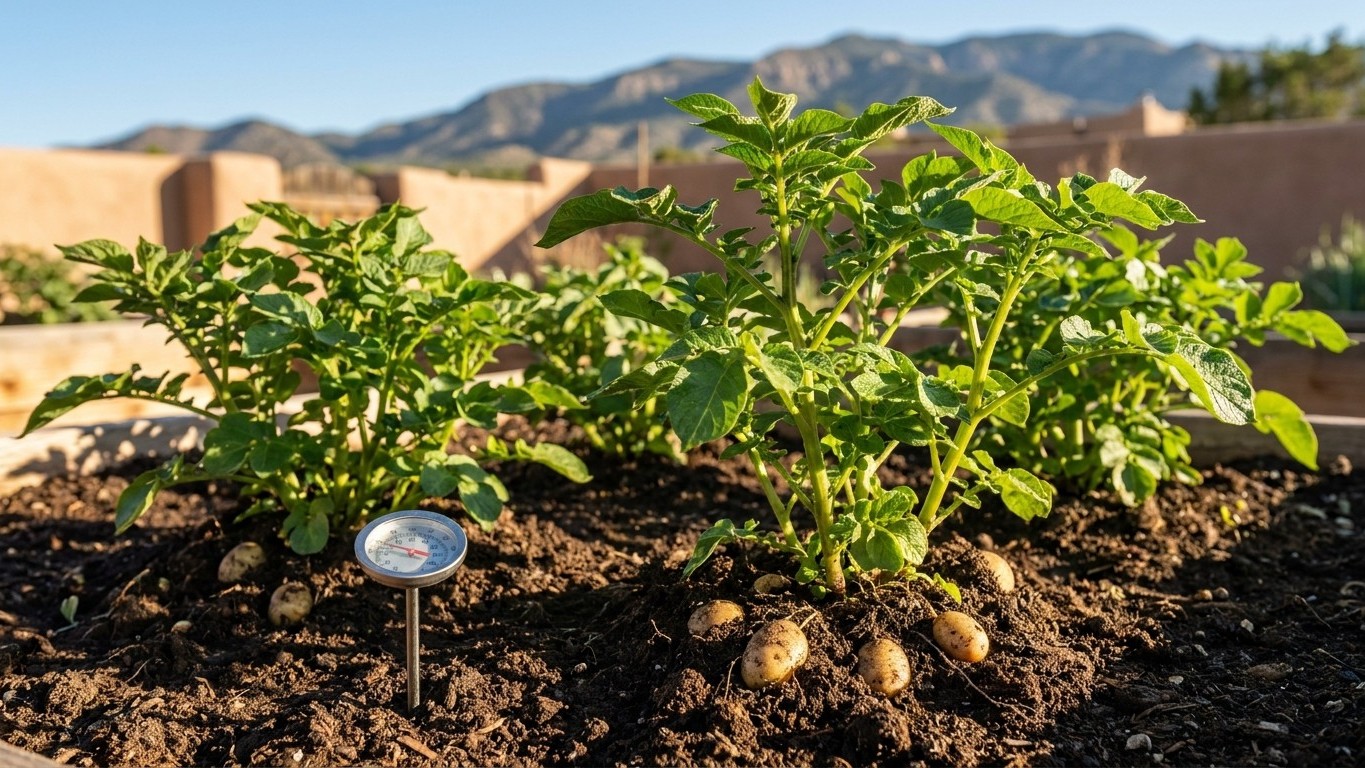

The short list for Massachusetts potato patches comes down to two names: Colorado potato beetle, the one doing almost all the damage, and European corn borer, which shows up as an occasional stem invader. Everything else UMass Extension documents in the state targets other crops entirely. Timing follows the frost-free window, which opens between April 1 and April 8 around Boston.
Which pests attack potato in Massachusetts
UMass Extension documents ten insects as present and worth watching for in Massachusetts vegetable gardens: Cabbage root maggot fly, Colorado potato beetle, European corn borer, Lily leaf beetle, Mexican bean beetle, Spotted lanternfly, Squash bug, Squash vine borer, Striped cucumber beetle, and Winter moth. That’s the full documented list for this territory, and it isn’t a potato-specific list. Most of it has nothing to do with a potato bed.
Cabbage root maggot fly goes after brassicas, the cabbage and broccoli family, laying eggs at the base of those stems, not potato hills. Lily leaf beetle is a lily and fritillary specialist, a flower-bed problem, not a vegetable-row one. Mexican bean beetle wants bean foliage. Squash bug, squash vine borer, and striped cucumber beetle are all cucurbit feeders, meaning squash, cucumber, melon, pumpkin, none of which resemble a potato plant closely enough to matter. Spotted lanternfly prefers tree of heaven, grapevines, and hardwood bark, and while it’s a serious concern for orchards and vineyards, it has no documented relationship to potato foliage here. Winter moth caterpillars strip the new leaves of fruit trees and oaks in spring; potato hasn’t emerged yet when that damage happens.
That leaves Colorado potato beetle as the pest that actually defines a Massachusetts potato season, with European corn borer as a secondary, less frequent problem when its larvae tunnel into potato stems rather than corn stalks. The error worth avoiding is assuming every insect on a state’s documented list is a threat to whatever you happen to be growing. A pest list is a regional inventory, not a diagnosis for one crop.
Colorado potato beetle is the one to know by sight: a rounded, hard-shelled beetle about a third of an inch long, cream to yellow-orange with five bold black stripes running down each wing cover. Its larvae are soft, humped, brick red to orange grubs with rows of black spots along the sides, and they do more leaf damage per capita than the adults. European corn borer larvae, by contrast, are rarely seen on the surface; they work inside the stem, which makes them a much harder call to make from a quick glance at the plant.
When each one shows up, and what it does first
Colorado potato beetle overwinters as an adult in the soil, usually at the edge of last season’s garden or a nearby fencerow, and it doesn’t move until the ground warms enough to wake it up. That timing tracks the frost-free window, which opens between April 1 and April 8 near Boston and later than that farther inland and in the Berkshires. Adults walk or fly short distances to the first potato foliage they find once soil temperatures climb, so the earliest sign in a Massachusetts garden is usually a beetle sitting openly on a young leaf, not hidden, not shy about it.
The first real damage shows up as small, ragged holes chewed through young leaves, concentrated near the growing tips where the tissue is tender. Within a couple of weeks those same beetles lay clusters of bright orange-yellow eggs on the undersides of leaves, and the larvae that hatch from them do the heavier feeding, stripping leaf tissue down to the veins if the population goes unchecked. A hill that looked full and green can look skeletal within days once larvae reach their later stages, because their appetite scales up fast as they grow.
European corn borer follows a different script. Its moths fly at night and lay egg masses on the underside of leaves, and the larvae that hatch bore directly into stems rather than chewing external leaf tissue first. The first visible sign isn’t a hole in a leaf; it’s a stem that wilts or snaps for no obvious reason, sometimes with a small entry hole and a bit of sawdust-like frass near the wound. Because the damage happens inside the plant, it’s usually noticed later than Colorado potato beetle feeding, often only after a stem has already gone down.
Neither pest waits for a calendar month. Both wait for temperature, moisture, and the plant’s own growth stage, which is why anchoring expectations to the frost-free window matters more than remembering a specific week from a previous year.
Telling the damage apart from everything else
A ragged, skeletonized leaf isn’t automatically an insect problem, and treating it as one before checking the alternatives wastes time and, sometimes, money on a treatment aimed at the wrong cause. The single habit that prevents most misdiagnoses is turning the leaf over before deciding anything. Insect feeding almost always leaves a visible actor, either the insect itself, its eggs, its frass, or a chewed edge with a clear direction. Disease and stress damage rarely do.
| What you see | Likely cause | What separates it |
|---|---|---|
| Round to ragged holes in leaves, beetle visible | Colorado potato beetle | Adults or striped larvae present on the leaf itself, often with orange egg clusters underneath |
| Stem wilts suddenly, small hole near a node | European corn borer | Frass near the entry hole; cutting the stem open reveals a tunnel and a larva |
| Yellowing between leaf veins, older leaves first | Nutrient deficiency | No chewing pattern, no insects present, spreads gradually rather than overnight |
| Leaf edges brown and crisp, whole plant wilts midday | Drought stress | Follows a dry stretch, affects the whole plant evenly, no localized chewing |
| Dark, concentric rings on leaves, spreading upward | Early blight or another foliar disease | Lesions have a target-ring pattern and spread from lower leaves up, not scattered chew marks |
| Broken stems, bruised tubers near hilling rows | Mechanical damage from cultivation | Damage lines up with the hoe or tiller path, not scattered randomly across the row |
None of this replaces an actual look at the plant in hand. If the symptom doesn’t clearly match one of these patterns, or if two seem to overlap, the county Extension office is built for exactly that call, and a photo plus a description of when the damage appeared is usually enough for them to work with.
What actually works here, and what is a waste of time
On a growing season bounded by a spring frost-free date that opens between April 1 and April 8, timing does more work than any single treatment. Hand-picking adult beetles and crushing egg clusters in the first two to three weeks after plants emerge prevents most of the damage that would otherwise come from the larval generation. It’s tedious, but it’s the single highest-leverage action available, because a female beetle removed before she lays eggs is a whole generation that never happens.
Row covers, floating fabric laid directly over the row, work well against Colorado potato beetle if they go on before the bed emerges and adults have a chance to walk in from the soil edge or fly in from a neighboring plot. Put the cover on after beetles are already established under it, and all it does is protect the insect from predators while it eats undisturbed. Crop rotation matters too: moving potatoes to a different part of the yard each year forces overwintering adults to travel farther to find food, and distance alone knocks down survival rates.
Certified seed potatoes deserve a plain mention here, separate from insect control: uncertified seed can carry viruses that no amount of pest management will fix once they’re in the plant. It’s a one-time decision made at planting, not a season-long chore, which makes it cheap insurance relative to everything else on this list.
What doesn’t help: broad insecticide use without confirming which pest is actually present, since a product aimed at a chewing beetle won’t touch a borer tunneling inside a stem, and vice versa. Guessing wastes a treatment window that, on a short Massachusetts season, doesn’t come around twice. This site doesn’t recommend specific products or active ingredients; what’s labeled and legal to use in Massachusetts changes, and that call belongs to UMass Extension, not a general gardening article.
Where to check this for your own county
UMass Extension is the authority behind everything documented on this page, and it runs county-level offices that track what’s actually active in a given part of the state in a given week, which a statewide list can’t do. The one figure worth writing down is the frost-free window itself, April 1 to April 8, because it’s the anchor for every other date on this page, and it applies to the Boston area specifically, not the whole state. Inland counties and the Berkshires run behind that window, sometimes by several weeks, which shifts every insect’s emergence date along with it.
A pest documented for Massachusetts as a whole doesn’t mean it’s present in every county, every yard, or every season at the same intensity. Local conditions, including how close the nearest overwintering site is, how mild the previous winter ran, and what was planted in that same soil the year before, all move the needle. The state list says what’s possible; it doesn’t say what’s in one particular garden.
The practical next step is contacting the county office of UMass Extension directly, ideally with a photo of the insect or the damage and a note on when it appeared relative to the last frost. That combination, image plus timing, is what lets an Extension specialist narrow a guess down to a confirmed identification, rather than working from a symptom description alone.
Common questions
Does Colorado potato beetle attack tomatoes too?
It can. Colorado potato beetle feeds on other plants in the same family as potato, and tomato is one of them, though potato foliage is usually its first and preferred target in a mixed garden.
Do I need to worry about Colorado potato beetle before plants emerge?
No. Adults need foliage to feed on, so there’s nothing for them to attack until the plants are up. The relevant window starts once potato leaves are actually visible above the soil, which follows the frost-free date rather than a fixed calendar day.
Is European corn borer damage reversible once it’s inside a stem?
Not for that stem. Once a larva has tunneled in, the affected stem is usually a loss. Prevention through timing and monitoring for egg masses on leaf undersides matters more than any response after the fact.
Why isn’t spotted lanternfly on the potato-pest list if it’s such a big concern in Massachusetts?
It’s documented in the state, but its host preferences run to tree of heaven, grapevines, and hardwood trees, not garden vegetables. It’s a real concern for orchards and vineyards, just not for a potato bed specifically.