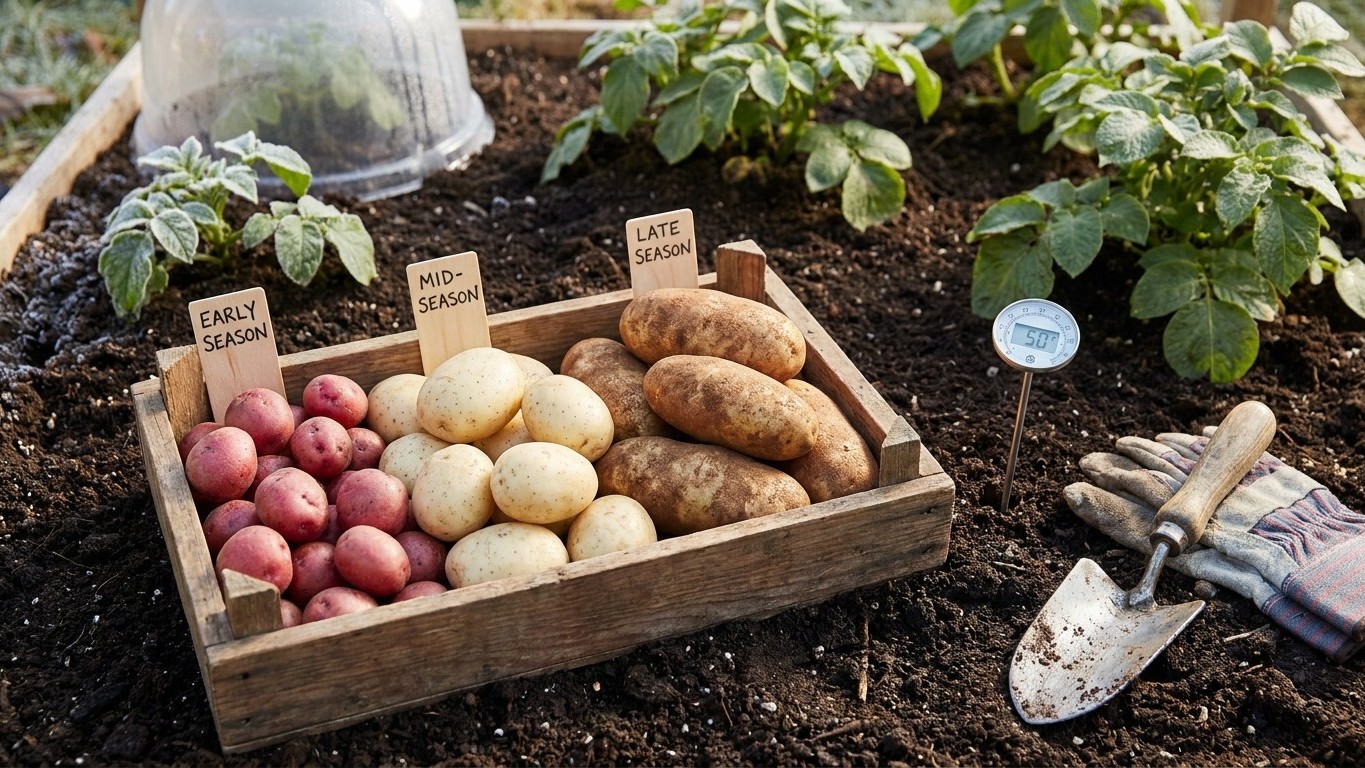

Massachusetts gardeners do best matching potato season class, not brand name, to their local frost window. Early and mid-season types fit the state’s spring planting slot before summer heat shuts down tuber sizing; late types work only where soil stays cool longest, mostly the Berkshires and the Connecticut River Valley’s cooler pockets. The variety that “suits” the state is really the one whose season class fits the calendar you’re planting into.
The short answer
Boston’s last spring frost falls between April 1 and April 8, based on the 32°F freeze-probability window in NOAA NCEI’s 1991-2020 Climate Normals for the Logan Airport station. That date matters less than what it triggers: potatoes go into the ground once soil hits 50°F, which lands 14 to 21 days before that last frost date, according to the University of Maine Cooperative Extension’s Bulletin #2077 and Utah State University Extension’s potato fact sheet. For a Boston-area garden, that puts planting somewhere in mid-to-late March, tubers already in the soil while frost risk is still real. Potatoes tolerate a light frost on emerging foliage far better than they tolerate late planting.
Here’s the part that actually decides which varieties suit the state: tuber set and fill stall once soil temperature climbs above 90°F. Watering doesn’t reverse it. Once that ceiling hits, the plant is done sizing tubers for the season regardless of how much top growth still looks healthy. Massachusetts summers push soil past that mark in most of the state by mid-summer, especially in the Connecticut River Valley and southeastern lowlands where sandy soil heats fast. That’s the mechanic that should drive variety choice, more than any list of names.
Practically, this favors early and mid-season classes for most of the state. An early-season potato sets and fills its tubers while spring soil is still cool, finishing before the heat ceiling becomes a factor. Mid-season types need a slightly longer cool window but still generally beat the worst of summer heat if planted on schedule. Late-season types need soil to stay below that 90°F ceiling for a much longer stretch, which is why they’re a better bet in the Berkshires or other high-elevation, slower-to-heat ground than in Boston, Worcester, or the South Coast.
Neither Utah State nor the University of Maine publishes a days-to-maturity number for named varieties, and no reliable one exists here, so this page won’t invent one. What both extensions do publish is the season class itself: early, mid-season, or late. Use that classification, plus your county’s typical soil-warming pattern, to choose. If you’re gardening in a warmer, coastal pocket that reaches 90°F soil early and often, lean early-season. If you’re at elevation in Berkshire County where soil stays cooler into summer, mid-season or late-season varieties have more room to finish properly.
What actually decides it
Soil temperature at planting, not the calendar date
The planting trigger is 50°F soil, not a date on a seed packet. That threshold arrives 14 to 21 days before the last spring frost date, per University of Maine Extension guidance echoed by Utah State’s fact sheet. In a Boston-area garden with a last-frost window of April 1 to April 8, that pushes the soil-ready window into mid-to-late March most years. But soil temperature is local: a south-facing raised bed in Springfield can hit 50°F well before a shaded, poorly drained plot ten miles away. Check the soil itself with a thermometer pushed 4 inches down rather than trusting a date from a chart built for a different yard.
The 90°F soil ceiling that no amount of watering fixes
Once soil temperature crosses 90°F, tuber set and fill stop. This is a biological limit, not a moisture problem, and it’s the single mechanism that should govern which season class a Massachusetts gardener plants. A late-season variety planted normally in a warm, sandy, low-elevation spot may still be trying to size tubers when soil crosses that ceiling in mid-summer, and no amount of irrigation reverses the stall. An early-season variety, by contrast, has usually finished sizing before soil gets anywhere near 90°F. This is why the right variety for a Cape Cod sandy loam garden and the right variety for a Berkshires hillside garden aren’t the same, even though both are in Massachusetts.
Elevation and soil type change the local ceiling date, not the 90°F number itself
The 90°F threshold doesn’t move. What moves is how fast a given plot reaches it. Sandy, south-facing, low-elevation ground in the Connecticut River Valley or South Coast warms fast and can hit that ceiling well before similar ground at elevation in Berkshire County, where cooler nights and heavier soil hold the line longer into summer. That’s the reasoning a gardener needs to apply to any Massachusetts spot this page never names directly: check how hot and how fast the local soil runs, then pick a season class that can finish its tuber-fill window before that local ceiling arrives.
How to do it
- Check your own soil temperature at a 4-inch depth starting in early March, rather than relying only on the regional frost-date window.
- Plant once soil reaches 50°F, which typically falls 14 to 21 days before your local last spring frost date; for the Boston area, that frost date runs April 1 to April 8 per NOAA NCEI Climate Normals for the Logan station.
- Choose an early or mid-season variety for most Massachusetts locations, since these classes are more likely to finish tuber set and fill before soil crosses the 90°F ceiling in summer.
- Reserve late-season varieties for higher-elevation or consistently cooler ground, such as parts of the Berkshires, where soil is slower to reach that 90°F mark.
- Buy certified seed potatoes rather than saved or grocery-store tubers; uncertified seed carries virus that no amount of good soil management corrects later in the season.
- Match variety selection to intended use rather than texture labels: choose a potato published as suited for baking if that’s the goal, or one published as suited for boiling if that’s the goal, since neither Utah State nor Maine Extension classifies potatoes as “waxy” or “floury.”
- Monitor soil temperature again in early-to-mid summer; if it’s tracking toward 90°F while tubers are still small, plan your harvest timing around that ceiling rather than expecting late growth to catch up.
What goes wrong
- Planting a late-season variety in a fast-heating, low-elevation garden. The plant runs out of cool soil before it finishes sizing tubers. Remedy: switch to an early or mid-season class, or move the planting to the coolest, most shaded plot available on your property.
- Waiting for a calendar date instead of checking soil temperature. Soil in a raised bed or south-facing slope can hit 50°F well ahead of the general frost-date window, while a low, shaded spot lags behind it. Remedy: use a soil thermometer at 4 inches rather than a printed date.
- Using saved tubers or grocery-store potatoes as seed. Uncertified seed frequently carries virus that reduces vigor and yield, and the problem doesn’t show clearly until the season is already underway. Remedy: buy certified seed potatoes every season.
- Assuming watering can rescue a crop once soil passes 90°F. Tuber set and fill are inhibited by heat itself, not by dryness, so irrigation doesn’t restart sizing once the ceiling is crossed. Remedy: plan for the ceiling in advance by choosing an early-season class and planting as soon as soil hits 50°F, rather than trying to fix the problem in July.
- Picking a variety by texture words like “waxy” or “floury.” Those terms aren’t part of the published guidance used here. Remedy: choose based on the stated use, baking or boiling, from Utah State or University of Maine Extension material.
- Treating one Massachusetts frost date as valid for the whole state. The April 1 to April 8 window is specific to the Logan Airport station and the state’s mildest coastal conditions; inland and higher-elevation gardens run later in spring and earlier in fall. Remedy: use the regional figure as a starting reference only, then confirm with your own soil temperature readings.
Common questions
Do early-season potatoes really matter more in Massachusetts than in other states?
The mechanism is the same everywhere: soil above 90°F stops tuber sizing, per Utah State University Extension and University of Maine Cooperative Extension. What changes is how fast Massachusetts soil reaches that point, which is why matching season class to your local warming pattern matters more here than following a generic national variety list.
Is the April 1 to April 8 frost date accurate for my town if I don’t live near Boston?
No. That window comes from NOAA NCEI Climate Normals for the Logan Airport station specifically, and it represents the mildest, most coastal conditions in the state. Inland towns and higher elevations, including much of the Berkshires, see later last-frost dates in spring, so soil there also reaches 50°F later.
Can I still grow a late-season potato in a warm part of the state?
You can, but the 90°F soil ceiling makes it riskier. If your garden reliably warms fast in summer, an early or mid-season class is more likely to finish tuber set and fill before that ceiling hits. Late-season classes fit better where soil stays cooler for longer, such as at elevation.
Why does certified seed matter so much for potatoes specifically?
Potatoes are propagated from tubers, not seeds in the botanical sense, so any virus present in a saved or store-bought tuber carries directly into next season’s plant. Certified seed potatoes are inspected specifically to keep that virus load out of your garden from the start.