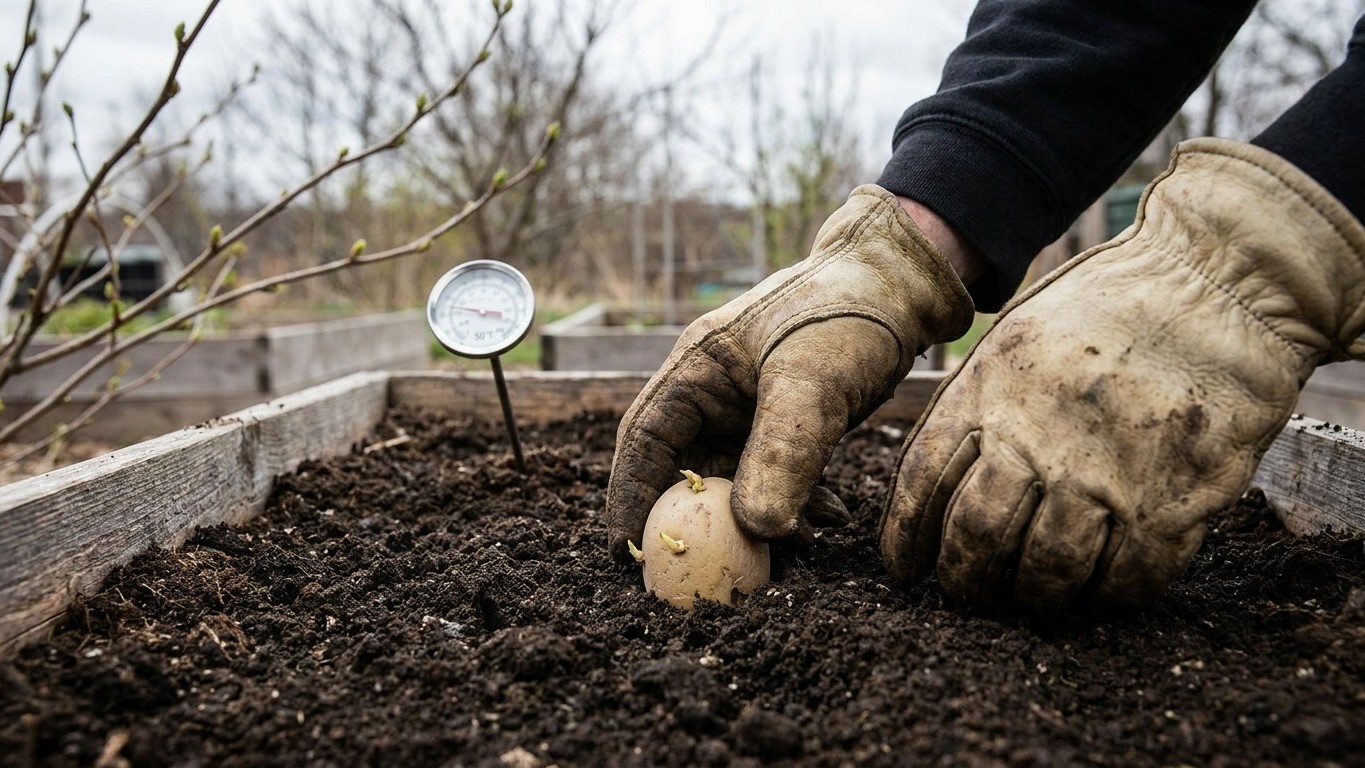

Plant potatoes in Massachusetts when soil temperature hits 50°F, which lands roughly 14 to 21 days before the last spring frost. For the Boston area, where NOAA NCEI’s 1991-2020 Climate Normals put the last spring freeze between April 1 and April 8, that puts most seed potatoes in the ground in mid to late March. Inland and western Massachusetts run later.
The short answer
For the Boston reference station (NOAA’s Logan Airport site, USW00014739), the 1991-2020 Climate Normals place the 30 to 70 percent probability window for a 32°F freeze between April 1 and April 8. That’s the last-frost anchor for eastern Massachusetts, and it’s the number every other date on this page counts backward from.
Potatoes don’t wait for that frost date, though. Utah State University Extension and the University of Maine Cooperative Extension (Bulletin #2077) both describe the same planting rule: get seed potatoes into the ground as soon as the soil reaches 50°F, which typically falls 14 to 21 days ahead of the last frost. Counting back from April 1 to April 8 puts that window at roughly March 11 to March 25 for the Boston area. Potato foliage tolerates a light frost far better than the seed piece cares about air temperature; it’s soil temperature that starts the clock.
That’s the eastern Massachusetts number, and it comes with a real caveat. Logan is a waterfront, urban station and the mildest spot in the state. It doesn’t represent the Berkshires, the Pioneer Valley, or even many suburban yards twenty miles inland, where cold air pools on clear nights and soil warms slower in spring. If you garden outside the immediate Boston area, treat April 1 to April 8 as an early-side reference, not your personal date. Push your own planting window later, and check your soil with a thermometer rather than a calendar.
The other half of the answer is what happens at the other end of the season. Massachusetts summers routinely produce stretches of soil temperatures above 90°F, and both extension sources are blunt about what that does to a potato plant: tuber set and fill shut down. Watering more doesn’t reverse it. That heat ceiling is why the planting date matters as much as it does, because it decides whether your crop finishes sizing before the hot weeks arrive or gets caught mid-season with soil too warm to keep bulking.
What actually decides it
Two separate thresholds run this whole decision, and they pull in opposite directions. One tells you when it’s safe to plant. The other tells you how much time you actually have before the crop stalls out. Neither is optional, and a gardener who tracks only the frost date is missing half the picture.
Soil temperature, not air temperature, starts the season
The 50°F soil threshold from Utah State and University of Maine Extension is a biological switch, not a weather forecast. Seed pieces sitting in soil colder than that don’t grow, they rot, because cold, wet soil is exactly the condition that favors the fungi and bacteria that attack a cut seed piece before it can callus and sprout. That’s why the guidance is soil temperature at planting depth, typically a few inches down, not the air temperature on the day you feel like gardening. A warm afternoon in early March can feel like planting weather while the soil eight inches under a mulched bed is still in the 40s. A soil thermometer pushed into the bed removes the guesswork, and it’s the only way to know you’re actually inside that 14-to-21-day window ahead of your local last frost, whatever that local date turns out to be.
The 90°F heat ceiling caps the other end
Tuber formation is a cool-soil process. Once soil temperatures climb above 90°F, according to Utah State University Extension, the plant stops setting and filling tubers regardless of how much water or fertilizer it gets. This is the mechanism that should govern how a gardener reads any given territory’s summer heat pattern. In a location where 90°F soil days come often and early, the strategy isn’t to plant later and hope for a longer cool stretch. It’s to plant as early as the 50°F soil threshold allows, so the bulk of tuber growth happens before the heat arrives, and to treat the harvest as a spring crop rather than a summer one. Where summers stay milder, that ceiling matters less, and the planting window has more flexibility on the late side. This is also why a single statewide date is close to useless: the reference city’s frost date only sets one boundary, and the local summer heat pattern sets the other.
How to do it
- Find your local last spring frost date. For the Boston area, NOAA NCEI’s 1991-2020 Climate Normals put the 30 to 70 percent probability window at April 1 to April 8. If you’re inland or in the Berkshires, expect your own date to run later; this page does not publish a figure for those areas.
- Count back 14 to 21 days from that date to establish your target planting window, per Utah State University Extension and University of Maine Cooperative Extension guidance.
- Check actual soil temperature at planting depth with a soil thermometer rather than relying on the calendar. Plant once the reading holds at 50°F, not before.
- Buy certified seed potatoes rather than saving grocery-store tubers or last year’s uncertified stock. Uncertified seed carries viruses that build up in the tuber and weaken every generation grown from it; certification is the one safeguard against that.
- Choose a variety by season class, early, mid-season, or late, based on how much cool growing time your site typically offers before summer soil heat sets in, and by intended use, since Utah State and University of Maine Extension publish end use (baking, boiling) rather than texture labels.
- Cut larger seed potatoes into pieces with at least one eye each, and let the cut surfaces callus for a day or two before planting, reducing rot risk in cool soil.
- Plant seed pieces at the depth and spacing recommended by your extension service, then hill soil around the emerging stems as they grow to keep developing tubers covered and shaded from direct heat.
- Track your local summer soil temperatures as the season progresses. Once readings approach 90°F, understand that tuber sizing has effectively stopped, which should shape your harvest timing rather than prompt extra watering or fertilizing.
What goes wrong
- Planting by the calendar instead of the soil. A gardener plants on a fixed date because “that’s when you plant potatoes,” without checking soil temperature. If the ground is still below 50°F, the fix is simple: wait, and confirm with a thermometer before committing seed pieces to cold, wet soil.
- Treating Boston’s frost date as a statewide number. The April 1 to April 8 window comes from a single waterfront station at Logan Airport, the mildest spot in Massachusetts. Gardeners inland or in the Berkshires who plant on that date often lose seed pieces to a later, harder frost or colder soil than the coastal number implies. The remedy is to treat this date as an eastern Massachusetts anchor only, and adjust later for any location further from the coast.
- Using uncertified seed potatoes. Tubers from a grocery store or saved from an untested planting can carry viruses invisible at planting time that stunt the whole crop. Buying certified seed potatoes each season is the direct fix, not a maybe.
- Ignoring the summer heat ceiling. A gardener sees slowing growth in midsummer and responds with more water and fertilizer, assuming stress. If soil temperatures have crossed 90°F, per Utah State University Extension, that response does nothing, because tuber set and fill are inhibited by the heat itself. The remedy isn’t more inputs; it’s planting early enough that bulking finishes before soil temperatures reach that point, and harvesting on schedule rather than waiting for growth that won’t resume.
- Skipping the soil thermometer altogether. Relying on air temperature or a warm afternoon as a planting cue misses what’s actually happening at root depth. A basic soil thermometer, checked over several consecutive days rather than once, is the only reliable way to confirm the 50°F threshold has actually been reached.
Common questions
Can I plant potatoes before my last frost date in Massachusetts?
Yes, and both extension sources expect it. The 50°F soil threshold typically arrives 14 to 21 days before the last frost, so planting ahead of the frost date is the normal pattern, not a risk, as long as soil temperature has actually reached 50°F.
Does a light frost after planting kill the potato plants?
This page’s sources don’t publish a separate frost-damage threshold for potato foliage, so no specific number can be given here. What is established is that the seed piece itself is more vulnerable to cold, wet soil before sprouting than the emerged foliage is to a brief cold snap.
Why does certified seed matter if the tubers look healthy?
Viruses that reduce potato yield often don’t show visible symptoms on the tuber. Certification programs test for these pathogens before the seed reaches gardeners, which is the only practical way to avoid starting a season with infected stock.
How do I know if my soil has crossed the 90°F heat ceiling?
A soil thermometer at planting depth is the direct way to check. Utah State University Extension identifies 90°F soil as the point where tuber set and fill are inhibited, so tracking readings through summer tells you when to expect growth to plateau rather than guessing from plant appearance alone.