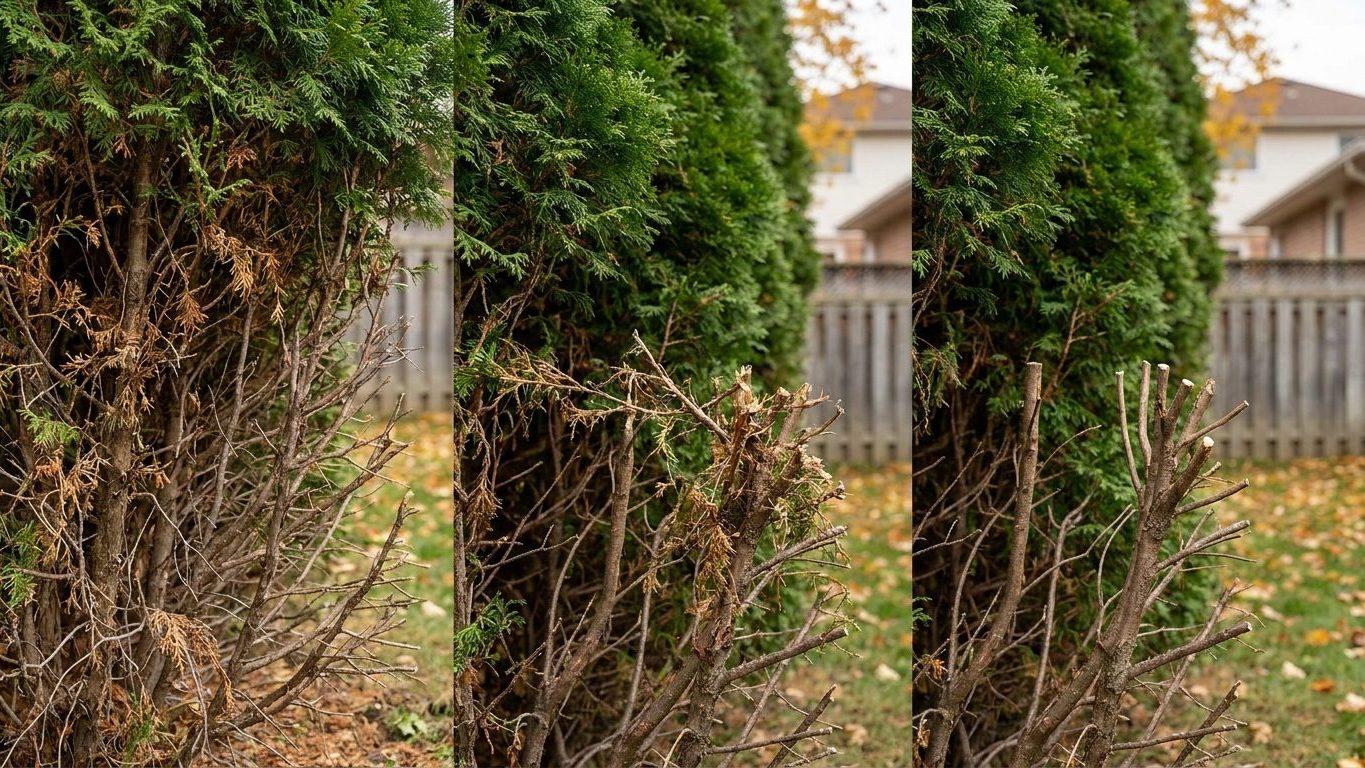

Arborvitae doesn’t regrow from bare, browned wood. Once a section of the hedge loses its green needles down low, that spot stays open for good, no matter how long you wait or how well you water. What matters now is figuring out which of three causes did it, because two of them can be stopped before they spread and one can’t.
Telling apart what makes arborvitae bare at the bottom
The location and timing of the bare patch point straight to the cause, and getting that right before you do anything else saves the rest of the hedge. Bareness that builds slowly, low and toward the interior of the plant, usually traces back to the hedge shading itself. As arborvitae grows taller and fills out at the top, the crown blocks light from reaching the lower branches. Those branches thin, drop needles, and eventually go bare over several seasons. This pattern shows up worst on the shaded side of a hedge row, often the north-facing side or wherever a fence, wall, or neighboring tree steals afternoon sun.
Deer damage looks different. It arrives over winter, and it’s ragged rather than gradual. Deer strip needles and tear small stems rather than cutting them cleanly, and the browse line sits flat and level across the whole hedge, right at whatever height the animals could reach standing in that season’s snowpack. If the bare zone has a hard, even edge and looks chewed rather than thinned, deer are the cause, not shade.
A bad cut is the easiest to place in time: it appears immediately after pruning, not months later. If someone sheared the hedge back into wood that had already gone brown, or cut lower than the green growth extended, the exposed wood simply stays bare. There’s no gradual decline to watch for here, the damage is done the moment the cut happens.
There’s a simple test that separates dead wood from wood that might still carry live tissue. Bend a bare twig: if it snaps dry and gray with no hint of green just under the bark, that stem is dead; if it flexes and shows green cambium beneath the surface, that section is still alive and worth protecting. Run this test on a few stems from the bare area before deciding whether you’re managing decline or already looking at permanent loss.
Bagworms deserve a mention here too, since they can strip a plant bare in a single season and get mistaken for shade dieback. Look for small, spindle-shaped bags hanging from the branches, especially in mid to late summer. That’s a different problem with a different fix, and it’s worth ruling out before you assume shade or deer.
Will it come back?
No. Once arborvitae foliage browns and the wood beneath it goes bare, that section will not refill, and that holds true whether the cause was shade, deer, or a pruning cut that went too far.
The reason comes down to how conifers grow. Unlike many broadleaf hedge shrubs, arborvitae carries no dormant buds tucked under the bark of older wood. New growth only forms at the tips of green, actively growing shoots. Needles brown, drop, and the stem underneath has no bud tissue anywhere along its length to push out fresh growth. There’s no reserve to tap. Once the green is gone from a section, that section is finished, permanently, regardless of how much sun, water, or fertilizer you throw at it afterward.
What can still happen is recovery of branches that haven’t fully died. If a lower branch has thinned from shade but still carries some live green at its tips, removing the cause (thinning the crown above it, fencing out deer) can let that branch hold on and even fill out slightly over time, growing at the species’ normal rate of 6 to 9 inches a year. That’s different from bare wood coming back. It’s existing live tissue getting a better chance, not dead wood regenerating.
The cost of waiting is that the cause keeps working while you decide. Shade dieback spreads outward and downward each year the crown stays uncorrected. Deer return to the same browse line every winter until it creeps higher, and a hedge that loses its bottom third to browsing rarely gets that third back through any means short of replacing the plant. Acting on the cause now doesn’t undo the bare section, but it stops the bare section from becoming the whole hedge.
Stopping the cause
What fixes this depends entirely on which of the three causes is at work, and arborvitae responds differently to each intervention.
For self-shading, the plant responds well to correcting the hedge’s shape. Arborvitae should be pruned slightly wider at the base than at the top, an A-frame silhouette rather than straight sides or a top-heavy shape. That lets light reach the lower branches instead of getting blocked by the crown above them. Prune in the late winter before new growth starts, or again in midsummer, and always cut into live green growth. Never cut back into brown or bare wood expecting it to recover, because that section will not push new growth at all. Getting the cut wrong is how a shade problem turns into a permanent one.
For deer, the plant doesn’t respond to pruning changes at all. The fix is exclusion: fencing tall enough to keep deer from reaching the foliage, or physical barriers around vulnerable plants through the winter months when browsing pressure peaks. Repellents can reduce browsing in some situations, but they don’t reverse damage already done, they only protect what’s left.
Sanitation matters more for pest problems than for shade or deer. Raking up dropped needles and debris around the base reduces habitat for bagworms and other pests that thrive in leaf litter, and it makes it easier to spot bags or webbing early, before they strip a season’s worth of foliage.
Spacing plays a role mainly at planting time. Arborvitae set too close together block light between each other from the sides, worsening interior thinning as they mature. If you’re planting a new hedge or filling gaps, give plants enough room based on their expected mature spread rather than crowding them for a faster-looking hedge now.
If you’re not sure which pest or disease is behind a bare section, or the pattern doesn’t match shade, deer, or a bad cut cleanly, your state’s land-grant university extension service can identify the cause from photos or a sample and tell you whether treatment makes sense.
What to do with what is left
Once the cause is stopped, the remaining decision is what to do with the bare section itself, and the honest answer depends on how much of the hedge it covers.
If the bare patch is small, low, and mostly hidden from the angle people actually see the hedge from, living with it costs nothing but a little patience while the rest of the plant fills in around it at its normal 6 to 9 inches a year.
Renovation pruning, the hard cutback that revives many overgrown deciduous hedges, doesn’t work on arborvitae. Because it carries no dormant buds on old wood, a hard cutback into bare or brown sections leaves permanent holes rather than triggering fresh growth. This is one species where the usual “cut it back and let it regrow” advice simply doesn’t apply.
Interplanting is the middle option. Low shrubs, ornamental grasses, or shade-tolerant groundcover set in front of the bare section can hide it from view within a season or two, while the arborvitae itself keeps growing at its own pace above.
Replacement is the realistic call when the bare section runs along a large share of the hedge’s height or width, especially on a street-facing or highly visible side. Arborvitae hedges typically run 4 to 15 feet tall, and a new plant closing a several-foot gap at 6 to 9 inches a year can take the better part of a decade to match its neighbors. That’s a real cost in time, and it’s worth naming plainly rather than suggesting the old section will somehow catch up.
Common questions
Can I cut an arborvitae hedge back hard to fix bare spots?
No. Arborvitae has no dormant buds on old wood, so any cut that goes past the green growth into bare or brown stems leaves a permanent hole. Prune only into live green, and do it in late winter before growth starts or in midsummer, timed to your local frost dates rather than a fixed calendar date.
Why is my arborvitae bare only on one side?
A one-sided bare patch usually points to winter burn on the windward side, shade from a building or taller planting nearby, or deer approaching the hedge from one direction only. Checking which side faces prevailing winter wind or the heaviest deer traffic usually settles it.
How fast will new arborvitae fill in?
Arborvitae grows 6 to 9 inches a year and reaches typical hedge heights of 4 to 15 feet depending on variety and age, within USDA hardiness zones 3 through 7. Filling a gap of several feet realistically takes multiple growing seasons, not one.
What eats arborvitae from the bottom up?
Deer are the main culprit, browsing foliage down to the snow line each winter and leaving a flat, ragged edge. Bagworms are the other major threat and can strip a plant’s foliage within a single season if left unchecked, so it’s worth checking for their spindle-shaped bags on the branches before assuming the damage is deer or shade.