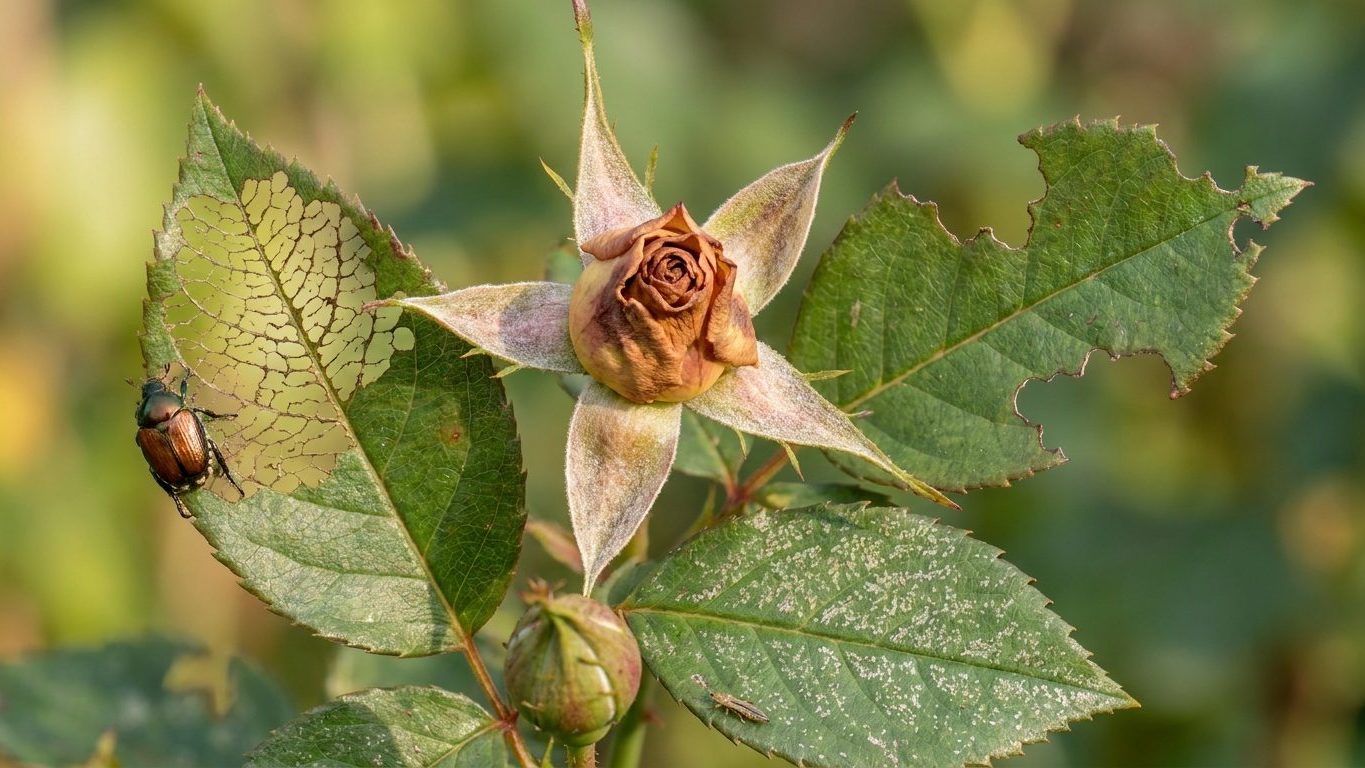

Chewed edges, skeletonized leaves, buds that turn brown before they open: rose damage usually points to one of six documented culprits: Fuller rose beetle, Japanese beetle, rose chafer, rose thrips, southern red mite, or two-spotted mite. Matching the damage pattern to the right pest is what determines whether you need to act at all.
Why this matters
A rose that’s high-maintenance by nature (that’s the plant’s own classification, not an exaggeration) has little tolerance for guesswork. Misidentify the pest and you’ll spray for beetles when mites are the real problem, or vice versa, and the damage keeps spreading while you wait to see results that were never coming.
Buds are the highest-stakes tissue on the plant. Thrips feeding inside a swelling bud can distort or brown the petals before the flower ever opens, and that damage is permanent for that bloom cycle. Left unchecked through a season, chronic defoliation from beetles or chafers reduces the leaf area the plant needs to rebuild energy for its next flush, which shows up later as fewer, weaker blooms rather than an immediate crisis.
When to do it
Pest pressure tracks the plant’s own growth stages, not a date on the calendar. Watch new growth flushes closely: tender young leaves and swelling buds are the tissue most insects and mites prefer, and damage shows up fastest there. A flush that emerges deformed, stippled, or chewed within days is your signal to inspect immediately rather than wait.
Bud set is the second checkpoint. Once buds begin to swell, check them individually for thrips, which hide inside the folded petals where a quick glance won’t catch them. Warm, dry stretches favor mites, which multiply fastest when humidity drops and populations can explode within a couple of weeks if the weather holds. After rain or heavy watering, look instead for beetle activity, since Japanese beetles and rose chafers are strongest fliers on warm, still days and tend to cluster on the sunniest side of the plant.
Because bloom timing, dormancy, and pest emergence all shift with climate, the exact timing for your area depends on your USDA hardiness zone. Check your state-specific rose page for the seasonal windows that apply where you garden.
How to do it
Start with a slow visual pass over the whole plant, not just the flowers. Look at both sides of several leaves, the stems where they meet the leaf, and the outside and inside of any swelling or open buds. The damage pattern tells you more than the insect itself, since many pests are small, fast, or nocturnal and you may never actually see one.
Reading the damage
- Skeletonized leaves (veins left intact, tissue between them stripped away) point to Japanese beetle, which feeds in groups and is most active in daylight, making it the easiest to catch in the act.
- Ragged, irregular holes along leaf margins, often at night with the culprit gone by morning, are the signature of Fuller rose beetle.
- Chewed petals and buds with a grayish or bronze cast on the flowers themselves suggest rose chafer, which favors the blooms over the foliage.
- Streaked, browned, or misshapen petals on buds that never fully open point to rose thrips, an insect so small it’s easier to diagnose from the bud than to spot directly.
- Fine stippling or a dusty, bronzed look on the leaf surface, sometimes with faint webbing underneath means mites, either southern red mite or two-spotted mite. Both are arachnids, not insects, which matters for how you respond.
Confirming what you’re looking at
For anything you suspect is a mite, hold a plain sheet of white paper under a suspicious leaf and tap the stem sharply. Mites are barely visible to the naked eye, but on white paper they show up as tiny moving specks, sometimes reddish, sometimes pale. A hand lens (the kind sold for reading fine print works fine) confirms it if you want to be certain before treating.
For beetles, early morning is the best time to check, since many species are sluggish in cool temperatures and easier to handpick before they warm up and fly. Knock them into a can of soapy water rather than crushing them on the plant, which can bruise tissue and attract more pests to the wound.
Once you’ve identified the pest, match the response to the biology: soap and water drown soft-bodied mites and small insects on contact but don’t work as a preventive spray; handpicking is most effective on beetles in small numbers; and severely damaged buds or leaves, once the pest has moved on, should simply be removed and discarded rather than left to signal more feeding sites nearby.
What Goes Wrong
The most common mistake is treating mites with a product meant for insects. Since mites are arachnids, an insecticide labeled for beetles or thrips often does nothing to them, and the population keeps building while the gardener assumes the treatment failed to reach the plant rather than realizing it was the wrong tool from the start.
Broad, routine spraying is the second failure, and it looks like diligence rather than a mistake. Spraying on a schedule regardless of what’s actually present kills the small predatory insects that would otherwise keep mite and aphid-type populations in check, which can make an infestation worse a few weeks later, not better.
Confusing pest damage with disease symptoms is a third trap. Leaf spots, blights, botrytis, powdery mildew, and anthracnose are documented diseases on roses, and they produce blotches, powdery coating, or dieback that has nothing to do with feeding insects. Spraying an insecticide on a fungal problem wastes time while the actual cause spreads untreated.
Finally, stripping every damaged leaf and stem “to be safe” removes tissue the plant still needs for photosynthesis, and it doesn’t address the pest still present elsewhere on the plant. Target the leaves and buds that are actively infested or unsalvageable, not everything that shows a mark.
Doing it differently
Container-grown roses make inspection easier since the whole plant is at a manageable height and can be turned to check every side without stooping into a bed. That accessibility also makes handpicking beetles more practical as a first response before reaching for anything else.
Greenhouse or indoor-grown roses face a different pressure: warm, dry, still air is exactly what mites favor, so populations can build faster indoors than outdoors, where wind and rain naturally knock them back. Raising humidity slightly and checking foliage more often helps catch an infestation before it spreads to neighboring plants.
Raised beds don’t change pest pressure on the foliage directly, but the better drainage they typically offer keeps the plant from the added stress of wet feet, and a stressed rose is generally slower to recover from feeding damage than a healthy one. Variety doesn’t change the pest response either: resistance to insect feeding and to disease are documented per cultivar, not per group, so a shrub rose and a hybrid tea growing side by side can show very different levels of damage from the same pest.
Common questions
Are rose thorns dangerous?
They are prickles, not true thorns. Prickles grow from the outer skin of the stem, which is why they can be rubbed off, unlike a true thorn, which is a modified stem and woody all the way through. Neither carries venom, but a puncture should still be cleaned to avoid infection.
Can I use one spray for all rose pests?
No single product treats insects and mites equally well, since mites are arachnids and respond differently than beetles or thrips. Identify the pest by its damage pattern first, then match the response, rather than reaching for a broad-spectrum product as a first step.
Do dropped or damaged leaves need to be cleaned up right away?
Remove leaves and buds that are actively infested or beyond recovery, but there’s no need to strip the plant bare. Black spot overwinters both in fallen leaves and in lesions on the canes, while powdery mildew overwinters in dormant buds and on stems, not in leaf litter, so raking alone won’t end either disease.
Should I leave any damaged wood standing over winter?
Remove wood that’s diseased or clearly unsafe, but dead stems cut back to 12 to 24 inches and left standing provide nesting sites for stem-nesting native bees. Full removal of every dead cane isn’t necessary and takes away habitat the plant would otherwise support.