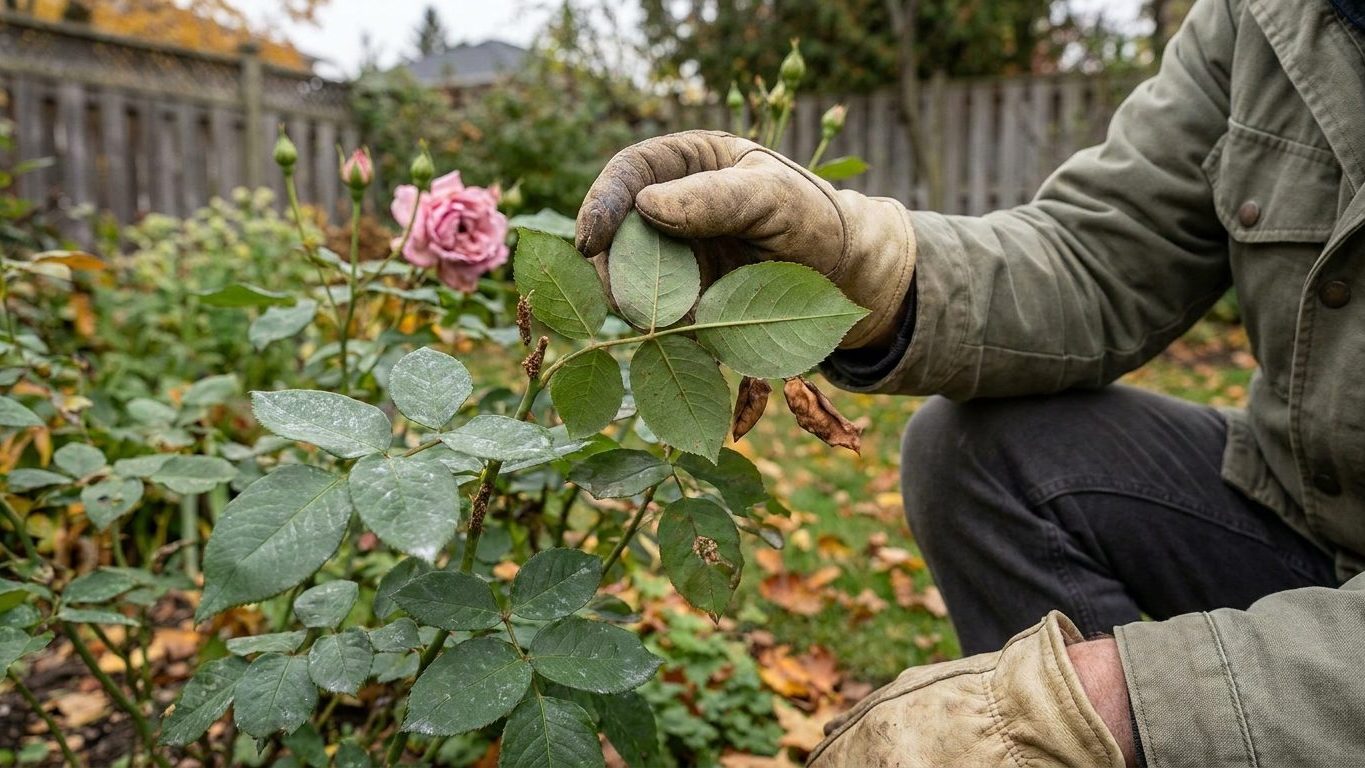

Reading a rose means walking the plant on a regular basis and matching what you see, spots, holes, wilted tips, sticky residue, against a short list of known culprits: a handful of insects and mites, five fungal diseases, and ordinary cultural stress. Most rose problems show a pattern within days, before real damage sets in. The skill isn’t guesswork. It’s knowing which surface to check, and when.
Why this matters
A rose sends signals through six or seven distinct surfaces before a problem becomes visible from across the yard: the underside of the leaf, the leaf margin, the cane, the bud, the base of the stem at the soil line, and the open flower itself. Missing any one of them means catching a disease weeks after it has already taken hold. Powdery mildew, for example, overwinters in dormant buds and on stems, not in fallen leaf litter, so a plant that looked clean going into the season can flare within a single humid week with no outside source of infection at all.
Skip the inspection and the cost compounds. Botrytis and other blights move fast on wet foliage, and a cane carrying anthracnose lesions passes the fungus into next year even after every fallen leaf gets raked up. Pests behave the same way. Two-spotted mite populations build unnoticed on leaf undersides for weeks, since mites are arachnids and rarely show themselves on the top surface where a casual glance lands. By the time stippled, bronzed foliage is obvious, the colony is already established and harder to knock back. Reading the plant on a schedule is what turns a five-minute fix into the whole story, instead of a rose that needs hard cutting back the following spring.
When to do it
Tie the inspection to what the rose is doing, not to a date. Check hardest right as new growth pushes: soft red shoots are exactly what aphids and rose chafer go after first, and thrips move into unopened buds before a single flower has shown color. Look again at the first flush of bloom, when petals and stamens sit close together and any browning or distortion signals thrips or botrytis before the bud even finishes opening.
Once the plant is in full leaf, watch closely after any stretch of wet weather. Black spot and other leaf spot diseases spread on splashed water, so the day or two following rain is when new lesions show up on the lower leaves first. A dry, hot stretch deserves its own check too, because that’s when spider mites and southern red mite populations build fastest, favored by exactly the stress that dry foliage creates.
Later in the season, once hips are forming and bloom has slowed, shift attention to the canes rather than the leaves. This is when lesions from anthracnose or older blight damage read clearly, and it’s the moment to flag which canes will need attention at pruning time, whenever that falls in your zone. The state-level page for your region covers the actual pruning window; this section is only about knowing what to flag before that window arrives.
How to do it
Work from the ground up, in order, every time, so nothing gets skipped out of habit.
Base and canes
Kneel at the crown first. Check the tag, or your own planting notes, to know whether this rose is budded onto rootstock or growing on its own roots. Hybrid teas, grandifloras, and many climbers are budded; most landscape shrub roses sold today, Knock Out and Drift among them, are own-root and carry no union at all. That distinction matters here because winter protection guards the union on a budded rose and the crown on an own-root one, and you can’t tell which you’re looking at without checking first.
Run a hand lightly down two or three canes. The sharp structures you feel are prickles, not true thorns: they grow out of the outer skin of the stem, which is why they snap off sideways instead of breaking like wood. A true thorn would be woody all the way through. While your hand is there, look for sunken or discolored patches, which point to cane blight or anthracnose lesions, and for sticky residue near the tips, a sign aphids have been feeding.
Leaves, buds, and flowers
Turn several leaves over. Round dark spots with fringed edges on the top surface, paired with yellowing around them, are classic black spot. A pale, powdery coating on stems and new leaves is powdery mildew rather than dust or spray residue. Fine stippling and faint webbing on the underside, especially after a dry week, points to spider mites; tap a suspect leaf over a sheet of white paper and watch for specks that start moving; that’s the mite, not dirt.
Check unopened buds for distortion or streaked color before they open; that pattern usually means thrips have been feeding inside. On open flowers, especially after rain, look for a fuzzy gray-brown blotch on the petals: that’s botrytis, and it spreads fast in humid weather. Later, watch the hips turn from green to red; they’re an accessory fruit holding the achenes inside, and they’re edible, but their color has nothing to do with when the plant goes dormant.
Do this weekly during active growth, and add an extra pass within two days of any heavy rain. A small hand lens helps with thrips and mites; nothing else is required beyond your own hands and a few minutes of attention per plant.
What goes wrong
The mistake that looks like extra care but isn’t: cutting every dead-looking stem flush to the ground the moment you spot it. Dead stems cut back to 12 to 24 inches and left standing serve as nesting sites for stem-nesting native bees. Removing them all in a burst of tidiness trades a genuine ecological benefit for a yard that looks marginally neater, and it’s easy to spot afterward: a bed with zero standing stubs anywhere, versus one with a handful of short, hollow-ended stems tucked among the live canes.
A second recurring error is treating a raked, litter-free bed as a finished job against disease. Black spot overwinters both in fallen leaves and in lesions on the canes themselves, and powdery mildew overwinters in dormant buds and on stems, not in leaf litter at all. A gardener who clears every leaf each fall but never inspects the canes will see the same disease return, and wrongly conclude the sanitation didn’t work, when really only half the source was ever addressed.
A third error is searching for insect damage patterns, wing marks, chewed edges, on symptoms that are actually caused by mites. Spider mites and the southern red mite are arachnids, not insects, and their damage (stippling, bronzing, fine webbing) reads differently from chewing damage left by Japanese beetle or Fuller rose beetle. Confusing the two leads to the wrong response and a colony left untouched.
Doing it differently
Roses in containers dry out faster than those in the ground, which pushes mite checks to the front of the list during any hot, dry stretch; confined roots also mean the crown area is worth a closer look for crowding before it shows above the rim. In a greenhouse or high tunnel, the extra humidity favors botrytis and powdery mildew specifically, so ventilation and airflow around the canopy matter as much as the inspection itself. Raised beds make soil pH easier to hold in the acid-to-neutral range roses prefer, but watch for iron chlorosis, pale yellow leaves with green veins, on soil that drifts alkaline above roughly 7.5.
Variety type changes the timing of one specific check. Once-blooming varieties are pruned in early summer, right after they flower, not in late winter like most repeat-blooming roses, so the cane inspection that leads into pruning happens on a different clock for those plants. Climbers flower from new wood, while ramblers flower from old wood, which means the canes worth protecting through the season are not the same canes on each type. There’s no single best method here, only a match between the growing setup or the variety and which check deserves priority first.
Common questions
Are rose thorns dangerous?
They are prickles, not true thorns. Prickles grow from the outer skin of the stem, which is why they can be rubbed off, unlike a true thorn, which is a modified stem, woody all the way through.
Do all roses fall into the same few types?
No. This site covers eleven rose groups, including hybrid tea, floribunda, grandiflora, shrub, climbing, rambling, miniature, ground cover, old garden, rugosa, hybrid musk, and polyantha. There is no closed number of “main” types; each group behaves a little differently.
Should I remove all the dead wood I find?
Remove what is diseased or unsafe, but leave dead stems cut back to 12 to 24 inches standing. They serve as nesting habitat for stem-nesting native bees.
Does clearing fallen leaves stop black spot for good?
No. Black spot overwinters in fallen leaves and in lesions on the canes themselves, so clearing litter without checking the canes leaves half the source of infection untouched.