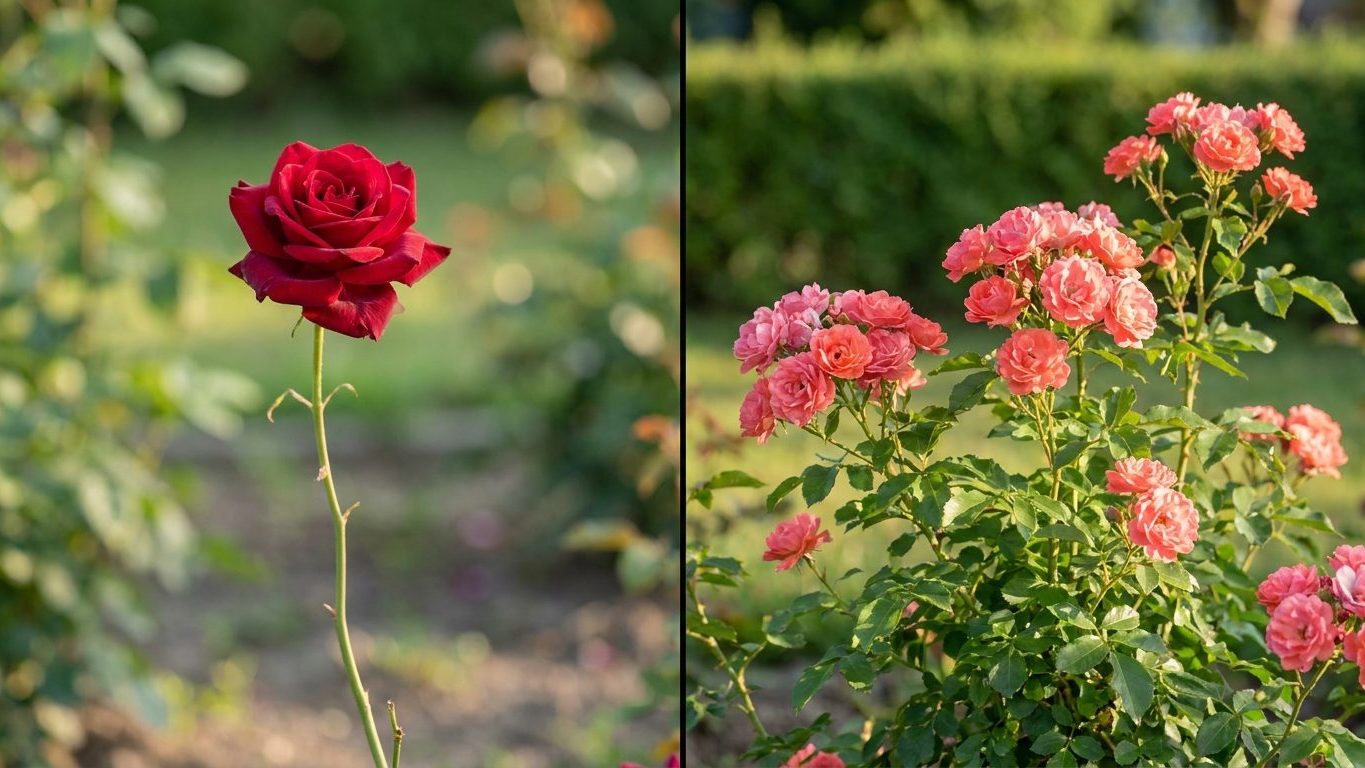

A hybrid tea carries one bloom at the end of a long stem, built for the vase. A floribunda carries clusters of smaller blooms on a bushier plant, built for garden color. That single difference in bloom habit is the fastest way to tell them apart, but this site actually tracks eleven rose groups, not just those two, and each one asks for a slightly different kind of care.
Why this matters
Getting the group right isn’t a labeling exercise. It decides when you cut the plant back and how hard, because the groups don’t all carry their flowers the same way. Ramblers bloom on old wood, the canes that grew last year. Climbers bloom on new wood, the growth made this season. Prune a rambler on a late-winter schedule built for a climber, and you cut off the canes that were about to flower. That single mix-up costs an entire season of bloom on a plant that may take another year to recover its shape.
Skip the identification step and you also mistreat the plant in smaller ways: mounding soil over a graft union that doesn’t exist on an own-root shrub rose, spraying a cultivar for disease it was specifically bred to resist, or handling a “thornless” climber as if its canes were unarmed when they still carry prickles. None of this is fatal on its own. Added up over a growing season, it’s the difference between a rose that rewards you with a full flush and one that limps along, over-pruned, wrongly protected, and short on flowers it was fully capable of producing.
When to do it
Identify the type before the first pruning cut, not after. The clearest window is the first bloom cycle: watch whether flowers open one to a stem or in small clusters, whether the plant stays under a few feet or throws long canes toward a fence, and whether the foliage looks glossy and modern or wrinkled and old-fashioned, as on a rugosa. That’s your evidence, and it’s more reliable than a nursery tag alone.
The actual pruning date depends on where you garden, since it tracks your last frost and your USDA zone, and roses in general are hardy from zone 5a through 11b, a wide enough range that a March cut in one state is a May cut in another. Most roses need yearly pruning in late winter, but the exact timing for your area belongs on your state-specific pruning guide, not here. What you watch on the plant, wherever you are, is the same everywhere: swelling buds low on the canes signal the plant is coming out of dormancy and ready to be cut back, while a rambler that has just finished its one big spring flush is telling you it’s time to remove spent old wood, not wait for late winter.
How to do it
Start with the flower itself. One large bloom per stem points to a hybrid tea. Small clusters of three or more blooms point to a floribunda. A plant that mixes both, tall hybrid-tea-style flowers arranged in loose clusters, is likely a grandiflora, a cross bred deliberately to combine the two habits. Miniatures repeat the hybrid tea’s bloom shape at a fraction of the size, while polyanthas cluster even more tightly than floribundas, in small, dense sprays.
Petal count is a second clue. Rose flower parts always come in multiples of five, and petal counts range from five on a single bloom to more than twenty on a fully double one. Old garden roses and rugosas often lean toward simpler, more open flowers, while modern hybrid teas and grandifloras tend to be heavily doubled.
Growth habit narrows it further. A low, spreading plant that hugs the ground is a ground cover rose. Long, stiff canes meant to be tied to a trellis, and that rebloom from new wood produced that same season, mark a climbing rose. Long, flexible canes that flower once from last year’s wood, often trained over an arbor, mark a rambler. A dense, rounded, self-supporting bush that doesn’t need training at all usually falls under shrub roses, a group that includes many of today’s low-maintenance landscape cultivars.
Check the base of the plant next. A visible knob or swelling near the soil line means the rose is budded onto rootstock, grafting being the most common propagation method for named cultivars, alongside seed and stem cuttings. No visible union at all means the plant is growing on its own roots, which is typical of many modern shrub roses sold today. This matters directly for winter protection: mound soil or mulch over the graft union on a budded rose, and over the crown itself on an own-root one.
Fragrance can confirm a guess. The five recognized fragrance groups are old rose, fruity, tea, myrrh, and musk, and certain classes lean toward certain scents, old garden roses toward the old-rose group, hybrid musks toward musk. If you’re cutting flowers for a vase, wait until the sepals have folded back and the first petal or two is unfurling; a bud cut tighter than that often never opens indoors.
| Group | Bloom habit | Typical use |
|---|---|---|
| Hybrid Tea | One large bloom per stem | Cut flowers |
| Floribunda | Clusters of medium blooms | Garden color |
| Grandiflora | Hybrid-tea blooms in loose clusters | Tall borders |
| Shrub | Variable, often repeat-blooming | Low-maintenance landscape |
| Climbing | Repeat bloom on new wood | Trellis, fence |
| Rambling | One flush on old wood | Arbor, large structure |
| Miniature | Small hybrid-tea-style blooms | Containers, edging |
| Ground Cover | Low, spreading clusters | Slopes, banks |
| Old Garden | Often once-blooming, simpler form | Historic gardens |
| Rugosa | Simple blooms, showy hips | Hedges, wildlife |
| Hybrid Musk | Clustered, musk-scented | Informal shrub borders |
| Polyantha | Tight clusters of small blooms | Compact beds |
What goes wrong
The single most common mistake is pruning a rambler on a climber’s schedule. Since ramblers carry next year’s flowers on this year’s old wood, a hard late-winter cut removes the flush before it ever opens; you find out only in spring, when a rambler that bloomed well last year stays bare.
A second mistake looks like extra tidiness but isn’t: cutting every dead-looking stem flush to the ground. Diseased or unsafe wood should go, but dead stems cut back to 12 to 24 inches and left standing give stem-nesting native bees a place to overwinter. Removing all of it “for a clean look” quietly removes habitat.
Assuming disease resistance is a group trait causes trouble too. Resistance is a cultivar’s own trait, not a whole class’s; some old ramblers are mildew-prone, while Knock Out, a shrub rose, was bred specifically for resistance. Spraying or skipping care based on the group name instead of the cultivar leads to wasted fungicide on a resistant plant, or a false sense of security on a susceptible one. Black spot compounds the confusion: it overwinters both in fallen leaves and in lesions on the canes, so raking leaves without also removing infected wood leaves half the problem in place.
Finally, gardeners sometimes let hips build up while continuing to deadhead, assuming the ripening fruit signals the plant to slow down. It doesn’t; dormancy follows day length and cold, not hip color. Every deadheading cut, meanwhile, pushes a new shoot, so cutting too late in the season produces soft growth that won’t ripen before frost.
Doing it differently
Container growing suits miniatures and many own-root shrub roses best, since their mature size, always somewhere in the genus-wide range of 1 to 8 feet tall, tends to run smaller for these groups; check the specific cultivar page rather than assuming a size from the group name alone. Ground cover roses are the better call for a slope or a bare bank where you want spreading coverage instead of a defined bush.
Climbers and ramblers both need a structure to train onto, but they’re not interchangeable: a rambler’s old-wood bloom and long, flexible canes want an arbor or a large support it can cover once and keep, while a climber’s repeat bloom on new wood tolerates the tighter, more frequent training a fence or trellis demands.
For a planting aimed at birds and pollinators rather than cut flowers, rugosas and hybrid musks earn their keep twice over, once with clustered or simple blooms across the season, and again in fall when the hips, an edible accessory fruit, turn from green to red and stay on the plant. Leaving those stems standing afterward, cut back to 12 to 24 inches rather than removed, extends that value into the following spring for nesting bees.
Common questions
Are rose thorns dangerous? They’re prickles, not true thorns. Prickles grow from the outer skin of the stem, which is why they snap or rub off sideways, unlike a true thorn, which is a modified stem woody all the way through. They still break skin, so gloves matter regardless of the terminology.
Is every rose grafted onto rootstock? No. Hybrid teas, grandifloras, and many climbers are typically budded onto rootstock, but most landscape shrub roses sold today, Knock Out and Drift among them, are own-root and have no union at all. Check the base of the stem before deciding what to protect over winter.
Can I tell rose types apart just by the flower? Partly. Bloom habit, one flower per stem versus clusters, is a strong first clue, and petal count from five to over twenty narrows it further. Confirm with growth habit, since a climber and a shrub rose can carry similar flowers on very different canes.
Do rose hips mean the plant is going dormant? No. Dormancy is triggered by shortening day length and cold, not by the hips ripening. Hips are simply an edible fruit that turns from green to red in fall, and they can form while the plant is still actively growing.