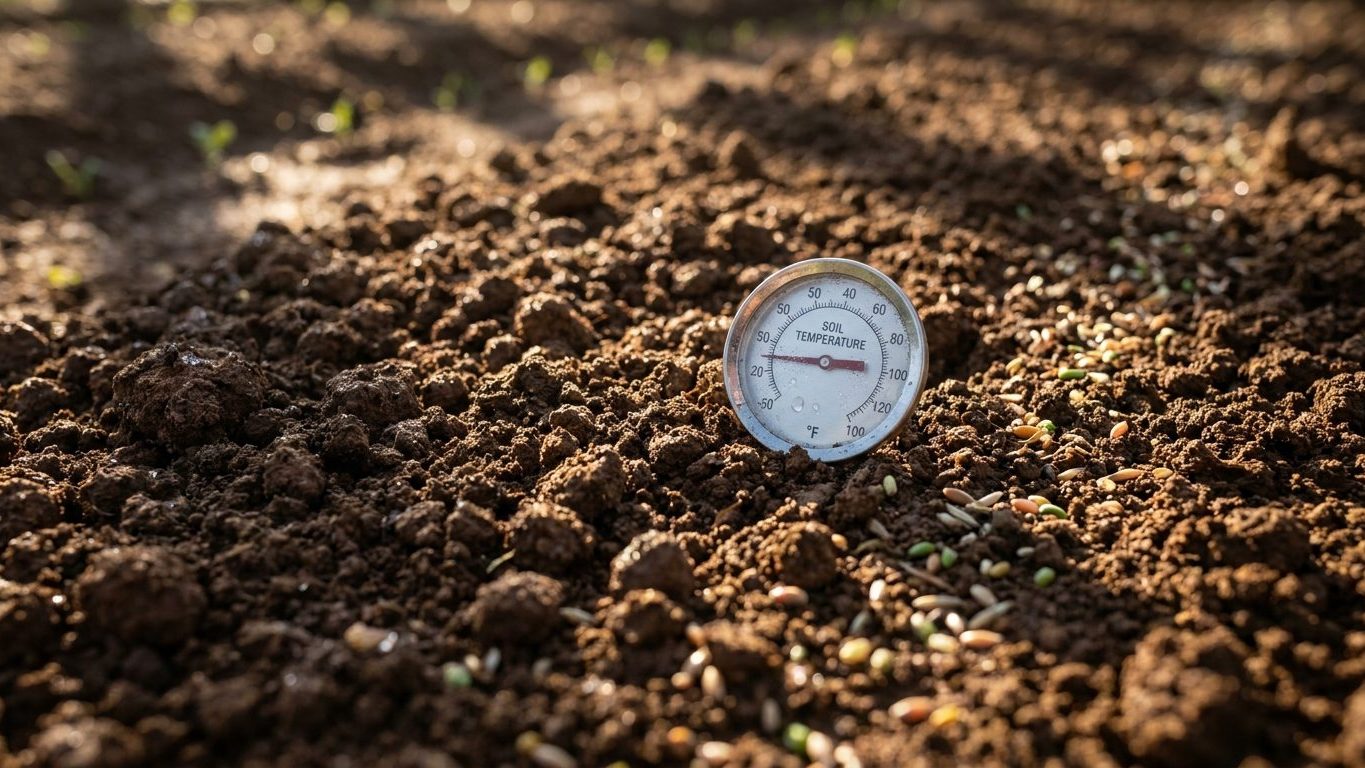

In Alabama, cover crops go into ground once soil temperature climbs into the workable range for the species you’re planting, which lands roughly two to four weeks after the last frost risk fades. The bigger driver isn’t the calendar at all: it’s a growing window that runs nearly seven and a half months in a good year, paired with a winter mild enough that some species never truly die back. That combination changes almost every decision that follows.
When the soil is warm enough in Alabama
At Huntsville International Airport, station USW00003856, the last spring frost falls somewhere between March 19 and April 3, based on NOAA’s 1991-2020 climate normals and the 30 to 70 percent freeze probability band. That’s a real measurement from a real station, not a rounded guess, and it’s worth treating it as exactly that: a probability, not a promise. Half the years in that dataset saw frost on one side of the window or the other, and a garden ten miles outside Huntsville, especially one sitting in a low spot or up in elevation, often sees frost linger later into spring and arrive earlier in fall than the airport does.
Frost date matters, but it’s a proxy for something else entirely: soil temperature. Air can clear 32°F and stay there for a week while the top few inches of ground remain too cold for seed to germinate reliably. Cover crop seed doesn’t care what the thermometer said on the last frost morning. It cares whether the soil itself has warmed enough for the species in question, and soil lags behind air temperature by anywhere from one to three weeks depending on how much sun the bed gets and how heavy the ground is. A shaded clay bed in north Alabama might not reach workable soil temperature until well into April, even though the air cleared frost risk weeks earlier.
This is exactly why seeding rate isn’t something to guess at from a general chart. Rate depends on the species, whether you’re broadcasting or drilling, and the source of the seed itself, and getting it wrong in either direction wastes a season’s worth of biomass. The Alabama Cooperative Extension System, at aces.edu, publishes county-specific guidance that accounts for local soil types and planting methods, and that’s the number to use, not a nationwide average.
Termination follows the same logic of matching method to conditions rather than reaching for a shortcut. This site works from mechanical termination only, meaning mowing, crimping, cutting, or letting frost do the job, and Alabama’s mild winter (more on that below) means frost can’t always be counted on to finish the work for you.
How long the season lasts here
Subtract the two frost windows from each other and Alabama’s frost-free stretch, measured at that same Huntsville station, runs somewhere between 213 and 242 days depending on which end of each probability band you land on in a given year. Even the short end of that range is a long season by cover crop standards. It’s long enough that a single fall-planted stand isn’t the only option available to most gardeners here.
A window that long allows something a shorter-season territory can’t: a second sowing within the same calendar year, or enough slack to let a summer cash crop finish naturally before the cover crop goes in behind it. Gardeners further north, working with frost-free windows closer to 150 days, often have to choose between a fall cover crop and a full harvest from a slow-maturing vegetable. In much of Alabama, that choice rarely has to be made. The season accommodates both, provided the sowing dates are staggered correctly rather than guessed at.
That staggering is really the whole game. Sowing too early into warm soil that’s still holding summer’s cash crop wastes seed and invites competition; sowing too late into a shortening day length means poor establishment before winter slows growth. The succession sowing guide on this site walks through how to stack a cool-season legume behind a summer crop, and how to time a second planting so it establishes before day length starts working against it, which for Alabama’s window generally means getting cool-season species in the ground well before that first fall frost date arrives.
The long window also changes whether transplanting versus direct-seeding matters as much here as it does elsewhere. In a short-season territory, transplants buy critical weeks. In Alabama, direct-seeded cover crops usually have enough runway to establish a full root system before winter regardless, which simplifies the decision for anyone managing more than one bed.
Heat and water in Alabama
Summers here run hot and humid enough that most gardening decisions in this state get filtered through heat tolerance first. But cover crops flip that question on its head. The plant isn’t trying to survive a July afternoon; it’s trying to survive, or deliberately fail to survive, the coldest weeks of winter. That’s what actually decides which species belong in an Alabama rotation.
The number that matters here is the mean daily minimum of the coldest month, which at the Huntsville reference station runs 33.1°F. That’s not a record low and it’s not a monthly average; it’s the typical low temperature on an ordinary night in the coldest stretch of winter. At just above freezing, that figure sits at the mild end of what most cool-season cover crops experience across the country, and it lines up with the state’s broader USDA Hardiness Zone range of 7a to 9a, a classification built on average annual extreme minimum temperatures rather than typical winter lows.
That mildness cuts both ways. A species that reliably winterkills in a colder state, leaving a tidy dead mulch behind by February, may simply keep growing through an Alabama winter instead. Oats are the textbook example: in much of the Midwest, a hard freeze kills the stand outright and gardeners plan around that. In the milder parts of Alabama’s zone range, oats can limp through winter alive, which turns what was supposed to be a self-terminating cover crop into something that has to be mowed or crimped by hand come spring, whether or not the gardener planned for that extra step.
The flip side of a mild winter is that a handful of species that would freeze out further north survive here reliably, which widens the menu rather than narrowing it. The tradeoff is that nothing gets terminated for free. Anyone planting in this state should assume mechanical termination will be needed regardless of species, and plan the mowing or crimping step into the calendar from the start rather than treating frost as a fallback.
Which cover crops suit Alabama
The right choice in Alabama comes down to matching plant type to two facts already on the table: a long frost-free window and a winter too mild to be relied on for termination. That points toward species chosen by category rather than by brand name or specific variety, because the local performance differences between named varieties are exactly the kind of detail a general guide like this one can’t responsibly claim to know.
Matching type to Alabama’s conditions
| Type | Winter behavior in a mild zone | Main benefit | Termination approach |
|---|---|---|---|
| Winter cereal grasses (rye, wheat, barley) | Often survive winter rather than freeze out | Fast biomass, weed suppression | Mow or crimp before seed set |
| Legumes (crimson clover, hairy vetch, winter peas) | Reliable winter survival across the zone range | Nitrogen fixation via root nodules | Mow or cut at flowering for best nitrogen release |
| Brassicas (daikon radish, mustard types) | Variable; some winterkill, some persist | Deep root channels, soil loosening | Frost-kill where reliable, otherwise mow |
Legumes deserve particular attention here because their contribution depends entirely on biomass and timing rather than a fixed number. Nitrogen fixation happens through root nodules as the plant grows, and the amount available to a following crop shifts with how much top growth the plant put on before termination and how that residue breaks down afterward. There’s no honest way to attach a pounds-per-acre figure to that process from a general article; it depends on the specific stand.
Disease pressure is the other filter worth naming. Humid stretches during establishment favor fungal issues on dense stands, which is one more reason airflow and spacing matter as much as species choice in this part of the country.
None of this replaces what a local trial can tell a gardener. The Alabama Cooperative Extension System, at aces.edu, runs variety trials specific to this state’s counties, and those results, tied to actual soil and actual winters here, are the only recommendation precise enough to plant with confidence. A general article can tell you the category that fits; only local data can tell you which named variety within that category performed best last winter, three counties over from where you’re standing.