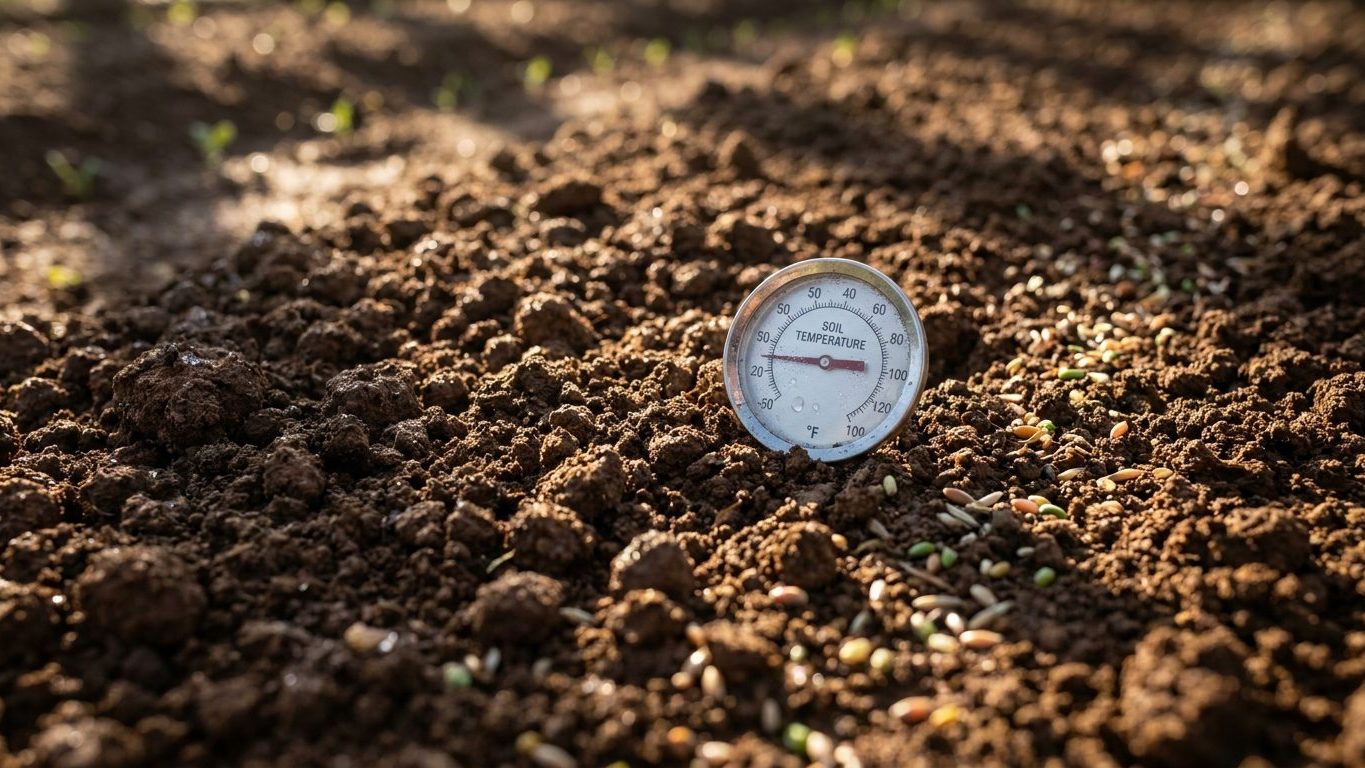

Alberta’s cover-crop calendar runs on a short, cold-edged window: sow after the soil has warmed past the average last frost near May 21, and plan termination before winter settles in around mid-September. The real decisions here aren’t about which brand of seed to buy, but which species survive an Alberta winter on their own, and which need a hand at the finish.
When the soil is warm enough in Alberta
The average last spring frost at Calgary Int’l A, per Environment and Climate Change Canada’s 1981-2010 climate normals, falls on May 21. That number is useful, but it isn’t a green light. It’s a mean date, which means in roughly one year out of two, frost arrives later than that. Treat May 21 as the midpoint of a risk window, not a promise the ground is safe.
More to the point for cover crops: frost date is only a proxy. What actually matters is soil temperature, and soil warms up on its own schedule, usually trailing a few days to a couple of weeks behind the last frost risk, depending on how wet the ground is and whether it’s shaded or exposed. A garden bed that thaws and drains early might be plantable before the average frost date passes; a low, heavy-clay spot might lag well behind it.
Matching species to a cool start
Cool-season species like field peas, oats, and clover germinate in soil that’s still on the chilly side, which makes them a natural fit for an Alberta spring where the frost-free window opens slowly. Warm-season species such as buckwheat or sorghum-sudangrass want soil that’s properly warmed through, not just frost-free, so they’re better held back a few extra weeks after the average date passes, especially in a cool spring.
How much of any of these to sow depends on species, seeding method, and whether you’re broadcasting or drilling, and that math is territory-specific enough that a wrong number wastes the season. Alberta’s provincial extension service, reachable through Alberta Agriculture and Irrigation, publishes rate guidance suited to this climate and is the better source than any generic figure.
Termination on this site is mechanical, full stop: mowing, crimping, cutting, or simply letting frost do the work. No herbicide step belongs in this process, and none is assumed here.
How long the season lasts here
Subtract the two dates from the Calgary Int’l A record and the frost-free window comes out to about 118 days, running from the average last spring frost on May 21 to the average first fall frost on September 16. That’s a moderate window by Canadian standards, but it’s still short enough that timing matters more than it would farther south.
What a 118-day window allows is one solid cover-crop cycle with room to spare, and sometimes a second, faster one if the first goes in promptly and the species chosen matures quickly. Field peas or buckwheat, for instance, can complete a cycle in a matter of weeks rather than months, which leaves a gap for a second sowing before the fall frost risk climbs back up. A slower-maturing species sown late in the window, on the other hand, may not get enough growth in before cold shuts things down, so the first sowing effectively becomes the only one.
Direct seeding versus transplanting
Cover crops are almost always direct-seeded rather than transplanted, but the length of the growing window still affects the decision to check root development before committing a bed to a second planting. In a shorter window, there’s less room for a slow start, so a quick root check after emergence, confirming the crop is establishing rather than sitting stalled, is worth the five minutes it takes. For readers weighing whether a second sowing fits before frost, the site’s succession sowing guide walks through how to sequence plantings against a known frost-free window like this one.
Heat and water in Alberta
This is where a lot of cover-crop advice written for warmer regions stops applying. The FACTS available for the Calgary reference station don’t include a count of days above 90°F or a summer rainfall figure, and rather than guess, it’s worth saying plainly: those numbers aren’t the ones that decide outcomes in this climate anyway. For a place with Alberta’s winter profile, the question that actually drives cover-crop success isn’t how hot summer gets. It’s how cold winter gets, and how early it starts.
The first fall frost, averaging September 16 at Calgary Int’l A, sets the last useful sowing date for anything that needs to establish before cold arrives. Sow too late and a cover crop never builds enough biomass to matter, whether as green manure or as winter mulch.
Why the coldest month is the deciding factor
The mean daily minimum in Calgary’s coldest month sits at 8.2°F, and that single figure does more work than any summer statistic could. It’s cold enough to reliably kill species that aren’t built for it, oats being the clearest example. In a mild coastal territory, oats can limp through winter and turn into a weed the following spring. In Alberta, that same cold snap turns oats into one of the easiest cover crops available, because winter does the termination for you. No mowing, no crimping, just a dead mat of residue waiting to be worked into the soil or left as mulch.
Species built to overwinter, like winter rye or hairy vetch, behave differently here. They’ll often survive the 8.2°F minimum and resume growth in spring, which means they still need a deliberate mechanical termination, mowing, crimping, or cutting, before they set seed or compete with whatever’s planted after them. Alberta’s Canadian hardiness zone of 4a, drawn from Natural Resources Canada’s 1991-2020 normals for the reference city, confirms the pattern: this is a zone built on seven climate variables, not just one, and it does not translate to a USDA zone despite looking similar on paper. A gardener used to USDA zone charts should not assume Alberta’s 4a behaves like any single USDA equivalent; NRCan’s own comparison shows Canadian 4a overlapping USDA zones from 3a all the way to 7a.
Which cover crops suit Alberta
Reasoning by type, rather than by brand or cultivar, is the only approach that holds up across a province this size. A short growing season favors species that mature quickly and don’t need a long runway, field peas, buckwheat, and oats among them, since they can complete a useful cycle well inside the 118-day frost-free window without gambling on an early fall frost.
Cold winters change the calculus around termination. Species that reliably winterkill at Alberta’s coldest-month minimum turn into low-effort choices, since the freeze does the termination step without a mower or a crimper ever coming out. Species built to survive winter, by contrast, demand a plan for spring termination, and that plan needs to happen before they set seed or start competing with a spring planting.
Why this page won’t name a variety
None of this points to a specific cultivar, and that’s deliberate. Seed trials run by provincial extension programs are the only source that reflects what actually performs in local soil, local moisture, and local disease pressure, and no general-interest page can substitute for that. Alberta Agriculture and Irrigation, at alberta.ca/agriculture-and-irrigation, is where that variety-level and rate-level guidance actually lives. Refusing to guess at a cultivar name here isn’t a gap in the advice. It’s the advice.
Seeding rates follow the same logic: they shift with species, method, and seed source, and a number pulled from the wrong context can waste an entire season’s growth. The extension service is built to answer that question with current, region-specific figures, which makes it the better stop than any fixed rate quoted from elsewhere.