
In coastal British Columbia, cover crops go into the ground once the soil itself has warmed, not on a fixed date circled on the calendar. The Vancouver area’s mix of a long frost-free stretch, a wet summer, and a mild-but-real winter chill shapes both the sowing window and which species make sense here. Timing and species choice both start with that pattern, not with a seed packet’s generic instructions.
When the soil is warm enough in British Columbia
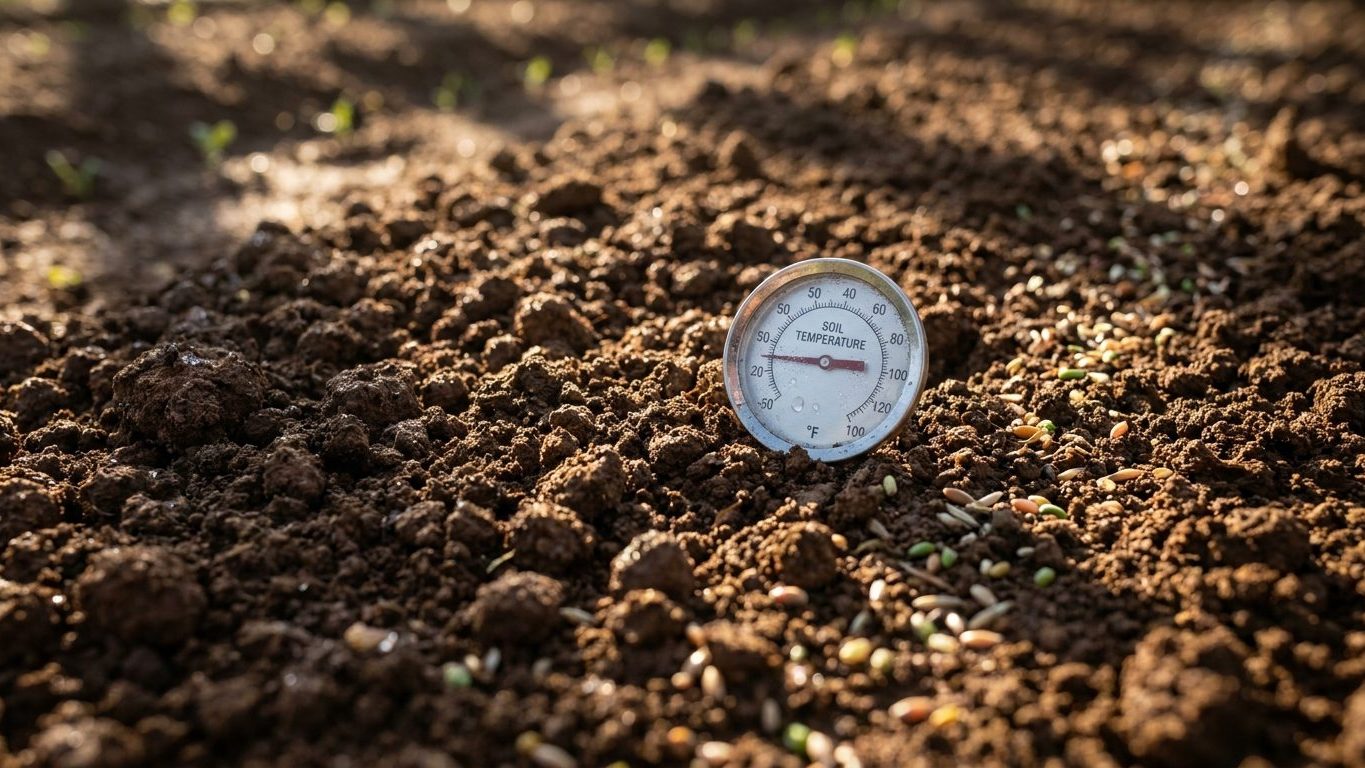
Ask five gardeners in the Fraser Valley or on the Sunshine Coast when to seed a cover crop, and most will point to a date. The better answer is a thermometer pushed a few inches into the bed. Cover crop seed germinates on soil temperature, and soil temperature lags air temperature by weeks, sometimes longer where beds stay shaded or heavy with clay.
The frost date most gardeners reach for is the mean last spring frost recorded at Vancouver Int’l A: March 18, from Environment and Climate Change Canada’s Canadian Climate Normals for 1981-2010. That number is a midpoint, not a guarantee. In one year out of every two, the last frost actually lands later than March 18, so treating it as a safe planting cutoff is a mistake baked into the statistic itself. Gardeners in the Fraser Valley interior, on Vancouver Island’s west coast, or up-elevation in the Interior should expect their own local frost to trail this coastal station by days or weeks.
What matters for cover crops is that frost date only marks air risk. Soil takes longer to catch up, especially after a wet Pacific Northwest winter that leaves ground cold and saturated well into spring. A cover crop seeded the week after the mean frost date, into soil still sitting in the low 40s, will sulk or rot before it germinates. Waiting an extra two to three weeks after that date, until the topsoil has actually warmed, does more for establishment than any calendar trick.
Species choice interacts with this timing. Cool-season legumes such as field peas, vetches, and clovers tolerate a light frost themselves and can go in before the mean date has fully passed, since they’re bred for exactly this kind of shoulder-season cold. Species that need real warmth to germinate reliably should wait until the soil, not the air, says spring has arrived.
On rate: how much seed to put down per bed or per row depends on the species, the seed size, whether it’s broadcast or drilled, and the purpose of the planting, whether that’s erosion control, weed suppression, or biomass for the next season. A single rate in pounds doesn’t transfer cleanly across those variables, and a wrong rate wastes a growing window that’s already tight in a coastal climate. British Columbia’s own agriculture ministry publishes region-specific guidance through the Ministry of Agriculture and Food’s extension service, and that’s the right place to confirm a rate before buying seed.
How long the season lasts here
Subtracting the two mean frost dates gives a rough sense of what’s available. From the mean last spring frost on March 18 to the mean first fall frost on November 10, coastal British Columbia runs about 237 days, close to eight months, between the two average frost points. That’s a long window by most standards, and it changes what’s worth planning for.
A window that long allows more than a single cover crop cycle. A spring-sown legume or cereal can be grown, cut or turned under, and followed by a second planting later in summer aimed at fall and winter soil cover, something a shorter-season territory simply can’t fit in. It also opens the door to comparing direct-seeded cover crops against transplants for anything grown alongside them in the same bed, since there’s enough season length to absorb the slower establishment of a transplant without losing the whole cycle to an early frost.
The catch is that both frost dates are means, not edges of a safe range. The actual usable window in any given year can run shorter on both ends: a late spring frost eating into the start, an early fall frost cutting the finish short. Planning two sowings back to back leaves less room for that kind of overrun than planning one, so gardeners who want to try succession sowing here should build in a buffer rather than counting on the full 237 days every year.
For the mechanics of staggering sowings, timing a second planting behind the first, and deciding when a follow-up crop still has time to establish before fall frost risk rises, this site’s succession sowing guide covers the sequencing in more detail than fits here.
Heat and water in British Columbia
For most of the year, the number that actually governs cover crop survival in coastal British Columbia isn’t a summer heat count. It’s winter. Verified extreme-heat data for the Vancouver reference station wasn’t part of the sourced figures for this profile, and that omission is telling on its own: this is not a climate defined by punishing summer heat. Coastal summers here run mild and often damp, particularly in the shoulder weeks of June and September, which brings a different set of problems than a hot inland territory faces. Persistent leaf moisture in a cool, humid summer favors powdery mildew and other fungal disease on crops with dense canopies, and slows ripening on anything that needs sustained warmth to finish.
The mean first fall frost, November 10 at Vancouver Int’l A, sets the last realistic date for sowing a fall cover crop that needs to establish before cold arrives. Miss that window and a fall-sown crop may not put down enough root or top growth to survive winter, regardless of species.
The figure that actually decides which species make it through winter here is the mean daily minimum of the coldest month: 33.5°F. That’s not a record low, and not a monthly average, it’s the typical overnight floor in the coldest stretch of the year. It sits just above freezing on average, which is a meaningfully mild winter by many cover-crop standards. That single number is what separates a species that reliably winterkills into a protective mulch from one that limps through winter and comes back as an unplanned weed the following spring. Oats are the clearest example: in a genuinely cold winter, oats die back cleanly and leave a dead mat of residue that’s easy to work with. In a winter as mild as 33.5°F suggests for this coastal reference point, oats can survive in patches rather than reliably dying, turning what’s meant to be a self-terminating cover crop into something that has to be cut or pulled by hand.
The Canadian plant hardiness rating for the reference city is Zone 9a, under Natural Resources Canada’s system, which is built on seven climate variables rather than the single minimum-temperature figure the USDA scale uses. That distinction matters enough to repeat: a Canadian zone number and a USDA zone number are not interchangeable, and this 9a figure applies to the reference station’s location, not uniformly across the province.
Which cover crops suit British Columbia
Given a long frost-free window, a mild rather than brutal winter, and a summer that runs cool and damp more often than hot, the species that suit this coastal territory sort naturally into a few types.
| Type | Fits this climate because | Watch for |
|---|---|---|
| Cool-season legumes (peas, vetches, clovers) | Tolerate light frost, establish early in the long spring window | Slow growth in a cool, wet spring |
| Cool-season cereals (oats, cereal rye, barley) | Fast biomass, good for fall sowing ahead of the November frost | Winter survival is uneven at 33.5°F minimum; oats especially may not fully die back |
| Brassicas (mustards, forage radish) | Quick canopy for weed suppression in the shoulder seasons | Susceptible to fungal disease in humid summer stretches |
| Warm-season grasses (buckwheat, sorghum types) | Fill the mid-summer gap in the long season | Need genuinely warm soil, not just frost-free air, to establish |
Disease resistance deserves more weight in a selection decision here than it would in a drier, hotter territory, given how much of the growing season runs cool and damp. A cereal or legume chosen mainly for its biomass or nitrogen contribution can still underperform badly if it’s prone to mildew in persistent leaf wetness.
None of that points to a specific variety, and this page won’t name one. Cultivar trials run by British Columbia’s own agricultural research stations account for local disease pressure, soil types, and microclimates in a way a general guide can’t replicate. The provincial extension service publishes current variety trial results and rate recommendations by species, and that’s the source worth checking before buying seed.
Termination, once a cover crop has done its job, stays mechanical here as it does across this site: mowing a cereal before it sets seed, crimping a mature stand to knock it flat, or simply letting a genuinely cold winter finish the job on a frost-sensitive species. Which method fits depends on the species chosen and how far along it is when the next planting needs the bed, which is exactly the kind of detail worth confirming locally rather than guessing at.