
In coastal and Southern California, the search for a “last frost date” comes up empty: NOAA’s 30-year record shows zero days at or below 32°F. That single fact rewrites the whole calendar for cover crops. But it only applies to part of the state, and the Central Valley, the Sierra foothills, and inland Northern California freeze on a completely different schedule.
When the soil is warm enough in California
At the reference station used for this page (Los Angeles), NOAA’s 1991-2020 Climate Normals list no computable freeze date at all. The daily record backs it up: zero days at or below 32°F across 30 years, and a frost-free season officially logged as 365 days. For a gardener in that band of the state, coastal and Southern California, there is no spring frost to wait out. The soil-warming question that drives cover-crop timing everywhere else simply doesn’t exist here in the same form.
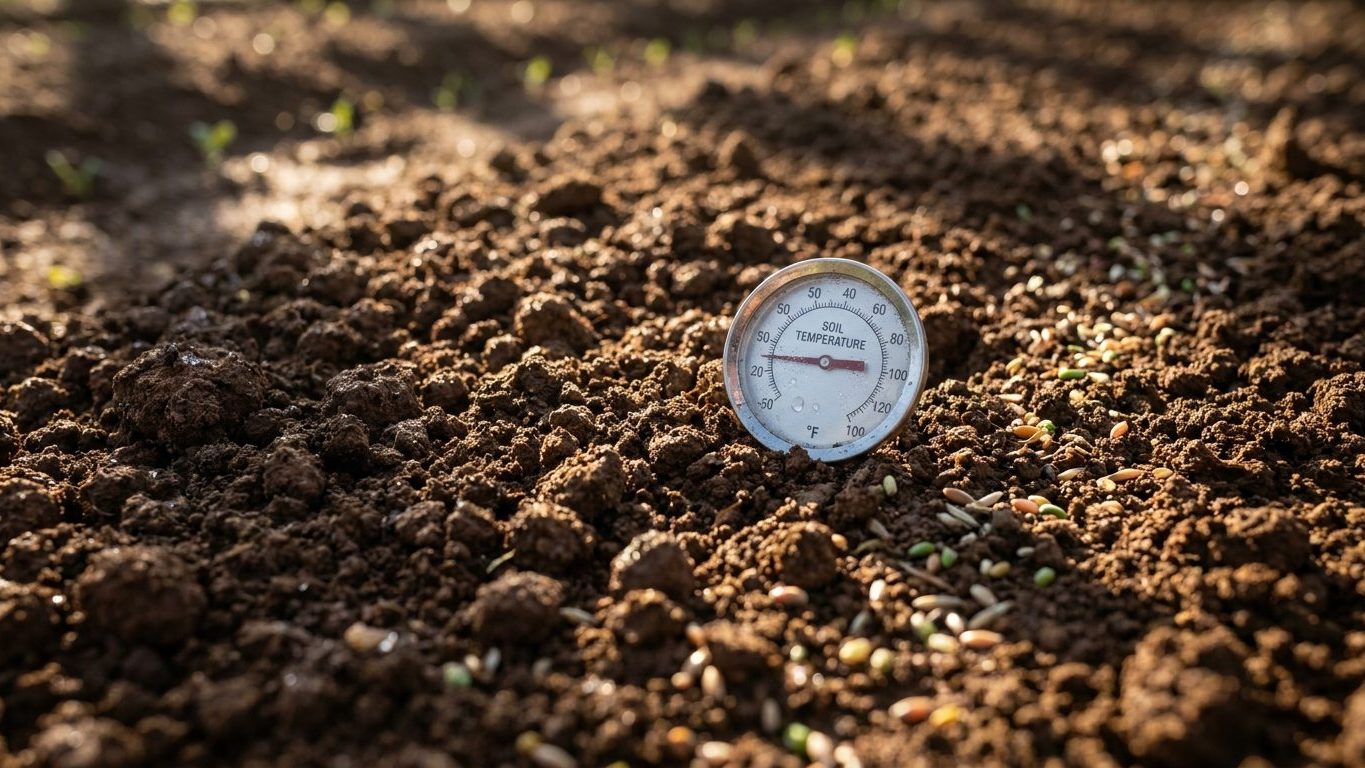
That is a genuinely different starting point than most of the country, and it changes what “timing” even means. Instead of watching for a frost date, gardeners in this zone are watching soil temperature and soil moisture directly, because legumes and grasses germinate on warmth and workable ground, not on a calendar square. A frost date, where one exists, is only ever a probability anyway, an average of when the risk drops low enough, not a guarantee for any single year. Here, that probability is close to zero year-round, which is useful information but not the same as a green light every week of the year.
The catch is that “frost-free” does not mean “climate-uniform.” Northern California, the Central Valley, and the Sierra foothills sit in a completely different reality, with real winter freezes that this reference station’s data does not capture. A gardener in Redding or Placerville working from Los Angeles frost data would be planting into ground that’s still locking up at night. That’s the core hazard of a state this size: one station’s normals describe one slice of it, and California’s slices don’t behave alike.
What actually governs planting week
Because the frost proxy is missing or unreliable depending on where you sit, soil temperature does the real work. Species vary widely in what they tolerate at germination, cool-season grasses generally push earlier than warm-season legumes, and how thick to sow depends on the species, the seeding method, and the goal (a thick stand for weed suppression sows differently than a thin one meant to be interplanted). Rather than borrow a rate from a bag or a website, the right move is calling the University of California’s Cooperative Extension network at ucanr.edu, which keeps county-level data that a statewide reference station can’t.
Termination follows the same logic, mechanically rather than chemically. Mowing, crimping, or simply cutting the stand down before it sets seed does the job this site recommends, and in the coldest parts of the state, a hard frost can do it for free. In the frost-free band, that free termination doesn’t come, so mechanical cutting becomes the only reliable stop.
How long the season lasts here
Both frost dates on record for the reference station say the same thing: no freeze occurs in an average year. There is no spring frost to end and no fall frost to start counting from, so the arithmetic that normally defines a growing window (first fall frost minus last spring frost) doesn’t produce a number here. It produces something closer to a 365-day frost-free season, at least at this specific station.
That’s not a small detail, it’s the whole story for coastal and Southern California gardeners. A frost-bounded window forces a choice: sow once and get it right, or squeeze in two plantings if the gap is wide enough. Without that boundary, the constraint shifts entirely to heat, water availability, and daylight, not frost risk. In practice, that opens real room for succession sowing, cutting a cool-season stand in late winter and following it immediately with a second one before summer heat takes over, since there’s no frost clock forcing an early finish.
The catch, again, is regional. This math describes the reference station, not the state. Sacramento, Fresno, Bakersfield, and the Sierra foothills all record real winter freezes that NOAA’s normals capture differently than they do for Los Angeles, and a gardener there is working with an actual frost-bounded window, shorter and firmer than the coastal one. Estimating a number for those areas from this data would be a guess dressed up as fact, so it isn’t offered here. If you’re gardening somewhere in California that does freeze, your local UC Cooperative Extension office has the actual normals for your county, and it’s worth a call before betting a planting date on it.
For a full walkthrough of how to stagger a second sowing once you know your actual window, the site’s succession sowing guide covers the mechanics in more depth.
Heat and water in California
The dataset behind this page doesn’t include a days-above-90°F count or a summer rainfall figure for the reference station, so neither gets invented here. What it does include, and what matters more for cover crops anyway, is the coldest month’s mean minimum temperature: 49.1°F at the Los Angeles reference station. That’s the number that decides winter hardiness, not the record low and not a seasonal average, but the typical overnight floor during the coldest stretch.
A mean minimum of 49.1°F is mild by any standard. It means most winter cover crop species never experience real cold stress, let alone a hard freeze. That sounds like an advantage, and in one sense it is: species that would die back into a mulch layer in a colder state, oats being the classic example, simply keep growing here. But that flips the equation rather than solving it. Without a killing frost, oats and other tender grasses don’t self-terminate. They persist, reseed, and behave like a weed the following season unless someone cuts them down by hand or mower first. Mild winters trade one problem (cold damage) for another (a stand that won’t quit on its own).
California’s dry-summer, wet-winter pattern (the defining feature of a Mediterranean climate) shapes this further, though not in numbers this dataset can put a figure on. Summer rain is scarce almost everywhere in the state, which is why cover crops here lean toward the cool-season window rather than trying to establish through a rainless summer. Coastal fog moderates some of that dryness right along the shoreline; inland valleys get none of that buffer and rely entirely on irrigation once the winter rains stop.
The takeaway for the frost-free band of the state isn’t a heat problem in the way a humid Southern state has one. It’s a termination problem. Where there’s no cold to do the job, the calendar for cutting or mowing a cover crop down has to be set deliberately, before seed set, rather than left to nature.
Which cover crops suit California
None of this points to a specific variety, and it shouldn’t. The right species and cultivar for a Los Angeles backyard and a Central Valley farm plot are not the same, even though both sit inside the state’s USDA hardiness range of 5a to 11a. That range itself is a warning sign: it spans six full zones, built on a single variable (the average annual extreme minimum temperature), and citing it as if it described one garden would be close to meaningless. Los Angeles, the reference city behind the 49.1°F figure used above, sits near the warm end of that range; the Sierra foothills sit near the cold end.
What the facts here do support is reasoning by type rather than by name. In the frost-free coastal and Southern California band, species that rely on winter cold to terminate themselves (oats being the clearest case) need a firm plan for mechanical cutting, since the climate won’t do it for you. In the interior valleys and higher elevations that do freeze, that same species can behave completely differently, dying back on its own and simplifying the whole termination step. Legume cover crops fix nitrogen through a soil-biology process tied to root nodules and rhizobia bacteria, and how much nitrogen ends up available to the next crop depends on the species, how much biomass it built, and when it gets terminated, not a number that holds true across a state this varied.
Seeding rate follows the same rule: it depends on the species, the method (broadcast versus drilled), and the goal, and getting it wrong wastes a season’s worth of water and effort. That’s exactly the kind of decision the University of California’s Cooperative Extension network exists for, since its county advisors track which species and cultivars actually perform in local trials, something no statewide page can responsibly claim to know. Their directory is at ucanr.edu, organized by county, and it’s the first stop before buying seed for any California garden.