
Florida doesn’t run on one cover-crop calendar. Near Jacksonville, cover crops go in once frost risk fades in late winter and come out before the first freeze in late fall, based on NOAA’s 30-year climate normals for that station. South of about Orlando, frost turns rare enough that the whole calendar flips: winter becomes the growing season, and summer heat is what a cover crop has to survive.
When the soil is warm enough in Florida
Ask five gardeners in Florida when to plant a cover crop and you’ll get answers that flatly contradict each other, because half of them mean the fall-into-winter window used in the north of the state, and the other half mean something that starts in winter and wraps up before summer heat takes over. Around Jacksonville, station USW00013889, NOAA’s 1991-2020 climate normals put the last spring frost between February 16 and March 7, using the 30-to-70 percent probability band for a 32-degree freeze. That’s not a guarantee. It’s the window where roughly a third to two-thirds of years still see frost fall on one side of it or the other, which is exactly why NOAA frames it as a probability, not a promise.
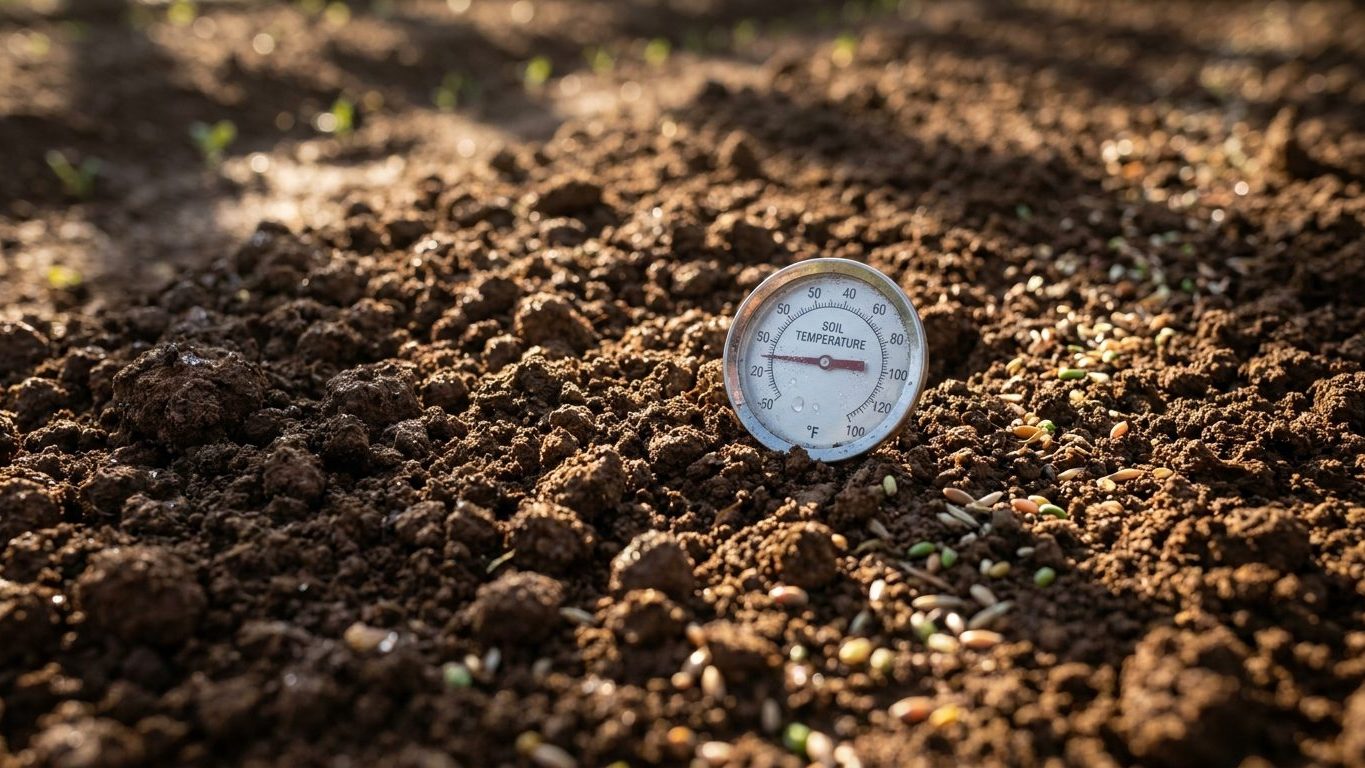
Frost date matters here mainly as a stand-in for something else: soil temperature. Seed doesn’t care what the calendar says about frost; it cares whether the soil around its roots has actually warmed enough to germinate instead of just sitting there and rotting. Soil lags behind air temperature by a week or two in spring, so the safe window for warm-season species like cowpea, buckwheat, or sunn hemp opens once that early-March frost risk has genuinely passed, not the day a chart says it should.
This is also where north Florida and the rest of the state part ways completely. Jacksonville is genuinely north Florida, and the airport station behind these numbers is an inland site; across the 30 years measured, three separate falls recorded no freeze at all. Push south past Orlando and frost becomes rare enough that gardens run effectively frost-free; get to Miami and it essentially doesn’t happen. In those regions the calendar inverts entirely, with the productive season running through the cooler months and summer becoming the thing to survive rather than the thing to plant into. None of the dates in this section belong to Orlando or Miami.
| Region | Frost pattern | Main cover-crop season |
|---|---|---|
| North Florida (Jacksonville reference) | Typical, last frost Feb 16-Mar 7, first frost Nov 26-Dec 13 | Fall through spring, with a warm-season stand possible in between |
| Central and South Florida | Rare to essentially absent | Winter is the main growing window; summer is the challenge |
For gardeners in the northern band, species choice at this point usually splits between legumes such as crimson clover or hairy vetch, sown for their nitrogen contribution, and grasses such as cereal rye or oats, sown for biomass and weed suppression. Exactly how much seed goes down per bed depends on the species, whether it’s broadcast or drilled, and the germination rate on the seed tag, so a single blanket rate would either waste seed or leave gaps. The University of Florida’s IFAS Extension service publishes rate tables by county and can match a figure to the actual spot being planted.
Termination follows the same rule as everywhere on this site: mechanical, not chemical. Mowing, crimping, or simply cutting a stand down before it sets seed turns the cover crop into a mulch layer instead of next season’s weed problem, and where a hard freeze does land, it often finishes the job for free.
How long the season lasts here
Subtract the two frost dates and the frost-free window around Jacksonville runs somewhere between roughly 264 and 300 days, depending on which end of each probability band a given year lands on: as short as early March to late November, as long as mid-February to mid-December. That’s a long season by most standards, closer to nine or ten months than the six or seven common further north.
A window that long changes the whole planning question. Instead of squeezing in one cover crop and hoping the timing works, gardeners here can realistically plan two: a warm-season stand established soon after the spring frost risk clears, terminated by mid-summer, followed by a second cover crop sown in fall that carries through the mild winter and gets terminated ahead of the next frost window. That’s the succession approach, and it’s worth reading through in more detail in this site’s succession sowing guide before committing to a two-crop plan for a specific bed.
The length of the window also changes whether transplanting is worth the trouble. In places where the frost-free season barely covers one cover crop cycle, gardeners sometimes start seedlings indoors just to buy a few extra weeks. Around Jacksonville, there’s usually enough built-in time to direct-seed and still check root development before committing to a second sowing, so the indoor head start that matters elsewhere isn’t doing much work here. It becomes more relevant only if someone wants to fit in a third, shorter cycle, or wants to run a longer-season legume like sunn hemp, which needs something like 60 to 90 days of growth before termination pays off in organic matter.
None of this applies south of the frost line the same way. Where frost barely exists, the “season length” question isn’t about counting days between two frost dates at all, it’s about how much of the winter stays cool enough for cool-season species to thrive before summer heat and rain shut the door on them, a separate calculation this page doesn’t cover.
Heat and water in Florida
The honest answer for this region is that winter, not summer heat, is the variable that decides the outcome. The mean daily minimum temperature for Jacksonville’s coldest month sits at 42.9 degrees Fahrenheit, according to NOAA’s 1991-2020 climate normals. That figure isn’t the record low for the season and it isn’t a monthly average; it’s the typical overnight low across the coldest month, and it sits comfortably above freezing. Combined with the fact that three of the last thirty falls at this station saw no freeze at all, it tells a clear story: a hard, reliable freeze isn’t something a cover-crop plan here can count on every year.
That mildness cuts both ways. The first fall frost, landing between November 26 and December 13 most years, sets the last realistic date to get a cool-season cover crop into the ground with enough runway to establish before growth slows. But the coldest month’s mild average minimum means that species which reliably die back into a mulch further north, oats being the classic case, often just keep limping along here instead of dying on schedule. In a colder territory, that’s a convenience; oats manage their own termination. In a territory this mild, it turns into extra mowing, because a stand that won’t die on its own has to be cut down by hand before it sets seed and becomes a weed the following season.
This page doesn’t have a station-level count of days above 90 degrees or a summer rainfall total to lean on, and it’s not going to invent one. What’s well documented for Florida generally is a humid, rain-heavy summer pattern, and for a cover crop that mostly means one thing worth watching: dense, damp foliage sitting in warm, wet air is exactly the setup that invites mildew and rot before a stand ever gets tall enough to terminate. Anyone planning a summer-season cover crop here should think about airflow between rows, not just species choice, going into the wet months.
Which cover crops suit Florida
None of this points to a specific variety, and that’s deliberate. The frost dates, the mild coldest-month minimum, and the long frost-free window all describe conditions, not products, and the cultivars that perform well under those conditions get sorted out through local trials, not through a general climate page. The University of Florida’s IFAS Extension service runs exactly those trials at the county level, and its recommendations reflect actual local performance in a way this page can’t.
What the conditions here do settle is the type of cover crop worth considering, by category rather than by name. The long fall-through-spring window favors legumes that need cool months to establish and build biomass slowly, such as clovers and vetches, alongside grasses that hold soil through a wet winter, such as cereal rye. A shorter warm-season gap between cool cycles favors faster types, cowpea and buckwheat among them, that can establish, grow, and get terminated before summer humidity turns against them. And because that humidity is the constant across almost the whole state, disease resistance within whatever type gets chosen deserves to be the first filter applied, ahead of biomass yield or nitrogen contribution, since a lush stand that rots in July isn’t contributing either one.
South and central Florida change this reasoning further still, since their frost-free or nearly frost-free winters shift the whole productive season into the cooler months and make summer the obstacle rather than the opportunity. A gardener in that part of the state working from this page’s north Florida dates would be planning against the wrong calendar entirely. That’s the last reason to route the actual species and timing decision through the extension office rather than a statewide guide: Florida’s own hardiness range, 8b through 11b on the USDA map, spans nearly the full range the system covers in the continental U.S., and a single set of recommendations can’t responsibly cover both ends of it.