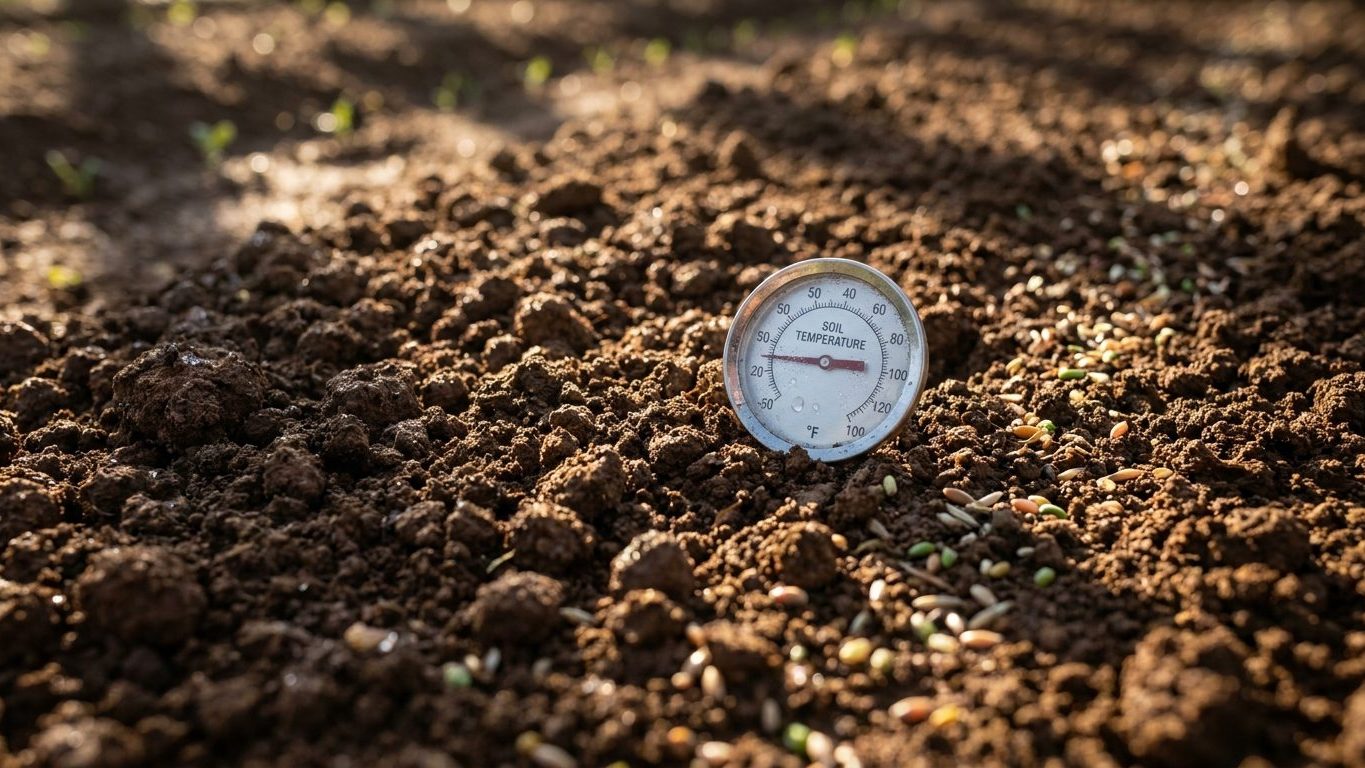

Georgia gardeners can start warm-season cover crops once soil temperatures climb past the mid-60s, which typically follows the last spring frost by two to three weeks, and can keep sowing cool-season species right up until the first fall frost locks the ground down for winter. The window is long, but the exact dates shift with elevation and how close you sit to the coast.
When the soil is warm enough in Georgia
The question everyone asks first is a date, so here it is: NOAA’s 1991-2020 climate normals put the last spring frost at the Atlanta station (USW00013874) somewhere between March 11 and March 29. That’s a 30-to-70 percent freeze probability band, not a single day, which means half the years in that window still carry real freeze risk on either side.
Frost date is a stand-in for something else entirely: soil temperature. Cover crop seed doesn’t care about air temperature on the morning you plant. It cares whether the top few inches of ground have warmed enough to trigger germination and hold it there without rotting the seed. For warm-season species like buckwheat, cowpea, and sorghum-sudangrass, that threshold sits well above freezing, closer to the mid-60s Fahrenheit, and soil lags behind air by roughly two to three weeks after the frost risk clears. Sowing on the frost date itself is usually too early for these species. Waiting until the soil has actually caught up is the safer bet.
None of this is a guarantee. A frost date is a probability drawn from thirty years of records, not a promise about this particular spring. Late cold snaps happen even after the 70 percent mark has passed, and a grower who plants the week the calendar says “safe” can still lose a stand to a rogue front moving down from the mountains.
What actually sets the rate
How much seed goes down per bed or per row isn’t a fixed number you can memorize from an article. It depends on the species you’re sowing, whether you’re broadcasting or drilling, how fine your seedbed is, and whether you’re planting a single species or a blend built for a specific soil goal. Those variables change enough from one situation to the next that a generic rate printed online does more harm than good. The University of Georgia Cooperative Extension (extension.uga.edu) publishes county-specific guidance and can walk you through the right rate for your exact setup, your soil test, and your goals, whether that’s erosion control, weed suppression, or building organic matter before a fall garden.
Termination follows the same logic on this site: mechanical, not chemical. Mowing, crimping, or simply letting a hard frost knock a stand down are the methods described here, and they work well for gardens where a sprayer isn’t part of the toolkit anyway.
How long the season lasts here
Stretch the two frost dates against each other and you get the working length of the Georgia growing year. Using the earliest possible spring frost (March 11) against the latest possible fall frost (December 1), the frost-free stretch runs about 265 days. Using the more conservative pairing, latest spring frost (March 29) against earliest fall frost (November 13), it shrinks to roughly 229 days. Either way, that’s somewhere between seven and a half and nearly nine months without a killing freeze, which puts most of Georgia among the longer growing windows in the eastern half of the country.
A window that long changes what’s worth attempting. Gardeners in shorter-season territories often get one shot at a summer cover crop between a spring harvest and a fall planting. Here, there’s usually enough calendar room for two. A quick-cycling warm-season cover like buckwheat can go in after early lettuce or spinach comes out, get mowed down six to eight weeks later, and still leave enough season for a second cover, or for the fall garden itself, before the first freeze shuts things down.
That second sowing question, whether it’s worth it, how to time it, and how to fit it between two cash crops, is exactly the territory covered in this site’s succession sowing guide, which walks through the timing math for stacking plantings inside a single frost-free window.
Length also changes whether transplanting makes sense versus direct seeding. In a shorter window, every week saved by transplanting matters, so gardeners lean harder on starts. In Georgia’s longer window, direct seeding a cover crop and letting it establish its own root system without transplant shock is usually the simpler, and often the more resilient, choice. Cover crops in particular are almost always direct-sown rather than transplanted, since the whole point is fast, cheap, disposable biomass, not a precious seedling worth babying indoors.
Heat and water in Georgia
For most vegetable crops, summer heat and rainfall totals drive the conversation. For cover crops, the calendar question runs the other way. What matters most is winter: when the first fall frost arrives, and how cold that coldest month actually gets, because those two facts decide which species survive the winter as living plants and which ones simply die back into a protective mulch on their own.
Georgia’s coldest month, drawing on the Atlanta reference station, averages a daily minimum of 35.6°F. That’s mild by the standards of the northern half of the country, and it sits right at the edge of where certain cover crop species stop reliably winterkilling. Oats, for instance, are prized in colder territories precisely because they freeze out cleanly, leaving a dead mat of residue that needs no mowing or crimping. In a climate with a 35.6°F average minimum for the coldest month, oats can survive milder winters instead of dying back, which turns a crop meant to disappear on its own into something that persists, reseeds, and behaves more like an unplanned volunteer than a tidy, self-terminating cover.
The first fall frost date, November 13 to December 1 at the Atlanta station, sets the last realistic sowing date for anything meant to establish before winter dormancy. Sow too late and a cool-season cover crop doesn’t get enough top growth or root development before cold slows it down, leaving a thin, patchy stand that does little for the soil.
Georgia’s USDA hardiness zone range, 6a through 9b across the state, reflects how much this varies by elevation and distance from the coast. That range is built on a single measure, the average annual extreme minimum temperature, and citing “Georgia” as one zone hides real differences. North Georgia and the mountains freeze weeks earlier in fall and hold colder minimums than the Atlanta reference figures suggest, while the coastal plain runs noticeably milder. A cover crop planting calendar built off Atlanta numbers needs adjusting in both directions depending on where in the state a garden actually sits.
Which cover crops suit Georgia
Reasoning from these numbers rather than from a seed catalog changes the shortlist. A long frost-free window, on the order of 229 to 265 days, gives room for both a quick warm-season cover and a full cool-season one in the same year, so timing pressure is lower here than in shorter-season states. A mild coldest-month minimum of 35.6°F means winter-active species need to be chosen for how cleanly they die back, not just how well they survive, since a plant that lingers into spring can turn into a weed problem in a mild year. And Georgia’s humidity, particularly across the coastal plain and the Piedmont, makes disease resistance a real factor for any cover crop left standing through a wet spring.
In practical terms, that means favoring types suited to warm, humid conditions with reasonable airflow between plants, and cool-season legumes and grasses chosen with an eye toward how reliably they winterkill rather than just how much biomass they produce. Species selection by type, legume versus grass, warm-season versus cool-season, clumping versus spreading, matters far more here than any single variety name.
This page won’t name a cultivar, and that’s deliberate. Seed companies trial dozens of varieties within each species, and performance differs by region even within a single state. A cover crop that thrives in the sandy coastal plain can struggle in the clay soils of the Piedmont a few hundred miles north. The University of Georgia Cooperative Extension (extension.uga.edu) runs regional trials and keeps current recommendations tied to actual local performance, not a generic list assembled for a national audience. That’s the recommendation worth following, because it’s the only one built on data from the ground a Georgia gardener is actually standing on.