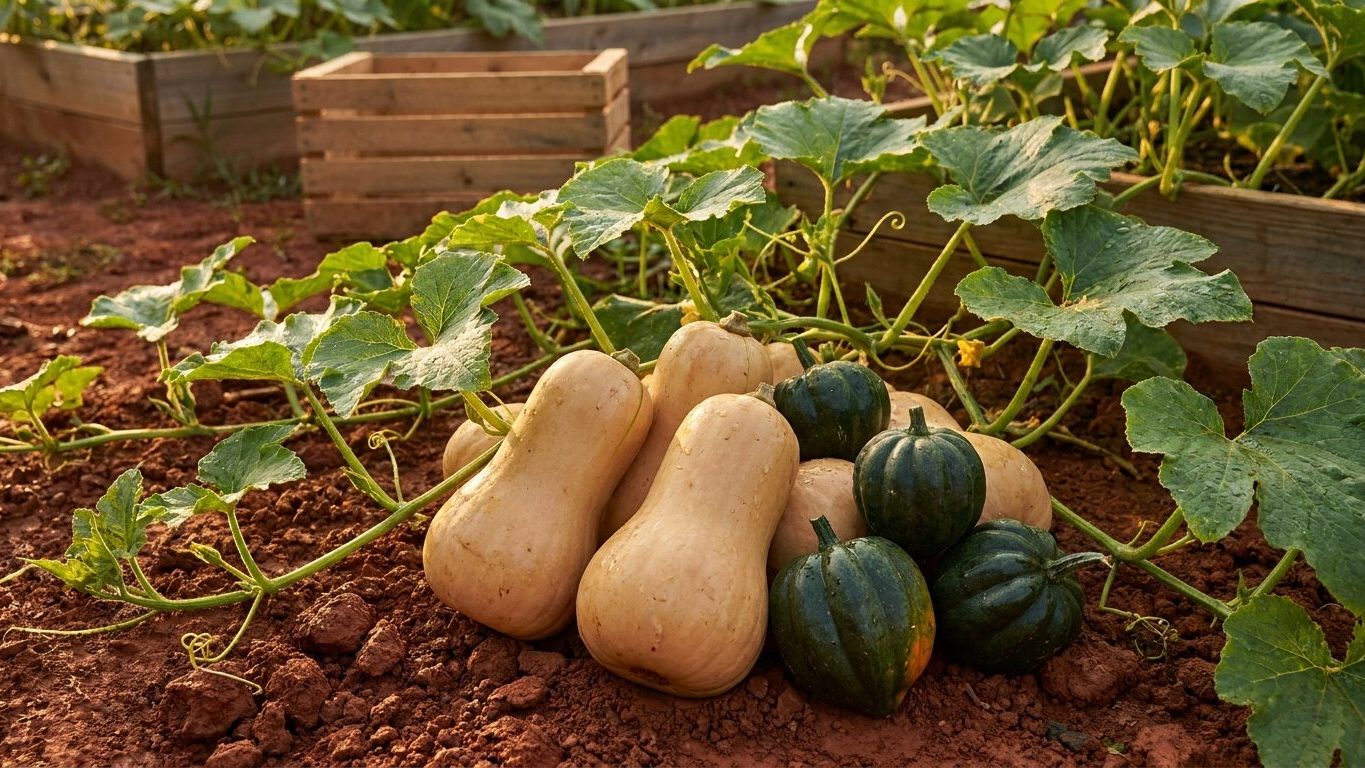

Butternut and other moschata-type squash top the list for most of Texas, thanks to their resistance to the vine borer and heat stress that wreck other winter squash here. Acorn and delicata can work too, but only if timed to dodge the worst of summer. Hubbard and kabocha are the riskiest bet outside the coolest parts of the state.
The short answer for Texas
The decision in Texas comes down to which species of winter squash you’re planting, not which variety name is on the seed packet. Cucurbita moschata, the group that includes butternut and the old tan “cheese” pumpkins, has a stem structure that resists squash vine borer far better than its cousins, and that single trait matters more here than almost anywhere else in the country. With 102.4 days a year at or above 90F at the Houston reference station, Texas gardens push winter squash through more heat stress than most seed catalogs assume, and moschata simply shrugs off more of it.
Cucurbita pepo, the group behind acorn, delicata, and spaghetti squash, matures faster and can still do well here, but the timing has to be deliberate. These vines mature in 80 to 100 days, which gives a Gulf-area gardener room to slip a crop in either before the vine borer moths peak in early summer or after that pressure fades, using the long frost-free window that runs from a last spring frost of February 4 to March 1 to a first fall frost of December 1 to December 19 at the Houston station.
Cucurbita maxima, the group covering hubbard, buttercup, and kabocha, is the hardest sell. These varieties often need cooler nights to set fruit reliably and take 100 to 110 days or more to mature, a stretch that runs headlong into the heaviest stretch of 90-degree days almost anywhere in the state except right along the coast or at higher elevation.
So the short version: lead with moschata for reliability, use pepo if you can time a spring or fall window around it, and treat maxima as a specialty crop for a narrower slice of Texas rather than a default choice.
What will not work here
Long-season maxima squash planted for a single spring-to-summer harvest is the most common failure pattern. A 105-day hubbard sown right after the last frost in early March is still filling out fruit in late June and July, exactly when the region logs the bulk of its 102.4 average days above 90F. Heat stress at that stage doesn’t just slow the plant, it can abort blossoms and stall fruit sizing altogether, so gardeners often end up with a lot of vine and very little squash.
Watering on a once-a-week schedule is the second failure point, and it trips up gardeners who’d otherwise pick reasonable varieties. Summer rainfall across the region averages only about 14.6 inches over June, July and August, with July the driest month at just 3.77 inches. That rain rarely arrives as a gentle, evenly spread soak. It tends to come as a thunderstorm that dumps an inch in an hour and runs off before it reaches the root zone, especially on clay soils common across much of the state. Combine that pattern with 90-plus-degree afternoons driving fast evaporation, and a squash vine on a weekly watering schedule is running a real moisture deficit for days at a stretch. Winter squash forgives a lot, but not a summer of inconsistent thirst during fruit set.
Dense spacing is the third trap, and it’s a humidity problem more than a heat one. Powdery mildew and other foliar diseases move fast through a squash canopy once afternoon humidity climbs, and packing vines close together, the way a lot of small-space garden plans suggest, keeps leaves wet longer and airflow low. Maxima varieties, with their sprawling, dense foliage, suffer the most from this, but even a tightly spaced pepo patch can lose most of its leaf canopy to mildew by late summer, well before the fruit has finished sizing up.
Finally, treating any statewide frost date as your own is a mistake worth naming directly. The window cited above, a last frost between February 4 and March 1 and a first frost between December 1 and December 19, comes from the Houston-area station and describes the mild end of the state’s climate, not the whole of it.
What changes across Texas
Texas carries a USDA hardiness zone range of 6a to 10a, and that spread is wide enough that no single planting recommendation covers the state. Zone 6a, found in parts of the Panhandle, and zone 10a, found near the Gulf coast and the Rio Grande Valley, describe two different growing realities separated by roughly 40 degrees of average annual extreme minimum temperature. There is no single answer here, only a range, and where a given garden sits inside that range changes almost everything about the calendar above.
A gardener in the northern or western part of the state, where winters run colder and frost-free seasons are shorter, should expect fewer than the 102.4 annual days above 90F recorded at the Houston reference station, and a narrower window between last spring frost and first fall frost than the Gulf-area dates cited earlier. That combination favors faster-maturing pepo types even more strongly, since there’s simply less runway to bring a 105-day maxima squash to harvest before frost shuts the season down. It also means vine borer pressure, while still present, arrives on a different calendar, so the planting-window strategy used along the coast needs to shift earlier or later to match local moth activity rather than Houston’s.
A gardener at the milder, southern end of the range gets the opposite trade-off: more heat, longer frost-free stretches, and more flexibility to squeeze in a second planting, but also more of the disease and heat-stress pressure described in the previous section, stretched over a longer season. Neither end of the range is easier across the board. It’s a different set of constraints to manage.
This page can’t tell an individual reader which zone their own garden falls into. The USDA Plant Hardiness Zone Map is built for exactly that lookup, and it’s worth checking directly against a home address rather than assuming based on the nearest big city.
Where to check this for your own county
Texas A&M AgriLife Extension, at agrilifeextension.tamu.edu, is the source built for this exact gap. A statewide page like this one can describe how species behave against heat, drought, and disease pressure in general terms, but it can’t replace a county-level planting calendar, and it shouldn’t try to.
Two things are worth looking for once there. First, the local planting calendar for the specific county, which will translate the frost-date ranges discussed above into dates that actually apply to that location rather than the Houston-area figures used in this piece. A county in the Panhandle and a county near Corpus Christi are both technically “Texas,” but their planting windows can differ by two months or more, and only a county-specific calendar captures that.
Second, look for the variety trial results or recommended-variety lists specific to that county or region. AgriLife’s county offices and regional programs often run their own variety trials under local soil and climate conditions, and those results carry more weight than a general species-level recommendation like the one above. A moschata variety that performs well in heavy clay near Houston may not be the same one recommended for sandy soils in the Trans-Pecos or the caliche-heavy ground of the Hill Country.
A county recommendation beats a state one every time, because it accounts for local soil texture, local pest pressure, and a planting calendar built from that specific area’s frost data rather than a single reference station. This page has given the mechanics behind the decision, the species-level logic, and the statewide range, but it is deliberately a state-level page. The county office is where that general logic gets converted into a date on a calendar and a variety name a neighbor down the road has actually grown.
Checking this against your own garden
No date on this page, or on any extension calendar, replaces what a garden itself is showing on a given week, and three signs are worth checking directly rather than trusting a calendar alone.
Soil warmth by feel is the first. Winter squash seed germinates poorly in cold soil no matter what the calendar says, so pressing a hand a few inches into the planting bed and feeling for warmth that holds through the morning, rather than soil that’s still cold from an overnight chill, is a better go-ahead than a printed date. Soil that stays cool to the touch into mid-morning usually means the ground hasn’t caught up to the air temperature yet, even after the last frost has passed.
The first flush of male flowers is the second sign worth watching. Squash plants typically produce male blossoms before female ones, and a strong early flush signals the plant has moved past initial establishment stress and into active growth. If male flowers show up but stall out with no females following within a week or two, that’s often a heat or moisture stress signal specific to that garden’s own microclimate, not something a regional average would catch.
The first true leaves, the second set that appears after the rounded seed leaves, tell a gardener whether a plant has actually established roots strong enough to support real growth, rather than just germinated. Slow, pale, or stalled true leaves after a seemingly good germination often point to a soil or drainage issue specific to that bed, something no statewide or even county calendar can flag in advance. Between these three signs, a gardener gets a read on their own patch of ground that outranks every date cited above.