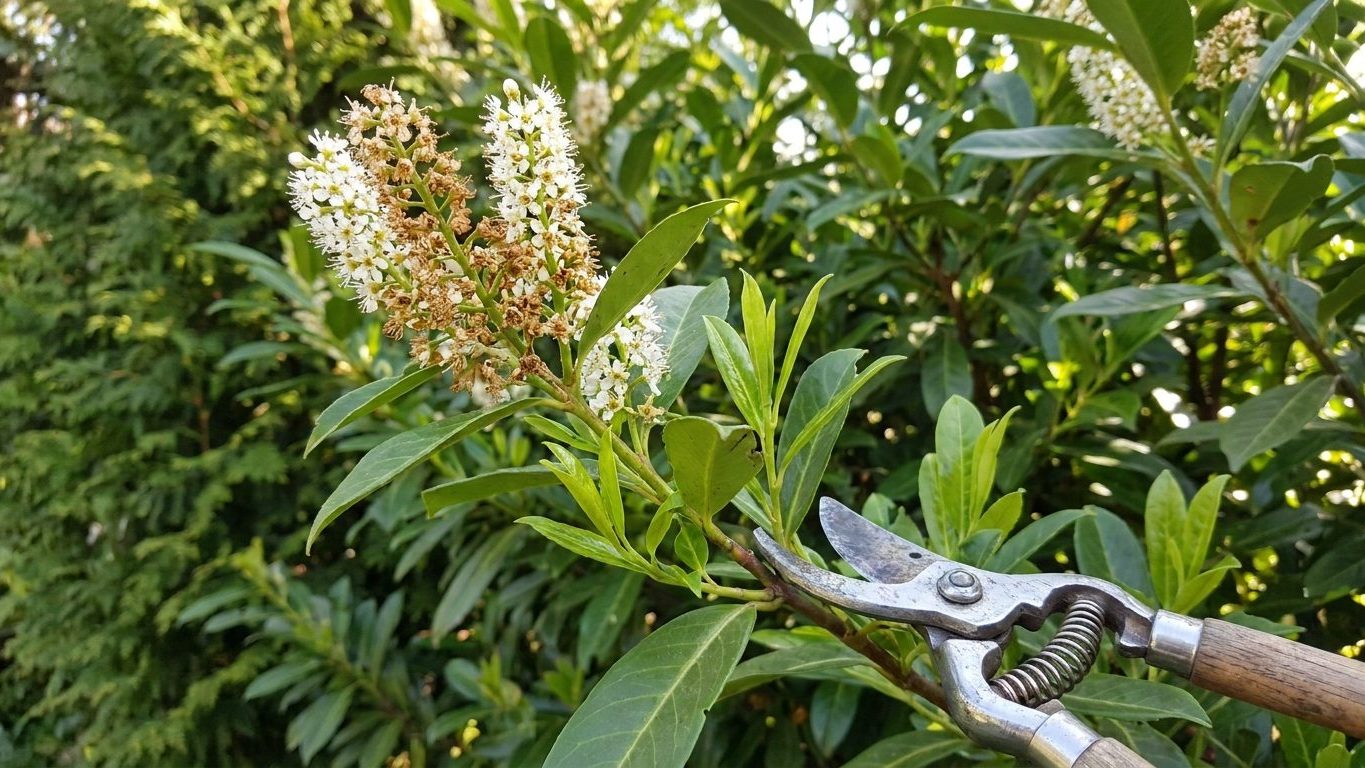

Cut cherry laurel back in late spring, once the white flower spikes have faded and before the season’s new shoots have hardened. That window works for both a light shaping pass and a hard cut into old wood. The exact week shifts with the zone, earlier in the warmer end of its range and later further north, but the plant’s own bloom cycle is the signal to watch, not a date circled on a calendar.
When to prune cherry laurel
The mechanism behind the timing
The flowering laurel signals more than a spring show. Once those upright white spikes brown and drop, the plant shifts its energy into the year’s main growth push, and that’s exactly when a cut heals fastest. Growing at 1 to 2 feet a year, cherry laurel throws enough new shoot growth over the following weeks to swallow up fresh pruning wounds and blend a hard line back into the hedge before winter arrives.
Cut the same hedge in September or October and that logic runs backward. Growth has already slowed for the year, the wound sits open through the cold months with no fresh tissue forming to close it, and any dieback around the cut edge has all winter to spread before spring growth arrives to compensate. University extension guidance across the plant’s growing range settles on the same answer for that reason: prune after bloom, not before winter.
Why zone matters more than the calendar
Cherry laurel is hardy from USDA zone 6 to zone 9, and flowering in the warmer end of that range can wrap up well before flowering finishes further north. A gardener near the Gulf Coast and one in the Ohio Valley are both watching the same plant signal, they’re just watching it happen weeks apart. That’s why the flower drop is the trigger to use, not a fixed date.
Because cherry laurel holds its leaves year-round, a hedge left unpruned into autumn also carries a rougher look through the entire dormant season, since nothing regrows to hide cut edges until spring returns. That’s a cosmetic reason to respect the same window, on top of the horticultural one. If the hedge needs a second, lighter tidy-up pass, doing it in late summer, well ahead of the first fall frost, keeps that new growth from getting caught out by cold before it firms up.
How hard you can cut it back
Why cherry laurel is different from conifers
Most advice about hard pruning gets built around conifers, and conifers do not carry dormant buds along bare wood. Cut a fence-line arborvitae hedge back into brown, leafless wood and that spot stays bare for good, because the plant has no living tissue left to push new shoots from. Cherry laurel carries dormant buds under the bark all along its older stems, so a cut into wood that looks solid brown and leafless still comes back green within a season.
That single fact is what makes cherry laurel the fix for a hedge that has outgrown its space. At 6 to 15 feet as a mature hedge, cherry laurel can be cut hard when it crowds a walkway or blocks a window, in a way most broadleaf and needled hedges simply cannot survive.
The staged renovation method
Renovate in stages rather than in one pass. For a hedge running 12 feet tall, the method looks like this:
- Year one: cut back the more visible or higher face to within a foot or two of the main stems, right after flowering.
- Year two: cut the opposite face or the top to the same close point, once the first side has filled back in.
- Year three, if the hedge is badly overgrown: even out height and width with a lighter shaping cut, since both sides now carry fresh growth.
Spreading the hard cuts over two to three seasons keeps the plant photosynthesizing on the untouched portions while the cut side regrows, instead of stripping the whole hedge bare at once and asking it to rebuild on stored energy alone. Skipping the staged approach and cutting a mature hedge back hard on every side in one session isn’t fatal to cherry laurel the way it would be to a conifer, but it costs a full season or more of thin, twiggy structure while the plant rebuilds leaf cover from nothing.
The shape that keeps the bottom alive
The taper that lets light reach the base
A hedge trimmed with straight vertical faces, or one that leans inward toward the top, shades its own lower growth without anyone noticing until the bottom goes bare. Every part of a hedge’s face needs direct sun to hold leaves, and a top-heavy profile blocks light exactly where it’s needed most, along the bottom two or three feet. Losing that light for a season or two is enough for cherry laurel to drop leaves low down and stop pushing new growth there, since the plant won’t spend energy filling a spot it can’t power with sunlight. That mechanism is behind a hedge that goes bald at the bottom, and once it happens, the low growth only returns once light reaches that zone again.
The shape that avoids the problem is a simple taper, base noticeably wider than the top, so the hedge reads more like a gentle A-frame than a flat wall. Every level of foliage then catches its own share of light instead of the top shelf shading everything below it. This matters most on hedges kept at the taller end of cherry laurel’s 6 to 15 foot range, where the light difference between top and base is greatest.
The one-third limit
Whatever shape a hedge is cut into, the amount removed in one session matters as much as the angle. Extension guidance holds to the same limit across most hedge species: never take more than one-third of a plant’s total foliage in a single pruning pass. Cherry laurel tolerates hard renovation cuts into old wood, covered above, but that’s a routine seasonal trim’s opposite case, not its equivalent. Take more than a third off a hedge that’s otherwise healthy and simply being shaped, and the plant responds with slower regrowth, thinner leaf cover the following season, and, in hot or dry weather right after cutting, some dieback on the stems cut hardest.
What actually kills cherry laurel
The two real threats
The two problems that actually take down a cherry laurel hedge are fungal, not cold or drought. Shot hole fungus riddles the leaves with small round holes and gives an established hedge a tattered, buckshot look, especially through wet spring weather when the fungus spreads fastest on foliage that stays damp. Root rot is the other threat, and it shows up in heavy, wet soil where water sits around the roots rather than draining away, a common problem in clay-soil hedgerows planted along a low fence line or a drainage swale.
What pruning changes
Pruning changes the odds on both problems without treating either one directly. A hedge left unthinned, dense through the middle, holds humidity inside its own canopy long after a rain shower has passed, and that trapped moisture is exactly what shot hole fungus needs to keep spreading from leaf to leaf. Opening that same hedge up with routine thinning cuts, removing some interior growth rather than only shearing the outer face, lets air move through the plant and dries leaves faster after rain.
Root rot has less to do with pruning above ground and more to do with drainage below it, but a hedge already stressed by wet roots recovers more slowly from any cut, hard or light. On a site with heavy or slow-draining soil, that’s a reason to keep hard renovation cuts to the staged, gradual approach rather than removing a large share of the canopy at once.
For a planting or disease question specific to a region, a state’s cooperative extension service, among them Penn State Extension, Clemson Cooperative Extension, NC State Extension, and UMass Extension, is the reliable place to check local disease pressure and confirm a planting decision.
Common questions
Can cherry laurel be cut back to bare wood without killing it?
Yes. It carries dormant buds under the bark along its older stems, so cuts into bare, leafless wood still push green growth within weeks of a spring cut, something most conifer hedges cannot do.
When is the worst time to prune cherry laurel?
Late in the growing season, once growth has already slowed for the year. A fall cut leaves the wound open through winter with no fresh tissue forming to close it, raising the odds of dieback around the cut edge.
How often does a cherry laurel hedge need trimming?
One main cut in late spring after flowering handles most hedges for the year. A second, lighter tidy-up in late summer works for hedges that push untidy regrowth, done well ahead of the first fall frost.
How tall will an unpruned cherry laurel hedge grow?
Left untrimmed, it grows at 1 to 2 feet a year and, as a mature hedge, typically reaches somewhere in the 6 to 15 foot range depending on the site and how long it’s gone without a cut.