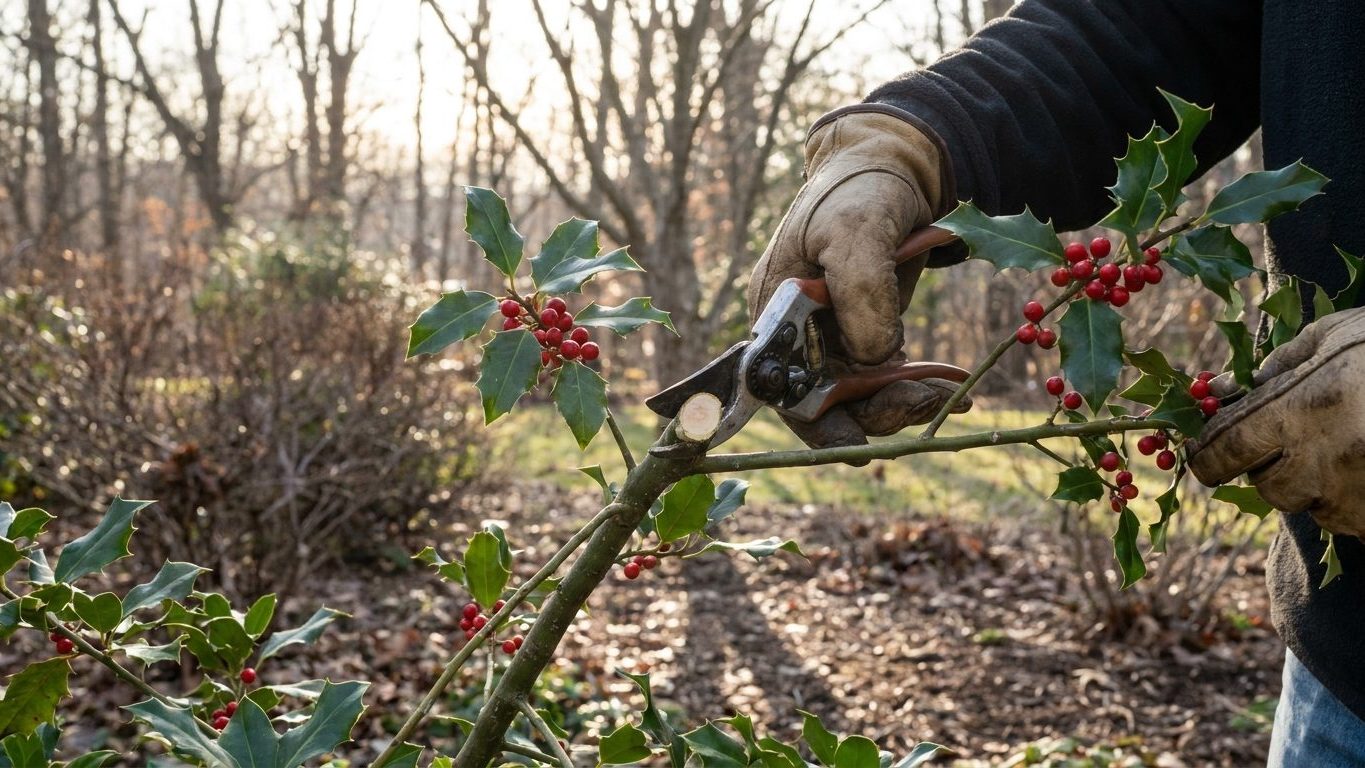

Prune holly in late winter, while the plant is still dormant and before new growth starts. That timing lets the spring flush of leaves cover fresh cuts within weeks, instead of leaving open wood exposed through a hard freeze. The exact week shifts by region, earlier in the Deep South, later in New England, but the plant’s own dormancy, not a date on the calendar, tells you when to start.
When to prune holly
Dormancy is the signal, not the season name. Holly stops pushing new growth once fall nights turn cold, and it stays shut down until the days lengthen and soil warms enough to trigger a fresh flush of leaves. Cut the plant during that dormant stretch and the wound sits closed for a few weeks, then disappears under new growth. Cut the same branch in October instead, and that wound stays bare and exposed through the coldest months of the year, with no leaf cover forming until spring.
That’s why late winter, right before growth restarts, is the window extension horticulture programs point to for this species. It isn’t a fixed date. Holly is hardy across USDA zones 5 through 9, a range that stretches from coastal Massachusetts to the Gulf Coast, and the point where winter loosens its grip shifts by weeks from one end of that range to the other. A gardener in South Carolina might see buds swelling in early February. A gardener in central Pennsylvania is often still waiting into March. A regional Cooperative Extension Service office can confirm the frost-free date closest to your county, then the cut goes in during the two or three weeks before growth typically resumes there.
Watching the buds is a more reliable check than watching the calendar. In the weeks before growth restarts, the buds along each stem swell and take on a rounder shape, and younger bark loses some of its winter dullness. Cutting a week or two before that swelling starts still lands inside the dormant window. Waiting until small leaves are already unfurling means the plant is spending stored energy on growth a saw or shears will remove, which slows recovery instead of speeding it.
How hard you can cut it back
Holly carries dormant buds tucked under its bark, along the full length of every branch, not just near the tips. That detail changes the answer for this species. Most advice about renovating an overgrown hedge gets written with conifers in mind, and conifers like arborvitae or spruce only carry live buds on the outer layer of green growth. Cut a conifer back into bare, leafless wood and that section never sprouts again. Holly is built differently. Because those dormant buds sit ready under the bark of even old, gray wood, a hard cut into what looks like dead stem still produces new shoots by the following summer.
That means an overgrown holly hedge, one that’s crept out to 15 feet and lost its shape, doesn’t need to be replaced. It needs a plan spread across a few seasons instead of one drastic cut. Taking the whole hedge down to stumps in a single pass works on paper, but it strips off every leaf at once, and a plant with no foliage can’t photosynthesize enough to push a full recovery quickly, especially on an older hedge. Spreading the renovation over two to three winters gets the same result with far less risk, and it keeps part of the hedge screening the yard while the rest recovers.
| Season | What to cut | What to expect |
|---|---|---|
| Winter one | One side of the hedge, cut back hard to 12-18 inches from the main stems | Bare wood on that side through spring, new shoots by early summer |
| Winter two | The opposite side, cut back the same way | First side leafed out and covering; second side bare through spring |
| Winter three | Light shaping cut across the whole hedge to even the new growth | Hedge reads as one shape again, full coverage by the following year |
Skipping the staged approach doesn’t ruin holly the way it would a conifer, but it does cost a full growing season of screening and slows the plant’s overall recovery, since it has to rebuild foliage on every side at once instead of leaning on the half that’s already covered. Because regrowth comes from old wood, a renovation that gets interrupted for a year isn’t wasted either. It just picks up again from where it stopped at the next dormant window.
The shape that keeps the bottom alive
A hedge sheared with dead-straight vertical sides, or worse, sides that lean in toward the top, blocks its own light from reaching the lower branches. Once the top and middle fill in, they shade everything below, and holly’s lower leaves start dropping wherever sunlight can’t reach. That’s the mechanism behind the bare, leggy look at the bottom of so many overgrown hedges, and it isn’t a disease or a soil problem. It’s a shape problem, caused by shears.
The fix is a taper: cut the hedge so the base stays wider than the top on both sides, angling the face inward slightly as it rises. A hedge with a base about 6 inches wider than the top, on each side, lets sunlight reach the lower branches at an angle even once the upper growth fills in, and that keeps leaves growing all the way to the ground instead of only at eye level and above.
How much comes off in any one pass matters as much as the angle. The standard guidance across extension programs for shrubs that respond to renewal pruning is the one-third rule: remove no more than about a third of the plant’s total growth in a single session, outside of a planned renovation like the staged schedule above. Take more than that off a hedge that isn’t mid-renovation, and the plant redirects stored energy into replacing lost foliage instead of building roots or berries. The one-third limit is the point where a plant this size recovers within the same growing season, instead of needing a second year to catch up.
The taper matters most on the sides that get sheared every year, not just during a one-time renovation. A quick check: stand at one end of the hedge and sight down its face. If the top and bottom lines run parallel, or the top overhangs the bottom, that hedge is heading toward bare wood below. Fixing it just takes a slight inward lean on the top of each pass, repeated yearly until the taper holds on its own.
What actually kills holly
Two problems account for most of the trouble reported to extension offices on this species: leaf miner and winter scorch. Leaf miner larvae tunnel inside the leaf tissue, leaving pale, blotchy trails, and heavy infestations weaken a plant over several seasons rather than killing it outright in one year. Winter scorch shows up on exposed sites, where wind and winter sun pull moisture out of the leaves faster than frozen roots can replace it, leaving brown, dried patches on the side of the plant facing the worst weather. Corners exposed to prevailing wind, and hedges near a road that gets winter salt spray, show scorch most often.
Pruning changes the odds mainly through disease pressure. A hedge sheared into a dense wall with no airflow through the middle holds humidity against its own leaves after every rain, and that damp, still air is exactly what fungal problems need to spread once they’re introduced. Thinning out crossing and crowded interior branches, on top of the regular shape cuts, opens that airflow back up and lets leaves dry faster, which is the main defense pruning offers on a plant that doesn’t carry many other vulnerabilities once established in the right zone.
One more detail matters for anyone planting a hedge from scratch: berries need a male plant growing nearby, and a hedge made from a single cloned variety, all female or all propagated from one plant, never sets fruit no matter how it’s pruned. That’s a planting decision, not a pruning fix, and it explains why a well-shaped, healthy holly hedge can still go a lifetime without berries. For identifying leaf miner damage or scorch symptoms on a specific plant, a state Cooperative Extension Service, the kind run through Penn State, Clemson, NC State, or UMass, is the resource built for that local diagnosis.
Common questions
Can you prune holly in summer?
A light shaping cut in summer won’t hurt an established hedge, but it won’t heal over the way a late-winter cut does, since the plant has already spent its main growth push for the year. Save any hard renovation work for the dormant window instead.
How do you know if holly is dead or just dormant after a hard cut?
Scratch a small patch of bark on a cut stem. Green or white tissue underneath means the branch is alive and will bud out once growth resumes. Brown, dry tissue all the way through means that section is gone, though the plant typically still sends up new growth from lower buds.
Does holly need pruning every year?
A hedge kept in shape benefits from one shaping pass a year, timed to the dormant window, to hold the taper and control size. A holly grown as a loose specimen shrub, left to its natural form, needs far less regular cutting.
Can you prune holly to control height for good?
Not permanently. Holly keeps growing 6 to 12 inches a year regardless of past pruning, so height control is an ongoing yearly task, not a one-time fix, unless the hedge is replaced with a shorter-growing variety suited to that spot.