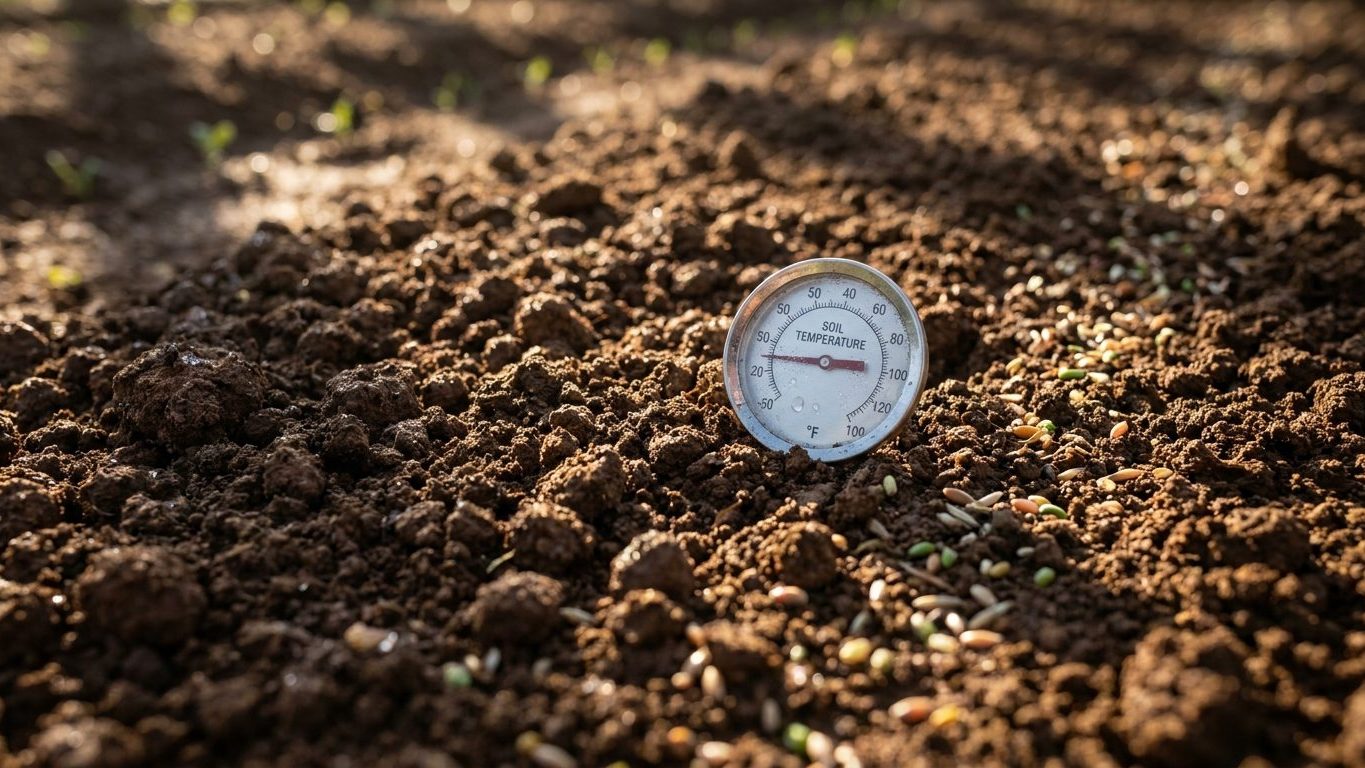

In Idaho, the answer to when you can grow a cover crop shifts by hundreds of miles and thousands of feet of elevation. A Boise gardener sows weeks before someone in the Sawtooth foothills even sees bare ground. What stays constant is the logic: soil temperature triggers germination, the first fall frost caps the growing window, and winter cold decides which species survive to spring.
When the soil is warm enough in Idaho
Ask five Idaho gardeners when to sow a cover crop and you’ll get five different dates, because the real trigger isn’t the calendar. It’s soil temperature, and soil warms on its own schedule, days or weeks behind the retreating frost risk.
The frost date, and what it actually measures
At the Boise reference station (NOAA station USW00024131), the last spring frost falls somewhere between April 23 and May 7. That window comes from the 1991-2020 Climate Normals, calculated as the range where the probability of a 32°F freeze falls between 30% and 70%. It’s a probability, not a promise: some years slip earlier, some later, and a late cold snap in early May sits well within the historical record even at the low end of that range.
That date describes the air, not the soil that roots actually depend on. Bare ground in a Boise backyard typically needs another one to two weeks of settled warmth before soil temperature at seeding depth climbs into the range most cover crop species need to germinate reliably. Cool-season species tolerate cooler ground and can go in close to the frost date itself; species that build most of their biomass in summer heat do better waiting until the soil itself, not just the air, has caught up.
Why elevation changes everything
Boise is the easy case. It sits in a low, sheltered valley, and most of the state farms and gardens at meaningfully higher elevation, where the growing season compresses and both frost dates and soil warming lag well behind what a Boise resident experiences. A gardener two hours from Boise in a mountain valley should treat that April 23 to May 7 window as a floor, not a target, and expect their own soil to lag by weeks rather than days.
Rather than guess at a seeding rate, treat that number as something to source locally: it changes by species, by whether you’re broadcasting or drilling, and by the seed source’s own germination testing. The University of Idaho Extension keeps current guidance by county and can point to trial data specific to your elevation. When it’s time to end the cover crop’s growth, mowing, crimping, or simply letting a hard frost do the work are the mechanical options this approach relies on, no spray required.
How long the season lasts here
Subtract one frost date from the other and Boise’s frost-free window runs somewhere between 153 and 181 days, depending on which end of the probability band a given year lands on. The earliest realistic start (April 23) paired with the latest realistic fall frost (October 21) stretches to 181 days, while a late spring start (May 7) meeting an early fall frost (October 7) shrinks the window to 153 days. That’s still a genuinely long season by cover crop standards, even at the short end.
What a long or short window changes
A window that size changes the whole calculus. In much of the Mountain West, gardeners get exactly one shot at a cover crop: seed it after the last cash crop comes out, watch it grow through fall, and let winter finish the job. Boise’s five-plus months open up a second option, a full cycle of a fast-growing cover crop between an early harvest and a fall planting, or a true succession where one cover crop is terminated and a second is sown before the first frost shuts things down.
If that second sowing is what you’re after, the timing and species choice both need more detail than fits here. The succession sowing guide on this site walks through how to stack two cover crop cycles inside one growing window without running out of daylight or soil warmth for the second seeding.
Where the window is shorter, closer to that 153-day floor, the math gets less forgiving. A cover crop sown directly in the ground eats into the season simply germinating and establishing roots, weeks that a transplanted start would skip. That’s the point at which checking root development on a transplant, rather than trusting a calendar date, starts to matter more than it does in a longer season: a root-bound start set out too late gains little from the extra weeks in a pot, while a healthy transplant put in the ground can use every one of those 153 days productively.
Elevation erases most of this arithmetic outside the Boise valley. Gardeners farther up in elevation are working with a compressed version of this same window, sometimes by a month or more on either end, which pushes many of them toward a single-sowing pattern regardless of what the math above suggests works at the valley floor.
Heat and water in Idaho
Summer heat and rainfall shape which vegetables thrive in a given Idaho garden, but for cover crops sown after harvest, that’s mostly the wrong season to worry about. The crop that matters here grows in fall and winter, and the number that actually decides its fate is the coldest month’s average low, not July’s high or August’s thunderstorms.
The number that matters
At the Boise reference station, the coldest month’s mean daily minimum runs 25.4°F. That’s not the record low and not the average for the whole month; it’s the average night, which is exactly the figure that separates a cover crop that survives winter from one that doesn’t. A species that tolerates temperatures well below that line will overwinter as a living plant and need active termination in spring. A species that doesn’t will die back into a mulch on its own, saving a mowing or crimping pass but leaving bare soil sooner than a survivor would.
One state, several climates
That 25.4°F figure is also why the same species behaves differently depending on where in Idaho it’s planted. Idaho’s USDA hardiness zones span 3b to 7b across the state, according to the USDA Plant Hardiness Zone Map built on 1991-2020 normals, a range wide enough to cover both genuinely mild valley floors and some of the coldest inhabited ground in the Mountain West. That range describes the state, not any one garden; the Boise figure above applies to Boise, and a gardener at higher elevation or farther north is very likely gardening in a colder zone within that span, where a species that reliably winterkills in Boise might instead persist as a living plant needing to be cut or crimped by hand come spring.
What this means in practice: a species chosen because it dies back cleanly in one part of Idaho can turn into unwanted spring cleanup in a milder pocket of the same state, and the reverse holds too. A species picked for its cold-hardiness in a harsh mountain valley may simply not experience enough cold in a warmer valley to behave the way it’s supposed to. That’s a reason to treat the coldest-month figure for the specific location, not a statewide average, as the number that actually governs the choice, and to lean on local extension data from the University of Idaho Extension rather than a single number for the whole state.
Which cover crops suit Idaho
Idaho’s range, from the frost dates around Boise to the far colder ground at elevation, means no single cover crop type is right for the whole state. But the facts already laid out point toward how to sort through the options, by type rather than variety.
Sorting by season length
Where the season is short, closer to that 153-day floor or shorter still at elevation, the earliest-maturing types in each category have the advantage. A fast broadleaf or a quick-germinating grass that can put on meaningful biomass before the first fall frost (October 7 to October 21 around Boise, earlier at elevation) does more good than a slower one that’s still small when cold shuts growth down. Sowing right after the frost-free window’s last useful planting date, rather than waiting, buys those extra weeks.
Sorting by winter behavior
Winter behavior is the second sorting question, and it comes straight from the 25.4°F coldest-month figure. Some grasses and broadleaves reliably winterkill at temperatures well above that line, dying back into a mulch on their own and leaving the gardener nothing to terminate by hand come spring. Others tolerate much colder nights and persist as living plants through winter, which means they need mowing, crimping, or cutting before they go to seed or compete with whatever’s planted next. Neither habit is better in the abstract; it depends on whether a self-terminating crop or a spring management chore fits the garden better, and on which side of that 25.4°F threshold the actual winter tends to land.
Legumes deserve a mention on their own terms: nitrogen-fixing types work through soil bacteria, and how much nitrogen ends up available depends on the species, how much biomass it built before termination, and when in its growth cycle it’s cut down, not on any fixed number a label can promise.
None of this replaces a straight answer from someone working with local trial data. The University of Idaho Extension tests specific varieties against the state’s actual range of elevations and frost patterns, and that local trial data, not a cultivar name printed on a national seed catalog, is the only recommendation worth following once the type has been narrowed down using the facts above.