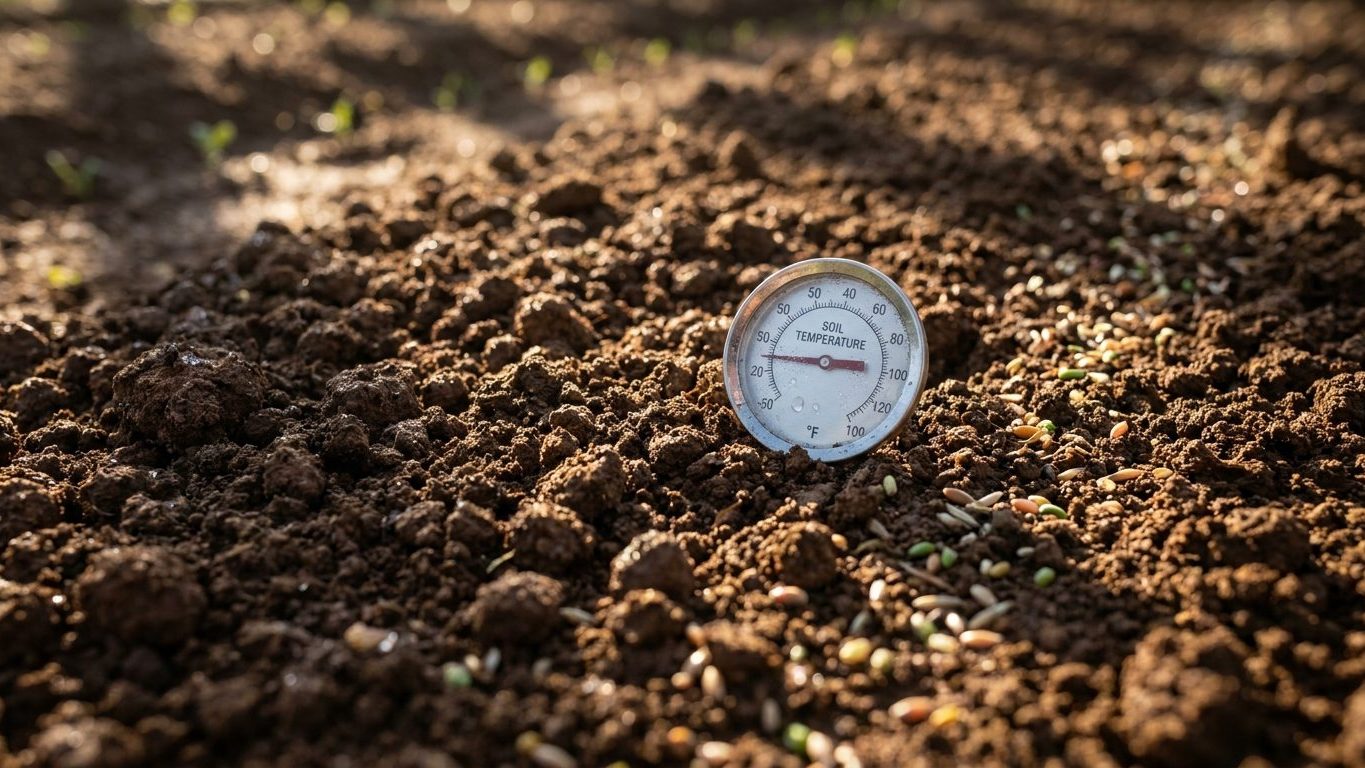

In Illinois, cover crops go into warm soil, not just frost-free air, and that soil warms up roughly two to three weeks after the average last spring frost. The window then runs into fall, closing when the first hard freeze hits, with the exact dates and what they mean for species choice, termination timing, and second sowings covered below.
When the soil is warm enough in Illinois
Gardeners often ask for a single calendar date, but soil temperature and air temperature are two different clocks. At Chicago O’Hare International Airport, NOAA’s 1991-2020 Climate Normals put the last spring frost (32°F) somewhere between April 11 and April 22, a 30-70% probability band, not a fixed day. That’s the frost date. Soil warmth is a separate, slower event: bare ground under Illinois skies typically needs another one to three weeks past that frost window before it holds steady warmth at planting depth, especially in clay-heavy fields that stay cold and wet into spring.
That distinction matters because a frost date is a probability, never a promise. A garden in the Chicago suburbs or out in rural DeKalb or Kankakee County can see frost later than the airport station shows, sometimes by one to two weeks, and low-lying or rural sites cool off faster than the pavement and buildings around an airport runway. So treat April 11 to April 22 as a starting reference, then watch your own soil, not just the calendar.
What actually decides when to sow
Cool-season species like oats, cereal rye, clover, and field peas tolerate cold soil and light frost, so they can go in as soon as ground can be worked, well before that spring frost window closes. Warm-season options such as buckwheat wait longer, since they sulk or fail outright in cold, wet ground. The right seeding rate depends on the species, the seeding method (broadcast versus drilled), and the seed source itself, which is exactly why this page won’t hand you a pounds-per-acre number that might be wrong for your setup. The University of Illinois Extension, at extension.illinois.edu, publishes rate tables tuned to Illinois conditions and updates them as trial data comes in.
Termination is the other half of the timing question, and this is where a lot of first-time growers stumble. There’s no herbicide step here: cover crops on a home garden scale get terminated mechanically, by mowing, crimping, cutting, or simply letting a hard frost finish the job on tender species. Oats, for instance, winterkill on their own in a typical Illinois winter, leaving a dead mat that can be worked into the soil or left as mulch. Cereal rye doesn’t die back the same way and needs a physical cut before it heads out and turns woody.
How long the season lasts here
Running the numbers from both ends of the frost window gives a rough season length. Using the earliest last-spring-frost date (April 11) against the earliest first-fall-frost date (October 24) yields about 196 frost-free days. Using the latest dates in each range, April 22 to November 3, gives about 195 days. So the frost-free window at the Chicago reference station runs somewhere around 195 to 200 days, a little over six months, depending on which end of each range plays out in a given year.
That’s a genuinely long window by national standards, and it changes what’s worth attempting. A six-month stretch leaves room for more than one cover crop cycle: an early spring planting that gets terminated by early summer, followed by a second sowing timed to build soil ahead of fall, or a fall-planted cover that overwinters and gets turned under the following spring. Gardeners in shorter-season territories often have to choose one sowing and commit to it; Illinois gardeners generally get to choose two, provided they plan the termination date for the first one before it starts competing with whatever comes next.
The catch is timing the handoff. A cover crop terminated too late eats into the window for the next planting, whether that’s a second cover crop or a food crop going in behind it. This is also where the case for transplanting versus direct seeding gets decided: a longer runway means there’s more slack to transplant seedlings started indoors rather than direct-sow and wait, since even a slow-to-establish species has time to catch up. For the mechanics of stacking two or more plantings into a single season without one crowding out the other, the succession sowing guide on this site walks through the sequencing in more detail than fits here.
Remember that the fall end of this window shifts too, and usually shifts earlier than the airport figure suggests. Rural gardens and low spots see that first fall frost arrive sooner than the October 24 to November 3 range implies, sometimes by a week or two, which trims the season length calculated above. Treat the 195-to-200-day figure as an upper bound for a well-sited suburban garden, not a guarantee for every county.
Heat and water in Illinois
For a cover crop, the defining season isn’t summer, it’s winter. The first fall frost sets the last sensible date to get a cover crop into the ground with enough time to establish before growth stalls, and the coldest month of the year decides which species make it through as living plants and which simply die back into a protective mulch. At the Chicago reference station, the coldest month averages a daily minimum of 18.8°F, a temperature that reliably kills back tender annuals like oats and buckwheat while leaving hardier options like cereal rye and some clovers alive and green under snow cover.
Why the state’s hardiness range matters here
Illinois spans USDA Hardiness Zones 5a through 7b, one of the widest ranges of any state in the Midwest, running from the colder north near Chicago down to the milder river bottoms of the far south. That range changes the whole calculation. In the northern two-thirds of the state, where winter lows regularly dip well below the mid-20s, oats winterkill on schedule almost every year, and that predictable die-off is exactly why gardeners rely on them: no cutting required, just a clean mat by spring. Further south, where winters run milder and closer to zone 7, that same oat crop can survive an unusually mild stretch and start regrowing, turning what was supposed to be a tidy, self-terminating cover crop into a volunteer weed that needs mowing after all.
Specific counts for days above 90°F and summer rainfall totals aren’t part of what’s verified for this page, and guessing at them would do more harm than good. What is worth flagging: Illinois summers run humid enough, especially in July and August, that dense cover crop stands can develop powdery mildew or slow to ripen if airflow at the base of the planting is poor. That’s a bigger practical risk for most home gardeners here than heat stress itself, and it’s a reason to favor looser stands and earlier termination over letting a cover crop grow thick and tall through peak summer humidity.
Which cover crops suit Illinois
The species that make sense here follow directly from the two facts above: a wide hardiness range that runs from reliably cold in the north to borderline mild in the south, and a long, humid growing season that rewards disease resistance over raw toughness.
In broad terms, three groups cover most of what a home gardener needs to consider:
- Cool-season grasses like oats and cereal rye, valued for fast fall establishment and, in the colder two-thirds of the state, predictable winterkill that leaves a mulch instead of a mowing chore.
- Legumes such as clover, field peas, and vetch, which fix nitrogen through their root systems as they grow, contributing more to soil fertility the longer they’re allowed to build biomass before termination.
- Fast warm-season fillers like buckwheat, useful for short gaps between other plantings but frost-tender enough that they die at the first real cold snap, which in a mild southern Illinois winter may not come as early as expected.
Which exact variety within any of those groups performs best is a question this page deliberately won’t answer. Cultivar-level recommendations depend on local disease pressure, trial results, and seed availability that shift from one growing season to the next, and a name printed here today could be the wrong call by next spring. The University of Illinois Extension runs its own regional trials and keeps that information current at extension.illinois.edu, and that’s the source built for exactly this decision, not a general guide covering a state that runs from Chicago’s suburbs to the Ohio River.
Seeding rates follow the same logic. How thick to sow depends on the species chosen, whether it’s broadcast by hand or drilled, and the germination rate of the specific seed lot, none of which a general guide can respect with a single pounds-per-acre figure. Termination, once again, stays mechanical here: mowing, crimping, or simply letting winter do it, matched to whichever species and region apply to the garden in question.