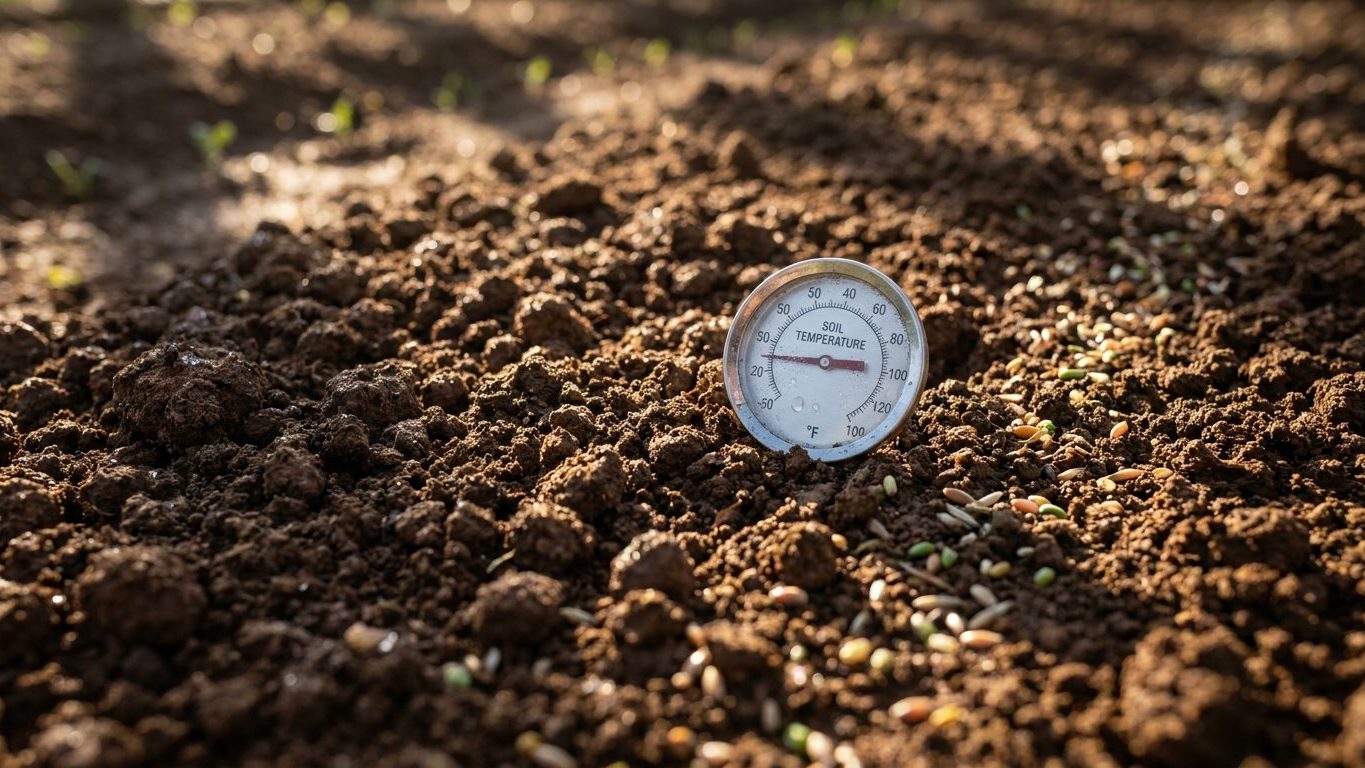

Cover crops go in the ground in Indiana once soil temperatures climb past the low 50s, which typically happens a few weeks after the last spring frost risk fades in the Indianapolis area. The window closes again in fall as the first hard frost approaches, and the state’s cold winters decide which species survive to spring and which die back on their own.
When the soil is warm enough in Indiana
Gardeners keep asking for a date, so here it is: NOAA’s 1991-2020 Climate Normals put the last spring frost at the Indianapolis station (USW00093819) somewhere between April 9 and April 21. That’s a probability band, not a promise, and Purdue’s own extension research adds a blunt caution worth repeating once: there’s still roughly a 10% chance of a 32°F freeze event after that spring date even lands. Anyone seeding on the early edge of that window should have row cover or an old sheet within reach.
But frost is only a proxy for what actually matters, which is soil temperature. Air can clear 32°F for good while the top few inches of dirt are still cold enough to stall germination. Cover crop seed doesn’t care what the thermometer on the porch says. It cares whether the soil itself has warmed enough to wake it up, and that lag between air and soil can run one to three weeks depending on how wet the ground stayed through winter and how much direct sun a bed gets.
That gap explains why two gardeners twenty miles apart in central Indiana can seed the same species a week apart and both be right. It also means the frost date is a starting point for a mental calendar, not a trigger to run out with a seed bag the morning after. Southern Indiana warms earlier in spring than the Indianapolis reference point, sometimes by two weeks or more, while the northern third of the state lags behind it. If a gardener gardens outside the Indianapolis corridor, the local pattern shifts, and the safest move is to watch the soil rather than the calendar.
What decides how much seed goes down
Seeding rate isn’t a single number worth memorizing here, because it moves with the species chosen, the method used to get seed into the ground (broadcast versus drilled), and even the seed source’s own germination testing. A rate that fits a legume broadcast over bare soil doesn’t fit the same legume drilled into a lightly tilled bed. Rather than guess, the reliable move is a call or visit to Purdue Extension, which tracks current, locally verified rates for the species growing in Indiana conditions.
Termination follows the same logic on this site: no herbicide talk, no product names. Cover crops here get cut down mechanically, by mowing, crimping, or simply letting a hard frost do the work for a tender species that can’t survive the state’s winter lows.
How long the season lasts here
Stack the two frost dates from the NOAA Climate Normals and the outdoor growing window in the Indianapolis area runs from roughly April 9-21 in spring to October 21-30 in fall. That’s about six months of frost-free ground, give or take the probability spread baked into both ends.
Six months sounds generous until it’s divided by what actually needs to happen in it. A spring-sown legume or grass needs time to establish, build enough biomass to matter, and then get terminated before a summer vegetable crop wants that same bed. A fall-sown cover crop needs to germinate and put down roots before the October frost line arrives, then either winterkill on its own or sit dormant until spring. In a six-month window, there’s real room for a spring cover crop, a summer vegetable planting, and a fall cover crop in the same bed, provided the timing of each stage is respected rather than rushed.
That’s the difference a longer window buys: sequence. A gardener working a bed on a six-month frost-free stretch can treat cover cropping as a rotation partner to the vegetable garden rather than a one-off event squeezed in before or after the “real” growing season. Where the window runs shorter, closer to four months in a harder northern Indiana winter, that sequencing tightens up considerably. The first sowing often becomes the only sowing that fits, and gardeners have to decide upfront whether a cover crop occupies a bed for the full season or gets displaced by a vegetable transplant partway through.
That decision, transplant now versus let the cover crop finish its job, comes down to root competition more than anything else. A young tomato or pepper transplant dropped into a bed still hosting an actively growing cover crop is competing for the same moisture and nutrients at the exact moment it needs both uncontested. Waiting those extra two or three weeks for a full termination and light till-in usually pays off more than the head start a slightly earlier transplant date offers.
Gardeners looking to string more than one planting into that window, cover crop followed by vegetables followed by another cover crop, will find the mechanics of that timing laid out in this site’s guide to succession sowing, which walks through how to stack plantings without either one shortchanging the other.
Heat and water in Indiana
For a vegetable garden, midsummer heat and rainfall dominate the conversation. For cover crops, they mostly don’t. The question that actually decides how a cover crop performs in Indiana is what happens after summer ends, not during it.
Two numbers from the NOAA Climate Normals do the heavy lifting here. The first fall frost, arriving between October 21 and October 30 at the Indianapolis reference station, sets a hard deadline: whatever gets sown as a fall cover crop needs enough weeks of growth before that date to establish real root mass, or it never gets the chance to do its job before winter shuts things down. Sow too late and the seed germinates into a cold snap instead of a growing season.
The second number matters even more for species selection. Indiana’s coldest month carries a mean daily minimum temperature of 20.9°F at the Indianapolis station. That single figure, not the record low, not the average, but the typical overnight low across the coldest weeks of winter, is what separates a cover crop that survives into spring from one that collapses into its own mulch by December. A species that shrugs off nights in the low 20s in a milder territory can turn into a persistent weed there; in Indiana’s winter, that same species dies back cleanly, leaving a protective mat of dead plant material instead of a living plant that needs to be pulled or tilled under come spring.
That’s the real trade-off Indiana gardeners are making when they pick a cover crop species, not heat tolerance, but cold tolerance calibrated to a 20.9°F winter low. A species right on the edge of surviving that temperature is the least predictable choice of all: some winters it winterkills as expected, others it limps through and needs to be terminated by hand in March. The USDA places most of Indiana in hardiness zones 5b through 7a, using the reference Indianapolis point as the anchor, and that range itself is a reminder that a species behaving one way in the southern third of the state can behave differently up near the Michigan border.
Which cover crops suit Indiana
None of this points to a single variety, and it shouldn’t. What Indiana’s numbers point to is a type of decision, made by matching a cover crop’s cold tolerance against that 20.9°F winter minimum, and its growth speed against the frost-to-frost window running roughly April 9-21 to October 21-30.
A gardener sowing after the main vegetable harvest, working against that October frost deadline, is generally better served by a fast-establishing type that can put down meaningful root and top growth in a handful of weeks rather than a slow starter that’s still small when the ground freezes. A gardener wanting the cover crop to die back cleanly and leave a mulch behind, no mechanical termination required, is choosing based on whether that type’s cold tolerance sits below Indiana’s winter low rather than above it. A gardener in the state’s humid summer stretch, dealing with the kind of moisture that lingers on foliage, is weighing disease resistance within a type as heavily as anything else, since fungal issues spread faster in a garden bed than in an open field.
These are decisions made at the level of species and type: legumes for their root-nodule relationship with soil bacteria, grasses for fast biomass and erosion control, brassicas for quick cover and root structure. None of it comes down to a brand name or a specific cultivar, and this page won’t offer one.
Why no variety gets named here
Naming a specific cultivar for a state this size would be a guess dressed up as advice. Indiana runs across USDA hardiness zones 5b to 7a, a real spread, and a cultivar bred to perform well in trials near the Ohio River doesn’t necessarily behave the same way in a bed near the Michigan state line. Local extension trials exist precisely to answer that question with actual field data from Indiana conditions, not a general write-up.
That’s the reason this page sends readers to Purdue Extension rather than dropping a product name. Purdue’s own trial results, plus its master gardener programs, reflect what’s actually performed well in Indiana’s soils and winters over multiple seasons, something no generic article can responsibly claim to know on a gardener’s behalf.