
In Iowa, most cover crops go into the ground in late summer or early fall, right after a cash crop or a vegetable bed comes off, so the plants can build root mass before the first hard freeze stops them. A spring seeding works too, but only for cold-hardy species planted once the soil itself has warmed, not the day the frost risk technically drops off. The two windows exist for different reasons, and this territory’s frost dates decide the shape of both.
When the soil is warm enough in Iowa
The last spring frost here runs from April 12 to April 24, according to NOAA’s 1991-2020 Climate Normals for the reference station used in this dataset (USW00014933). That is a probability window, not a promise: even inside those dates, some years still throw a late cold snap, and some years don’t. Iowa State Extension’s county-level records, built from a longer 1950-2021 dataset, tend to push that date about 4 days later, so treat the airport figure as the optimistic end of the range, not the rule.
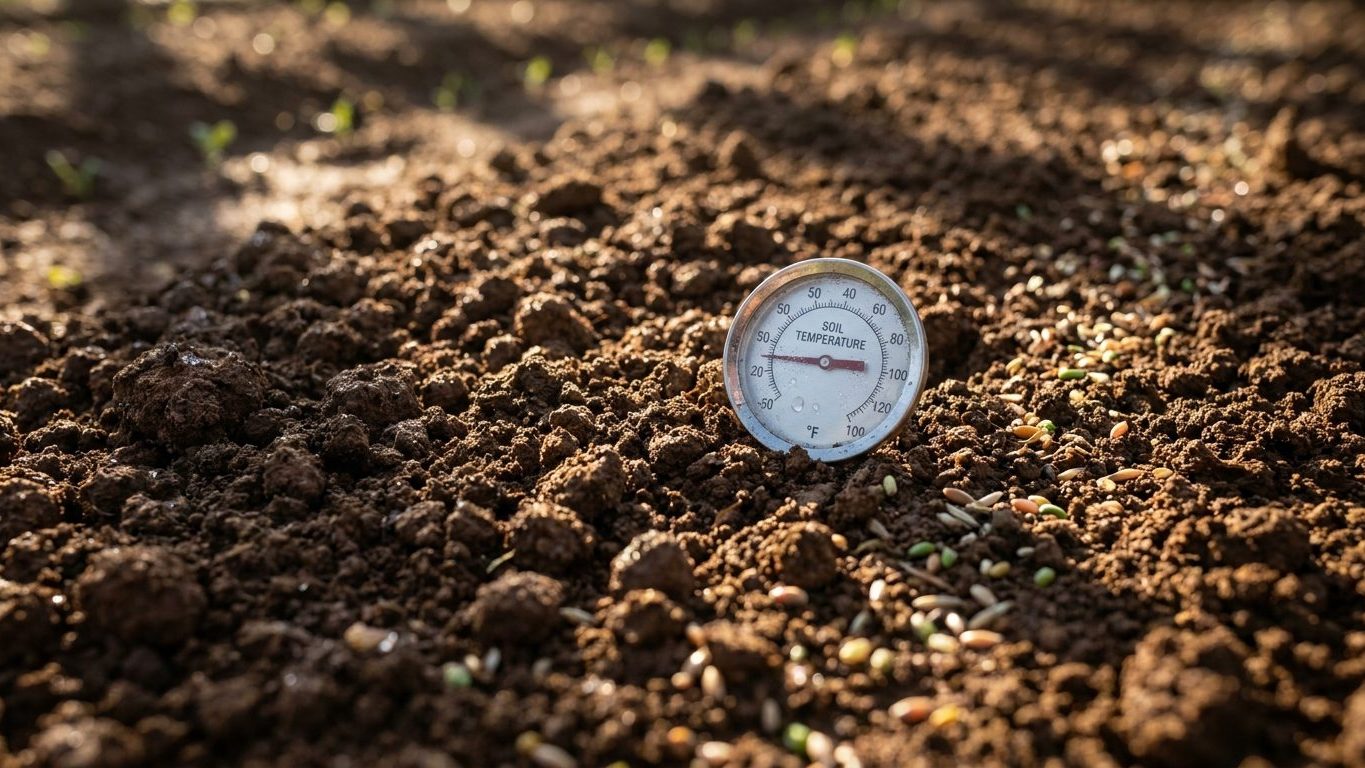
Frost is a stand-in for the number that actually matters, which is soil temperature. Air can clear 32°F on a given morning while the top few inches of ground are still cold enough to stall germination or rot a seed outright. Cool-season grasses and small-seeded legumes generally want the soil itself to have warmed past the mid-40s before they sprout with any reliability; brassica-type covers tolerate a touch cooler. That gap between “frost is over” and “soil is ready” is often a week or two in a heavy clay-loam Iowa soil, longer in a wet spring, shorter in a sandy one that drains and warms fast.
Why the date on the calendar isn’t the trigger
A gardener who seeds by the calendar alone is gambling on an average. A gardener who checks the soil with a simple probe thermometer before seeding is reading the actual variable that governs germination. That’s the more useful habit to build, frost date or not.
None of this changes what governs how much seed to put down. Seeding rate depends on the species, the seeding method (broadcast versus drilled), and whether the cover crop is a single species or a blend, and getting it wrong either wastes seed or leaves bare soil between plants. That number belongs with a local agronomist, not a blanket figure repeated across every state. Iowa State University Extension (extension.iastate.edu) publishes county-specific guidance and can size a planting to the actual bed or field in question.
Termination follows the same logic on this site: mowing, crimping, cutting, or simply letting a hard frost finish a tender species, rather than reaching for a chemical burn-down. A crimped rye stand or a frost-killed oat crop leaves a mat of residue that suppresses weeds and holds moisture, and it does that without a spray program.
How long the season lasts here
The first fall frost in this same dataset runs from October 14 to October 25. Paired with the spring window of April 12 to April 24, that gives a frost-free stretch somewhere between 173 days, in the tightest case (April 24 start to October 14 end), and 196 days, in the most generous case (April 12 start to October 25 end). Call it roughly five and a half to six and a half months, depending on which end of each range a given year lands on.
| Scenario | Spring start | Fall end | Window length |
|---|---|---|---|
| Tightest case | April 24 | October 14 | 173 days |
| Most generous case | April 12 | October 25 | 196 days |
A window that size is enough for a single cash crop cycle followed by a real cover crop planting, and in many years it’s enough to squeeze in a short-lived cover species ahead of the cash crop too, not just after it. That’s the practical payoff of the longer end of the range: a gardener can sow a fast brassica or a quick-growing cereal in early spring, terminate it before the main planting date, and still have the whole summer and fall ahead for the cash crop and a follow-up cover.
The tighter end of the range changes the math. If the frost-free stretch runs closer to 173 days, there usually isn’t room for a spring cover crop cycle before the main season crop goes in, which makes the fall-seeded cover the only real opportunity most years. That same tightness is also what decides whether starting a cover crop from transplants makes sense at all, since transplanting buys a few weeks of field time but costs a few weeks of indoor lead time first, and in a short window that trade isn’t always worth it. For the mechanics of stacking a spring cover, a cash crop, and a fall cover crop into one season, the site’s succession sowing guide walks through the sequencing in more detail.
Heat and water in Iowa
This dataset doesn’t carry a days-above-90°F count or a summer rainfall total for the reference station, so no number gets invented here to fill that gap. That absence turns out to matter less than it might for a vegetable crop, because for cover crops the deciding season isn’t summer at all. It’s winter.
The first fall frost, October 14 to October 25, sets the last realistic date to get a fall cover crop seeded with enough time to establish before growth stops. Miss that window and a seeding either germinates too thin to matter or doesn’t germinate before the ground locks up. The coldest month here averages a daily minimum of 13.8°F, per NOAA’s 1991-2020 Climate Normals for the Des Moines reference station, and that single number is the one that actually separates cover crop strategies. It’s not the record low, and it’s not a monthly average temperature; it’s the typical low on an ordinary cold night in the coldest month, and that’s the figure that decides which species make it through winter alive and which don’t.
At 13.8°F, a fair number of cover crop species that survive winter in warmer parts of the country simply don’t survive it here. That’s not a drawback so much as a feature, once a gardener plans around it. A species that reliably winterkills at that temperature turns itself into a dead mulch by spring, no mowing or crimping required, which is one less job in April. A species that’s hardy enough to shrug off 13.8°F stays green into winter and has to be terminated mechanically once the ground firms up in spring, which is more work but also more spring biomass and a longer window of living roots holding the soil.
The USDA Plant Hardiness Zone Map places this territory across zones 4b to 6a (2023 map, built on 1991-2020 normals), which is a wide range for a single state and is built on one variable, the average annual extreme minimum. That range is a reason to treat any zone-based recommendation as a starting point tied to a specific city, not a blanket rule for the whole territory. A garden at the 4b end of that range and one at the 6a end can have genuinely different outcomes with the same cover crop species.
Which cover crops suit Iowa
Sorted by type rather than by variety, three broad groups cover most of what gets planted here. Cereal grains and cool-season grasses are the backbone of a fall cover crop program: some, like oats, reliably winterkill once temperatures drop into the range this territory sees in its coldest month, leaving a weed-suppressing mat by spring with no termination labor at all. Others in the same family are winter-hardy enough to stay alive through that same cold and need to be mowed, crimped, or cut back once growth resumes.
Legumes bring a different function. As they grow, certain bacteria living on their roots pull nitrogen from the air and fix it into a form the soil, and later a following crop, can use. How much nitrogen actually becomes available depends on the species, how much biomass the plant put on before it died or was terminated, and how it was terminated, which is exactly why no pound-per-acre figure appears here: that number shifts too much between a thin, frost-killed stand and a thick one that grew through a mild winter to mean anything as a blanket claim. Winter hardiness varies a lot within this group too, from species that winterkill readily to species that need mechanical termination in spring, the same split seen in the grasses.
Brassica-type covers, radish and turnip types among them, grow fast, punch roots down through compacted soil, and in a winter with a coldest-month minimum around 13.8°F, tend to die back on their own, which suits a gardener who wants a fall cover crop that needs no spring intervention at all.
None of this points to a specific cultivar, and that’s deliberate. Seed companies trial their varieties against local conditions, and the varieties that perform best in one part of this territory, given the 4b to 6a hardiness spread, aren’t necessarily the same ones that perform best in another part of it. Iowa State University Extension (extension.iastate.edu) runs and publishes exactly those local variety trials, county by county, and that’s the only recommendation worth following once the choice comes down to a specific seed to buy.