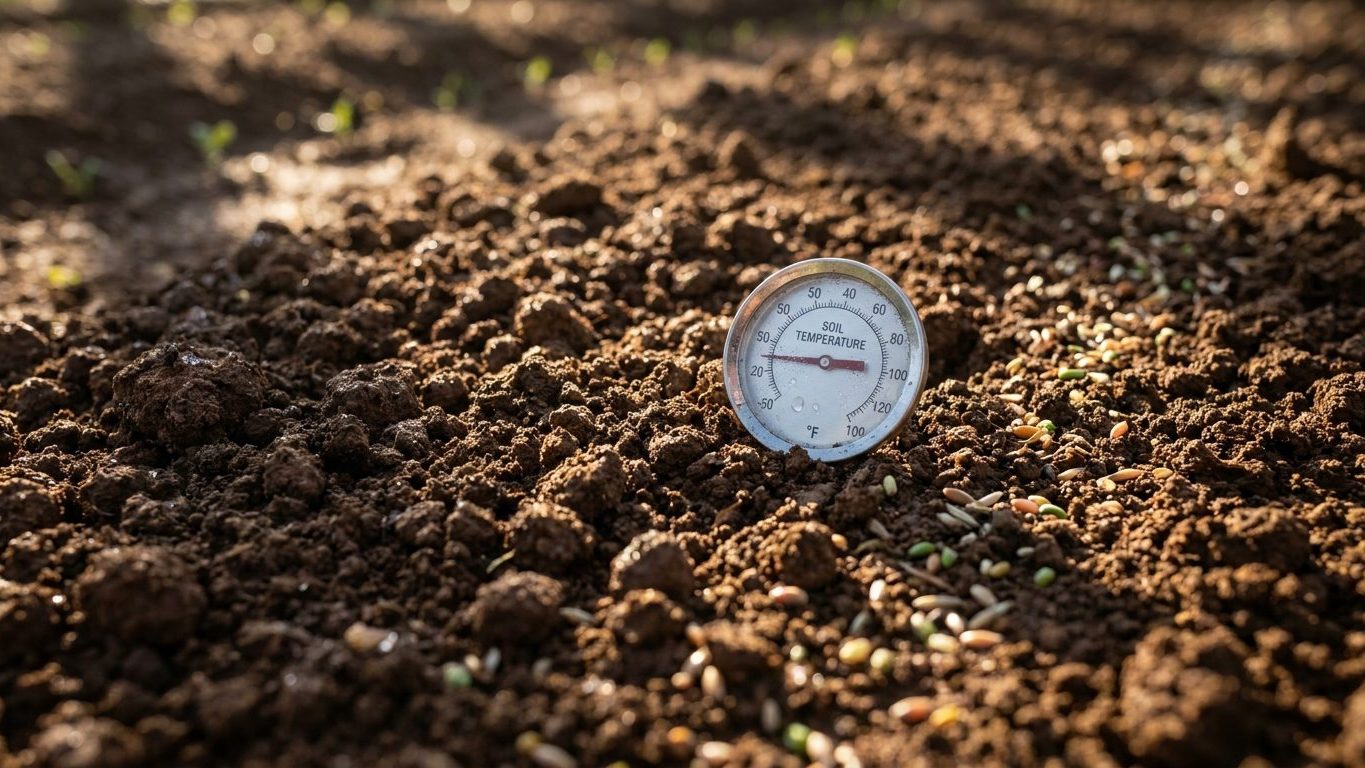

Cover crops go into Kansas soil once nights stop dropping below freezing and the ground itself has warmed, not just the air. That means waiting past the spring frost window, choosing species suited to the state’s long hot summers and short but genuine winters, and picking a termination method that doesn’t involve a sprayer. The right timing and the right species depend on where in Kansas the garden sits, and on soil temperature more than the calendar.
When the soil is warm enough in Kansas
The last spring frost at Wichita, drawn from NOAA’s 1991-2020 climate normals, falls somewhere between April 4 and April 18, based on the 30 to 70 percent freeze probability band. That’s a wide window on purpose. Frost dates are probabilities, not promises, and a garden thirty miles outside the city, especially one sitting low or at elevation, often sees its last freeze one to two weeks later than the airport station does.
Here’s what most planting calendars skip: frost is a stand-in for something else entirely. What actually determines whether a cover crop seed germinates is soil temperature, and soil warms on its own schedule, usually trailing the air by a week or two after the freeze risk clears. A warm-season species like buckwheat or a summer-annual legume such as cowpea will sit dormant, sometimes rot, if it goes into ground that’s still cold a few inches down, even on a day when the thermometer reads 70 degrees at noon.
That gap between “frost is over” and “soil is warm” is why late April through May tends to work better than the first frost-free morning for warm-season cover crops in most of Kansas. Cool-season species flip the logic. Oats, field peas, and crimson clover germinate at lower soil temperatures and actually prefer to go in while the ground is still cool, either in early spring ahead of a summer vegetable bed or in late summer as the soil starts to cool back down for a fall stand.
Kansas spans USDA Hardiness Zones 5b to 7a, a range built on the average annual extreme minimum temperature rather than spring warmth, so it doesn’t answer the sowing-date question directly. But it’s a reminder that a garden in the state’s northwest corner and one near the Oklahoma line aren’t running on the same clock, and the Wichita frost dates above describe the reference station, not every county.
What decides how much seed to use, and how thick to sow it, isn’t something a general guide can hand out responsibly. Rate depends on the species itself, on whether it’s broadcast or drilled, on soil condition, and on whether the goal is erosion control, weed suppression, or nitrogen contribution from a legume. Kansas State University’s extension service, at ksre.k-state.edu, publishes species-specific rate guidance that accounts for local soil types, and that’s the source worth checking before buying seed.
Termination deserves the same honesty. This isn’t a page that reaches for a sprayer. Cover crops here get taken down mechanically, by mowing a stand before it sets seed, by crimping a mature cereal rye to lay it flat as a mulch, or simply by letting a hard freeze do the work on a tender species like buckwheat, which turns to blackened mush at the first real cold snap and needs no further effort. The method depends on what was planted and what’s going in next, but the tools stay the same: a mower, a roller, or the calendar itself.
How long the season lasts here
Stretch the two Wichita frost windows to their outer edges and Kansas gardeners get somewhere between 188 and 212 frost-free days, depending on which end of each range applies in a given year: the shorter estimate runs from the latest recorded last-frost date, April 18, to the earliest recorded first fall frost, October 23; the longer one runs from the earliest last frost, April 4, to the latest first fall frost, November 2. Either way, six to seven months without a killing freeze is a genuinely long season by national standards, though Wichita’s own figures may not hold for every county.
That length changes what’s realistic to plant, and when. A season running close to seven months leaves room for a full cool-season cover crop ahead of the summer vegetable garden, say a stand of oats or field peas seeded as soon as the soil is workable in March, terminated by mowing before the last frost clears, and followed by tomatoes or peppers going in on schedule. Then, after that summer crop comes out in August or September, there’s still enough calendar left to establish a second cover crop, typically cereal rye or crimson clover, before the first fall frost locks things down.
A shorter version of the same season, closer to the 188-day estimate, tightens that math. There’s less slack for a spring cover crop to finish its job and get terminated before summer planting needs the space, which pushes many Kansas gardeners toward a single cover-crop window each year: fall, after the last vegetable harvest and ahead of the season’s real cold. In that scenario the question isn’t whether to squeeze in two rounds of cover cropping, it’s whether starting a fall species early enough to build real root mass, rather than direct-seeding it late and hoping for the best, is worth the extra step.
The caution attached to these figures cuts one way for outlying gardens: suburban and rural Kansas properties typically see their last spring frost land later than Wichita’s dates suggest, and their first fall frost arrive earlier, sometimes by one to two weeks in each direction. That trims the working season by up to a month for anyone gardening outside the city itself, which matters most for the shorter end of the succession math above.
Gardeners weighing whether their own timeline supports a second sowing, spring and fall in the same year, can work through the mechanics in this site’s succession sowing guide, which lays out how to sequence cover crops around a cash-crop calendar without either one crowding the other out.
Heat and water in Kansas
For a summer vegetable, heat and rain make the difference between a good season and a bad one. For a cover crop, the number that actually matters is different: how cold the coldest month gets, because that’s what separates a species that mulches itself for free from one a gardener has to kill by hand.
At Wichita, the reference station for this territory, the coldest month averages a daily minimum of 22.5°F, per NOAA’s 1991-2020 climate normals. That’s not the record low for the winter, and it’s not the monthly average either; it’s the typical overnight low during the coldest stretch, and it’s the figure that decides which cover crops survive Kansas winters standing and which ones don’t.
Oats are the clearest example. In a territory where winter minimums regularly drop into the low 20s, as they do here, oats reliably winterkill: the plant grows through fall, gets nipped hard by the cold, and collapses into a flat, brown mat that acts as mulch straight through to spring planting, with no mowing or crimping required. Move that same oat crop to a much milder climate, one where winter minimums stay closer to freezing than to the low 20s, and it often survives instead of dying, turning from a self-terminating mulch into a green plant a gardener now has to deal with, sometimes becoming a weed in the following crop.
Kansas’s winter numbers put it solidly in oat-killing territory across most of the state, which is one reason the species shows up so often in cover-crop plans here: the cold does the termination work for free. Species meant to overwinter, cereal rye chief among them, need that same cold confirmed as survivable, and rye’s hardiness comfortably covers USDA Zones 5b through 7a, the range this state spans according to the USDA Plant Hardiness Zone Map’s 2023 update.
The first fall frost, arriving at Wichita between October 23 and November 2, sets the other half of the winter equation: it’s the practical deadline for getting a fall cover crop seeded early enough to put down roots before growth stops for the year. Seed a cool-season species too close to that date and it may never build enough biomass to survive, let alone contribute anything, before winter shuts things down. This site doesn’t have confirmed local data on summer heat-day counts or growing-season rainfall for this reference station, and it won’t guess at figures that aren’t verified, but the winter numbers above do the real work of deciding which cover crops belong in a Kansas garden anyway.
Which cover crops suit Kansas
Match the type of cover crop to what this territory’s own numbers demand, and the choice narrows fast even without picking a named variety.
The frost-free window running from mid-April to late October favors cover crops that mature quickly enough to fit either end of it. In spring, fast-growing broadleaf types like buckwheat can go in, bloom, and get mowed down within about six weeks, freeing the bed for a summer vegetable without eating into the calendar. In fall, quick-establishing cool-season grasses and legumes, oats and field peas among them, take advantage of the weeks before that October or November frost to build a root system, then let the winter cold described above finish the job on the tender species.
Kansas summers push cover-crop choices toward sturdier legumes and warm-season grasses when a bed is being held over the hottest stretch rather than cleared for a fall crop. Species like cowpea and sorghum-sudangrass tolerate heat well and, planted at a reasonable stand density, shade their own root zone enough to reduce the moisture stress that thinner covers struggle with in a Kansas summer. That self-shading matters more here than it would in a cooler territory, where the same species might get chosen for other reasons entirely.
Where a species survives the winter, cereal rye standing through the cold under Kansas’s Zone 5b to 7a range, termination stays mechanical on this site: mowing before seed set, crimping a mature stand to lay it flat as a residue mulch, or simply letting it go dormant and cutting it back once the following crop needs the space. No herbicide step is assumed or needed for a rye stand crimped at the right growth stage.
What this page won’t do is hand over a specific cultivar name, and that’s deliberate rather than an oversight. Seed rates, disease resistance, and even which type performs best shift from one Kansas county to the next depending on soil, local rainfall patterns, and pest pressure that a general guide has no way to account for. Kansas State University’s extension service, at ksre.k-state.edu, runs the regional variety trials that actually answer that question, and checking there before buying seed beats guessing based on a mix bag label.