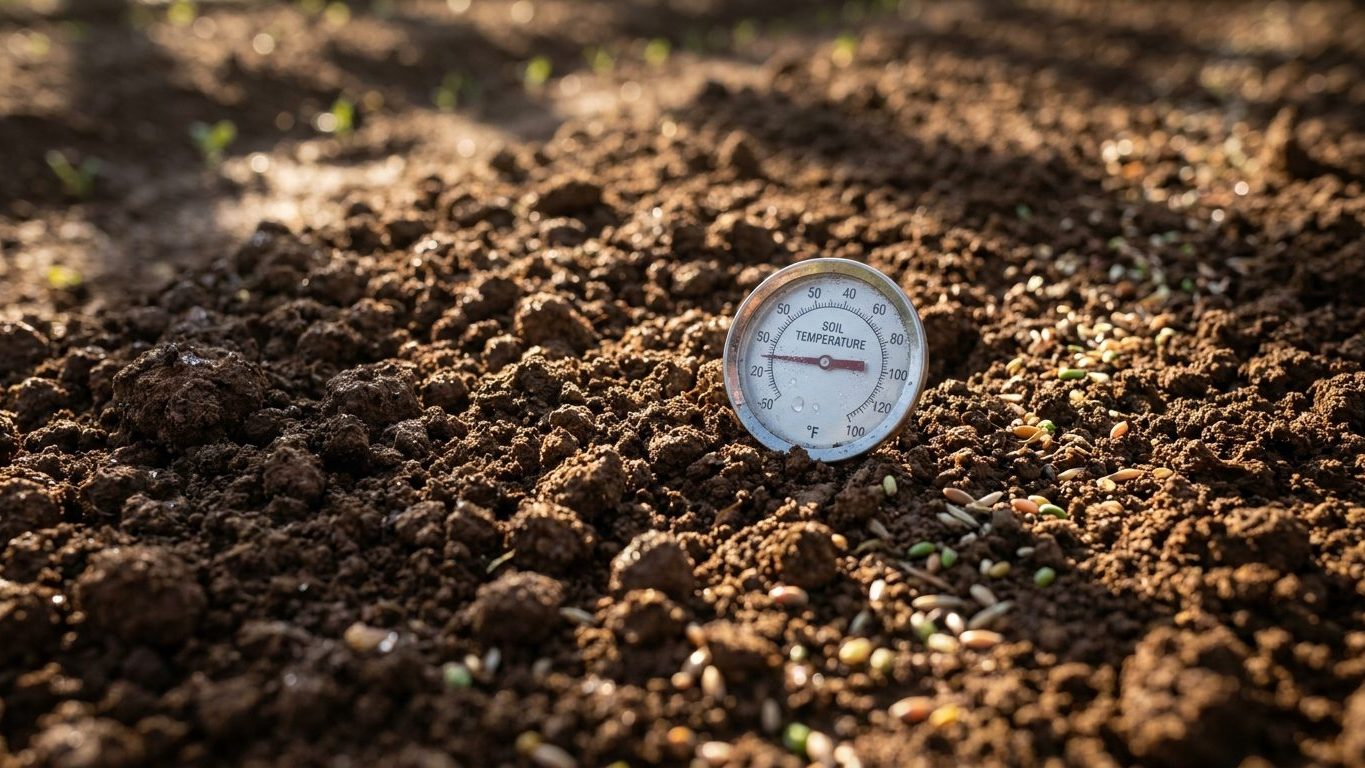

Soil temperature, not the calendar, decides when a cover crop seed will actually germinate in Maine. Coastal Portland sees its last spring frost between April 22 and May 1, but that date only marks when the air stops freezing, the ground underneath stays cold for weeks longer, and it’s the ground that a cover crop seed cares about.
When the soil is warm enough in Maine
Every planting guide for Maine leans on that NOAA frost window of April 22 to May 1, drawn from the 1991-2020 Climate Normals recorded at the Portland reference station. It’s a solid number, but it answers the wrong question. A 32°F freeze probability tells you when frost becomes unlikely in the air a few feet up. It says nothing about the six inches of soil where a cover crop’s roots have to establish, and that soil in Maine typically lags the air by two to three weeks in a cold, wet spring.
This matters because most cover crop species germinate on soil temperature thresholds, not air temperature thresholds. Cool-season grasses and some legumes will sprout in soil that’s still chilly, while warm-season options wait for real heat underground. Sow into cold, wet Maine dirt too early and the seed simply sits there, sometimes rotting before it germinates at all.
There’s another wrinkle worth saying plainly: a frost date is a probability, not a promise. The April 22-May 1 window at the Portland station marks the range where freeze risk runs between 30 and 70 percent, meaning frost can still land after May 1, and a frost-free stretch can still start before April 22. Treat it as a planning guide, not a guarantee, especially since coastal Portland sits at the mild end of Maine’s climate. Inland valleys and the northern half of the state run their last frost noticeably later and their first fall frost noticeably earlier, which compresses the whole growing window for cover crops grown away from the coast.
Because seeding rates depend on species, seed size, drilling versus broadcasting, and germination percentage, there’s no single number that fits a Maine backyard and a Maine field alike. The University of Maine Cooperative Extension publishes rate tables tuned to this state’s soils and season length, and that’s the source to use rather than a generic figure lifted from elsewhere.
Termination here is mechanical, not chemical. Mowing, crimping, cutting, or simply letting a hard frost do the work are the standard tools for ending a cover crop’s growth before it goes to seed or before spring planting begins.
How long the season lasts here
Stack Maine’s two frost windows against each other and the frost-free season runs somewhere between 161 and 182 days, depending on where in that four-to-twelve-day spread each frost date actually falls in a given year. Take the tightest combination, a late spring frost on May 1 followed by an early fall frost on October 9 — and the growing window shrinks to 161 days. Take the loosest combination, an early spring frost on April 22 followed by a late fall frost on October 21, and it stretches to 182 days.
That’s a real range, and it changes what’s realistic to plant. A 180-day season leaves enough room to grow a summer vegetable crop, terminate it, and still get a fall cover crop established with weeks to spare before the ground freezes. A 160-day season is tighter: it often makes the difference between fitting in one cover crop cycle after the main harvest, or missing the window entirely if that harvest runs late.
This is also where the coastal-versus-inland gap bites hardest. The dates above come from the Portland station, Maine’s mild edge. Move inland or north and both ends of the window close in, sometimes by weeks rather than days, since spring arrives later and fall frost lands earlier the farther a garden sits from the coast’s moderating effect. A gardener in Aroostook County isn’t working with the same 161-to-182-day window as one in Cumberland County, even though both are technically “Maine.”
| Region | Spring frost risk | Fall frost risk | Growing window |
|---|---|---|---|
| Coastal (Portland reference) | April 22 – May 1 | Oct 9 – Oct 21 | 161–182 days |
| Inland and northern Maine | Later than coastal dates | Earlier than coastal dates | Shorter than coastal |
A season on the longer end of that range opens the door to succession sowing: one cover crop after a spring harvest, a second after the fall harvest, timed so each has enough weeks to establish real biomass before frost. Anyone weighing whether their particular window supports two rounds instead of one should work through the timing math in the site’s succession sowing guide, which lays out how to count backward from a target frost date. On the shorter end, that first sowing is often the only one that fits, and the better question becomes whether to direct-seed or start something indoors and transplant it out once the soil catches up.
Heat and water in Maine
Maine’s dataset doesn’t hand over a days-above-90°F count or a summer rainfall figure for this territory, and that absence is itself informative. Summer heat stress simply isn’t the variable that shapes cover cropping decisions here the way it does farther south. What the sourced data does hand over is the number that actually matters for this climate: a coldest-month mean daily minimum of 15.6°F at the Portland reference station, under a USDA hardiness range of 3b to 6a across the state.
For cover crops, that reframes the whole conversation around winter, not summer. The first fall frost sets the last realistic sowing date, since anything seeded too close to it won’t build enough root and top growth to survive what follows. Then the coldest month takes over and does the real sorting: some species die back on contact with hard cold and leave a dead mulch on the surface by spring, while others shrug off that same cold and keep growing, needing to be cut or crimped by hand once the ground thaws.
Oats are the clearest example of how location-dependent this split gets. In a mild territory, oats can survive winter well enough to turn into an unwanted volunteer crop the following spring, effectively a weed. In a territory where the coldest month’s average low sits at 15.6°F, oats reliably winterkill, which turns them into one of the simplest cover crops available: sow them, let winter do the termination, and find a dead straw mulch waiting in spring with no mowing or cutting required. Maine’s winter numbers put it much closer to that second category than the first, especially inland and north where winter cold runs deeper than the Portland reference station records.
Summer here brings its own quieter set of problems that have nothing to do with heat. Maine’s growing season tends toward cool, damp stretches rather than dry heat, and that favors slower ripening, higher disease pressure, and a greater risk of mildew on crops left standing too long in humid air. That’s a different management headache than drought stress, but it’s no less real, and it factors into how long a cover crop should be left standing before termination.
Which cover crops suit Maine
None of this points to a single named variety, and it shouldn’t. It points to categories, and the categories follow directly from the numbers above.
A season capped around 161 to 182 frost-free days rewards the earliest-maturing types within whatever species group a gardener chooses, since anything slow to establish eats into an already tight window. A climate where winter, not summer heat, does the sorting rewards species chosen deliberately for how they behave against a 15.6°F coldest-month minimum: either reliably winterkilling into a mulch, or reliably surviving to be terminated by hand come spring. And a climate prone to cool, damp summers rewards disease resistance as a first-line criterion, ahead of yield or biomass, since a cover crop that mildews out before it builds root mass isn’t doing its job.
Broad species groups worth weighing against those three filters include:
- Cold-tender grasses that reliably winterkill in Maine’s coldest month, leaving a surface mulch with no spring termination labor
- Winter-hardy grains and legumes bred to survive into spring, which then require mechanical termination by mowing, crimping, or cutting before they set seed
- Fast-establishing broadleaf species useful for filling a short gap between two main crops within a compressed 160-day window
Naming a specific cultivar here would be the wrong move, and it’s worth saying why. Variety performance in cover crops shifts with local disease pressure, soil type, and microclimate in ways a statewide article can’t account for, and coastal Portland’s numbers don’t automatically apply to a garden in the Maine interior or the far north. The University of Maine Cooperative Extension runs the variety trials that actually reflect these differences, and its recommendations are the only ones calibrated to a specific county’s conditions rather than to a statewide average. That’s also where to get seeding rates suited to a particular species and planting method, since a rate that works for drilled winter rye has little to do with one that works for broadcast field peas.