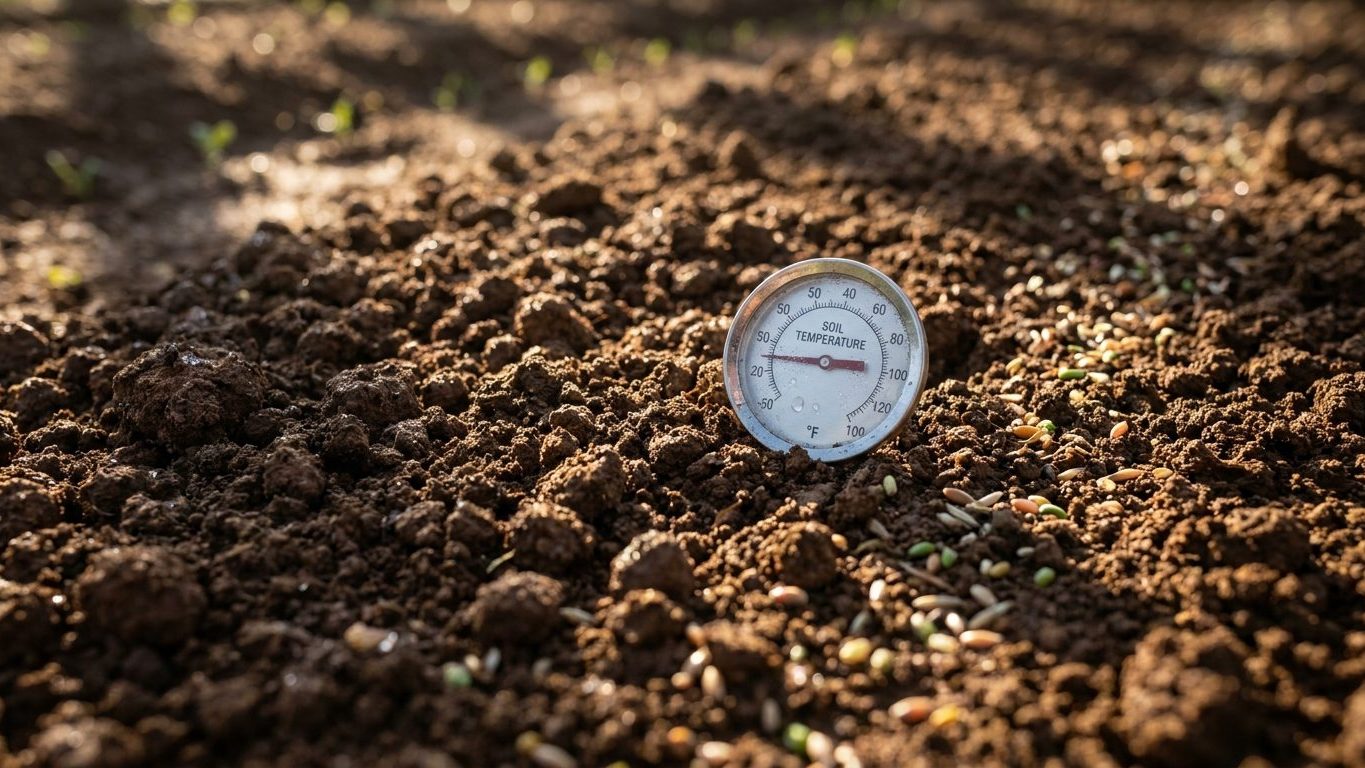

Manitoba gardeners can seed cover crops once the soil itself has warmed, not the moment the calendar says frost is over. That point lands in late May here, and the plant needs to be down by late September, before the season’s real cold sets in. Between those two facts sits everything else: which species make sense, how much room there is for a second planting, and why winter, not summer heat, runs the whole show in this province.
When the soil is warm enough in Manitoba
The average last spring frost at Winnipeg Richardson International Airport, the reference station for this region, falls on May 23, according to Environment and Climate Change Canada’s 1981-2010 climate normals. That date gets treated like a starting gun, but it’s really a midpoint. In one year out of two, frost shows up later than May 23, sometimes well into June. Soil temperature, which is what actually triggers germination for most cover crop species, tends to lag a week or two behind the air’s last brush with freezing. So the honest answer is: wait for the frost date, then give the ground a little more time to catch up before you seed.
This matters more for cover crops than for tender vegetables, oddly enough. A gardener transplanting tomatoes watches the ten-day forecast obsessively. Someone broadcasting a cover crop mix of oats, field peas, or a brassica like tillage radish has more slack, because these are cool-tolerant species by design. Oats in particular will germinate in soil that’s still on the cool side, which is one reason they show up so often in Prairie cover cropping. But cool-tolerant isn’t frost-proof at the seedling stage, and a hard freeze right after emergence can wipe out a stand that was seeded too eagerly.
What decides the actual seeding rate, whether you’re broadcasting by hand or drilling a bare bed, isn’t something a general climate page can hand you. It depends on the species you pick, how you’re putting seed in the ground, and the source of that seed. Manitoba Agriculture keeps rate tables and current guidance for the province, and that’s the right place to check before buying anything, not a national blog post that doesn’t know your soil.
Termination here is mechanical, and that’s worth saying plainly: mowing, crimping, cutting the stand down, or letting a hard frost do the killing for you. No herbicide step belongs in a home garden cover crop cycle, and none is assumed anywhere on this site.
How long the season lasts here
Subtract May 23 from September 22, the average first fall frost at the same Winnipeg station, and the frost-free window comes out to roughly 122 days. That’s not a long season by North American standards, and it shapes almost every planting decision that follows, cover crops included.
A 122-day window is enough for one full-length vegetable crop and a fall cover crop seeded after harvest, but not much more. Compare that to a region with a six- or seven-month frost-free stretch, where a gardener can run vegetables, terminate a cover crop, plant a second vegetable succession, and still fit in a fall cover before frost. Manitoba doesn’t have that luxury. The practical pattern here tends to be: spring vegetables or a spring-sown cover crop, then a single fall-sown cover crop going in as soon as the main crop clears the bed, with September 22 as the rough deadline for anything that needs real growth before winter shuts it down.
That short window also changes whether transplanting versus direct-seeding cover crop species is worth debating at all, since cover crops are almost always direct-seeded anyway, root disturbance being irrelevant when the plant’s job is to grow fast, cover ground, and get killed on schedule rather than produce a harvest. Where the calendar really bites is on the second-sowing question, and the numbers above answer it about as clearly as they can: with roughly four months total, a true double cover crop cycle, spring cover terminated in time for a summer cover, then a fall cover after that, is tight enough that most gardeners here settle for two plantings a year rather than three. Anyone weighing a second or third sowing in a short-season garden should look at the site’s succession sowing guide, which walks through how to stack plantings when the frost-free stretch is this compressed.
Heat and water in Manitoba
Summer heat isn’t the variable that decides cover crop success in this province. Winter is. Manitoba’s growing season is short enough, and its winters cold enough, that the fall frost date and the depth of the coldest month do almost all the work that heat and rainfall totals do farther south.
The number that matters most here is the mean daily minimum of the coldest month, which sits at -6.6°F according to Environment and Climate Change Canada’s 1981-2010 normals for the Winnipeg reference station. Natural Resources Canada places the reference city in Canadian hardiness zone 3b, using the Canadian system’s seven-variable model rather than the single-variable USDA scale. That distinction isn’t a technicality. NRCan itself notes that a single Canadian zone can span nine different USDA zones, so a gardener who’s used to reading USDA zone numbers from American seed catalogs should not try to map 3b onto anything they already know. It’s a different measuring stick.
What that cold minimum decides, practically, is which cover crop species survive winter here and which don’t. That’s the real fork in the road for this territory: oats, field peas, and most brassicas die back completely once temperatures drop into that range, leaving a dead mulch on the surface that never needs to be killed by hand. Cereal rye and hairy vetch, by contrast, are bred to survive winters far colder than this and will often green up again in spring, which means a gardener growing them here has to plan on mowing or crimping a living stand before it goes to seed. In a milder territory, oats winterkilling might be seen as a limitation, forcing gardeners toward things that persist. In Manitoba, that same winterkill is the advantage, oats becoming close to a set-and-forget option precisely because the cold does the termination work for free.
Rainfall totals and days above 90°F aren’t part of the record for this reference station in the data used here, and it would be a disservice to guess at numbers that don’t exist. What can be said honestly is that a short, cool Prairie summer tends to bring slower ripening and a higher chance of mildew on dense stands than a longer, hotter growing season would, which is one more reason airflow through a cover crop planting matters here even without a heat index to point to.
Which cover crops suit Manitoba
Reasoning from the numbers above rather than from a seed rack label points toward a fairly short list of types, not named varieties. A short frost-free window favors the earliest-maturing, fastest-germinating types, which is why oats and field peas turn up constantly in Prairie cover cropping conversations, alongside brassicas like radish that build root channels quickly before winter arrives. A genuinely cold winter, meanwhile, sorts species into two camps: those that winterkill cleanly at -6.6°F and leave behind a dead mulch, and the more cold-hardy cereals and legumes that need mechanical termination, by mowing, crimping, or cutting, in spring because they’ll survive the cold on their own.
Disease pressure from a cooler, damper summer is a real consideration too, even without a specific rainfall figure to cite for this station. Spacing a stand so air can move through it, and picking types known for holding up under cool, humid conditions rather than hot, dry ones, matters more here than it would in a drier climate.
This page won’t name a specific cultivar, and that’s a deliberate choice rather than an oversight. Seed companies breed different strains of the same species for different regions, and the variety of winter rye or field pea that performs well in a trial plot near Winnipeg may not be the one sold under the same species name somewhere else. Manitoba Agriculture runs and publishes local variety trials, and that’s the only source with the standing to say which specific strain of a given species has actually proven itself in this province’s soil and winters.
The same logic applies to seeding rates and to any nitrogen contribution a legume might add to the soil. Both depend on the exact species, how much biomass the stand puts on before termination, and when that termination happens, not on a single number that could apply equally to a garden in Manitoba and one two thousand miles away. Manitoba Agriculture’s extension service is the right stop for both of those answers, and for confirming which winterkill or winter-hardy species has a track record in the district a gardener is actually working in.