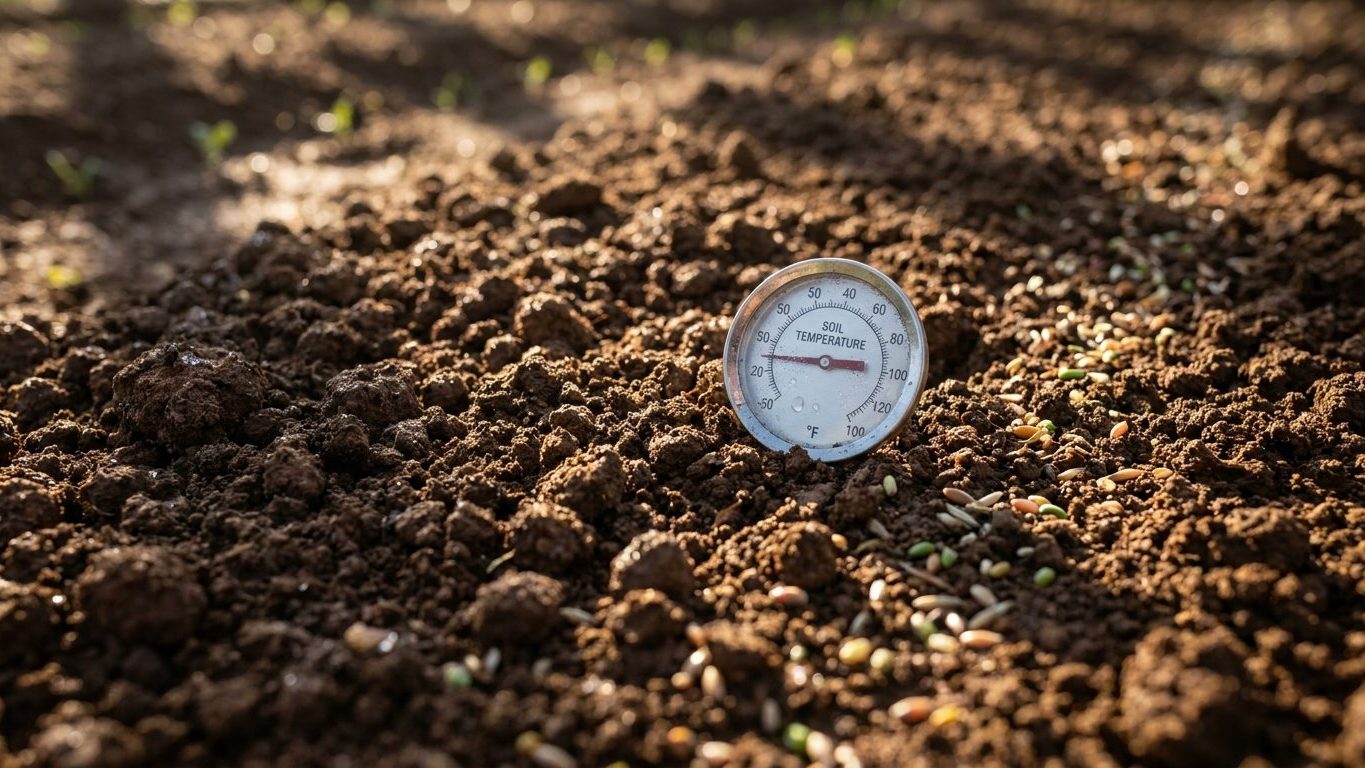

Cover crops take root in Massachusetts once soil temperature climbs into the mid-40s and holds there, which usually happens a week or two after frost risk has genuinely passed, not on the calendar date itself. The short answer: warm-season covers go in from mid-May through June, and the state’s cold, variable winters decide whether a species survives to spring or dies back into mulch on its own.
When the soil is warm enough in Massachusetts
Gardeners fixate on the frost date, but frost is a stand-in for the real number, which is soil temperature. NOAA’s 1991-2020 Climate Normals, drawn from the Logan Airport station (USW00014739), put the last spring frost with a 30-70% probability window between April 1 and April 8. That’s a probability, not a promise: some years the last freeze lands earlier, some years it doesn’t. Treat it as a planning range, not a guarantee.
Here’s the part that trips people up. Soil doesn’t warm the moment frost risk ends. Cold ground holds its chill for weeks after the air stops freezing, especially in clay-heavy or shaded beds common across inland Massachusetts. A cover crop seed sitting in 40-degree soil just sits there, vulnerable to rot and slow to germinate even if it survives. So the practical window for warm-season cover crops opens closer to mid-May in most of the state, later still in the Berkshires or any low-lying frost pocket.
Why the Logan reading isn’t your backyard reading
Logan Airport sits on the waterfront in Boston, which makes it the mildest reporting station in the state by a wide margin. Ocean proximity buffers both the last spring freeze and the first fall one. If you garden in the Pioneer Valley, the Berkshires, or any inland suburb tucked into a valley, expect your own last frost to run later than the Logan window and your first fall frost to arrive earlier. That gap matters more for cover crops than for most garden plants, because cover crops are usually sown at the edges of the season on purpose, either right after a spring harvest or right before a hard freeze locks the ground.
What governs how much seed you actually need isn’t a fixed number you can memorize. Rate depends on the species you pick, whether you’re broadcasting or drilling, and the source of the seed itself, and a rate borrowed from the wrong context wastes a season’s growth. The UMass Extension service publishes region-specific guidance for exactly this, and it’s worth checking before you buy anything.
Termination follows the same logic this site applies everywhere: mechanical, not chemical. Mowing, crimping, cutting, or simply letting a hard frost do the work are the methods that fit a home garden scale, and they avoid the guesswork of matching a product to a species you may not have identified precisely. A frost-killed cover crop lying flat on the bed by late November has already done its job without a single pass of anything sprayed.
How long the season lasts here
Subtract the two frost windows and you get a real number, not a guess. From the earliest last-frost date to the earliest first-frost date, April 1 to November 3, the frost-free stretch runs about 216 days. From the latest edges of both windows, April 8 to November 14, it stretches to roughly 220 days. Call it 216 to 220 frost-free days depending on where in the probability band your particular yard lands.
That’s a long season by New England standards, and it changes what’s worth attempting. Seven months of open ground is enough time to run a spring cover crop, harvest a summer vegetable planting in between, and still fit a fall cover crop before the ground locks up. Gardeners in shorter-season territories often only get one shot at a cover crop each year; Massachusetts gardeners, especially those near the coast where the Logan numbers apply most closely, frequently get two.
What a long window actually buys you
A 216-to-220-day season means the difference between treating cover cropping as a once-a-year event and treating it as a rotation tool. Sow a quick-growing cover in early spring, terminate it mechanically in time to transplant tomatoes or peppers in late May, then follow the summer harvest with a fall-sown cover that has enough weeks left before the first frost to establish real root mass. That second sowing is where most of the soil-building value shows up, since fall covers spend the whole autumn undisturbed.
Inland gardeners working with a shorter effective window, because their local frost dates run earlier in fall and later in spring than the coastal Logan reading, may find the first sowing is the only one that fits comfortably. In that case the calculus shifts: is it worth transplanting a summer crop into a bed that just hosted a cover crop, checking that roots have broken down enough not to compete, or is it simpler to let the cover run its full course and skip the summer vegetable that year? For a full breakdown of how to stack multiple sowings into one season, the site’s succession sowing guide walks through the timing math in more detail.
Heat and water in Massachusetts
This is where a lot of cover crop advice written for the South or the Plains simply doesn’t apply. Massachusetts isn’t a state where cover crops fight against blistering heat or drought stress through the growing season. The dominant story here is winter, not summer, and the numbers back that up.
The coldest month in Boston averages a daily minimum of 23.1°F, based on NOAA’s 1991-2020 Climate Normals. That figure, the mean daily low rather than a record cold snap, is the one that actually decides whether a cover crop species survives the winter standing or gets killed outright by the cold. The state’s hardiness zones run from 5a to 7b under the USDA Plant Hardiness Zone Map, a range built entirely on average extreme minimum temperature. That’s a wide spread for one state: coastal areas near Boston sit at the milder end, while inland hills and the Berkshires drop into the harsher zones. Any recommendation tied to hardiness zone should reference the specific area, not the state-wide range.
Winter is the filter, not the summer heat
Because the coldest-month minimum sits well below freezing, this is a territory where a species like winter rye reliably survives to spring as living cover, needing a deliberate mechanical termination such as mowing or crimping before it goes to seed. In a much milder state, that same rye might barely die back at all and turn into a weed problem the following season. Cold here does the work that a mower would otherwise have to do, at least for the tenderer species.
Summer conditions matter less for stress and more for disease pressure. Coastal and inland Massachusetts both see humid, occasionally sticky summer stretches, and a cool damp spell can bring mildew, slowed ripening, and fungal issues to a cover crop just as easily as it does to tomatoes. That’s a different problem than the scorching, drought-driven stress covered in advice written for hotter regions, and it changes what to watch for: airflow between plants and avoiding overly dense stands matters more here than irrigation planning.
The practical takeaway is that the first fall frost, somewhere between November 3 and November 14 depending on location, sets the real deadline for the last useful sowing of the year. Miss that window and a fall cover crop won’t establish enough growth before winter locks it down, whatever the summer weather did or didn’t do.
Which cover crops suit Massachusetts
None of this points to a single named variety, and it shouldn’t. Cultivar performance depends on trials run in local conditions, and the only trials that mean anything for a Massachusetts backyard are the ones run in Massachusetts. That’s exactly the kind of dated, location-specific recommendation the UMass Extension service tracks and updates, and it’s the right first call before buying seed.
What this territory’s own numbers do point to is a type of crop, not a brand or a mix. A frost-free season running 216 to 220 days, paired with a coldest-month minimum around 23°F, favors species with two different survival strategies. One group, exemplified by the small grains like winter rye, is bred to live through cold winters as standing cover and requires deliberate mechanical termination, whether that’s mowing, crimping, or cutting, before it sets seed in spring. The other group, the tender legumes and broadleaf species, is expected to die back on its own once that 23°F average minimum arrives, leaving a frost-killed mulch that needs no cutting at all.
Matching type to the state’s own numbers
A short effective window in the colder inland zones argues for whichever species establishes fastest, since there’s less margin before the ground freezes. A humid coastal summer argues for keeping stands thin enough that air moves between plants, since disease pressure here is a bigger threat than drought stress ever is. And the wide 5a-7b hardiness spread across the state argues for checking a variety’s cold tolerance against your specific zone, not the state average, before assuming it will overwinter reliably.
Legume species contribute nitrogen back to the soil through their root nodules, but how much depends on the species chosen, how much biomass it built before termination, and the timing of that termination, not a number that transfers cleanly from one garden to another. The mechanism is worth understanding; the specific figure isn’t worth chasing, since it changes with every one of those variables. What stays constant is the approach: pick a type suited to this territory’s cold winters and humid summers, terminate it mechanically, and let the local extension service settle the cultivar question with data this page simply doesn’t have.