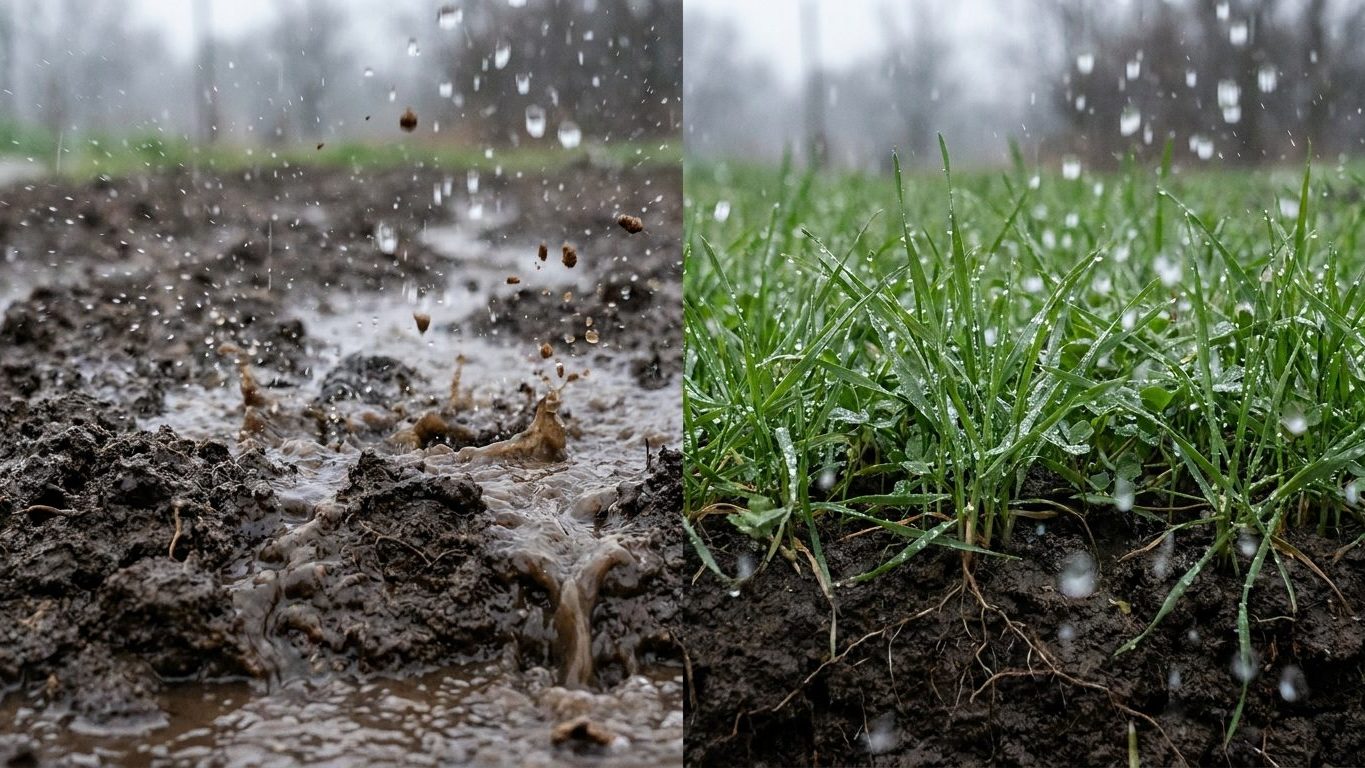

Erosion cover crops work by putting something alive between falling water and open dirt through the cold months, when a garden or field would otherwise sit exposed. A cereal grain or grass sown in early fall grows just enough leaf and root before frost to break rainfall, slow runoff, and hold particles that would otherwise wash into the nearest ditch. The species chosen and the timing of planting matter more than how thick the stand looks in October.
What is actually going on
Rain does not fall gently on bare dirt. Each drop hits with enough force to knock loose soil particles into the air, a process soil scientists call splash erosion. Those loosened particles settle into the tiniest gaps between soil crumbs, sealing the surface into a hard crust within a season or two of exposure. Once that crust forms, water stops soaking in and starts running off, carrying topsoil with it toward the lowest point in the yard. A canopy of leaves absorbs that impact before it ever reaches the ground, and a network of living roots holds the particles that would otherwise be free to move once the crust breaks apart.
Roots do more than grip soil in place. As they push through the profile, they leave channels that water can follow downward instead of sideways across the surface. Dead root tissue and root exudates feed soil microbes, which glue mineral particles into stable clumps called aggregates. Soil held in aggregates resists both splash erosion and the slow slump that happens on any slope during a thaw. Bare ground has none of that structure, so a single warm rain in February can move more soil than an entire summer of thunderstorms on a planted bed.
Grasses versus legumes
Cereal grasses such as rye, oats, or winter wheat build a fibrous, shallow root mass that spreads wide and knits the top few inches of soil together fast, which is exactly what a slope or an exposed vegetable bed needs. Legumes like clover or hairy vetch root less densely but host bacteria in their nodules that pull nitrogen from the air and store it in plant tissue, a benefit that shows up later when the plant breaks down. Most erosion-focused plantings favor a grass alone or a grass paired with a legume, leaning on the grass for coverage and the legume for the soil-building bonus.
Winter itself does not stop the protection. Even after growth slows or stops, the root system stays alive underground in most climates, still anchoring soil through the freeze-thaw cycles that heave and crack bare ground. Cereal rye in particular keeps growing in cold soil longer than almost any other common cover crop, which is part of why it shows up so often on erosion-prone sites.
In the garden
The question that actually matters is not which seed to buy but how much living cover a piece of ground needs before winter, and that answer changes with slope. A flat raised bed and a hillside behind a house are not the same problem, even if both are bare dirt in October.
| Situation | What the cover needs to do | What goes wrong if it is too thin or skipped |
|---|---|---|
| Flat vegetable bed | Close a canopy over most of the surface before hard frost stops growth | Winter and early spring rain still pools and crusts the surface, making the bed slow to dry out and hard to work in spring |
| Gentle slope, roughly under 5 percent grade | Full canopy plus a root mat dense enough to resist surface slump during thaw | Sheet erosion strips the finest, most fertile particles first, leaving a paler, sandier surface by spring |
| Steep slope or bank, above 8 to 10 percent grade | Continuous cover with no bare gaps, since water moves fast enough to cut small channels through any weak spot | A single skipped strip becomes a rill, and rills widen into gullies within a season or two if untreated |
| Paths or edges between planted rows | Same species carried right up to the walking line, not stopped at the bed edge | Water concentrates in the bare path, then cuts across the planted bed at the low corner |
Exactly how thickly to sow depends on the species, the planting method, and how late in the season the seed goes down, which is why this page will not hand out a rate in pounds. A local land-grant university extension office can match a rate to the exact species and calendar window for a given region, and that number changes enough from one state to the next that a national figure would do more harm than good.
The other variable gardeners underestimate is planting date. A cover crop seeded even two weeks late may germinate fine but never build the canopy or root mass needed to matter, which means a bed can look “covered” in a seed catalog sense while behaving exactly like bare soil once the rain starts.
What it depends on where you are
Season length is the piece of this page that cannot be generalized. A cover crop needs a certain number of frost-free days to establish a canopy and a root system worth having, and that window opens and closes at wildly different calendar points depending on latitude, elevation, and how close a piece of ground sits to a large body of water. Summer heat and summer rainfall patterns shift the picture further, since a species that thrives through a mild, wet fall in one region may struggle in a region where fall still brings triple-digit afternoons.
None of that can be answered honestly from a single national page, and any article that gives a specific planting date or hardiness zone here would be guessing. The state-by-state guides on this site work through those local details, matching species and timing to the growing conditions in a particular part of the country, and are the better next stop for anyone ready to move from theory to a planting date. Readers can find their region among the cover crop guides organized by state.
Beyond this site, a local cooperative extension office is the most reliable source for anything tied to a specific address. These offices, run through land-grant universities in every state, track regional frost dates, local disease and pest pressure, and which species perform best in that county’s soil type. A quick search for a state name alongside the words “cooperative extension cover crops” usually turns up a planting calendar built for that exact climate, something no general-interest article can responsibly replicate.
The mistake that costs the most
The single most expensive mistake is not skipping a cover crop. It is tilling one under too early in spring, right before the season’s heaviest rain, and leaving bare, freshly disturbed soil exposed at the exact moment runoff risk peaks. Gardeners do this because a cover crop looks finished once it starts flowering or once the calendar says it is time to plant vegetables, so they till it in weeks ahead of the actual planting date to “get ready.” That gap between termination and the next crop taking hold is when the most soil moves all year, because tilling breaks up every aggregate the roots spent months building and leaves loose, structureless dirt sitting under open sky.
The fix is sequencing, not a different species. Terminate the cover crop mechanically, by mowing, crimping, or cutting it down, as close as practical to the actual planting date rather than weeks in advance. A hard frost will finish off many species on its own without any tool at all. Leaving the cut residue in place as a mulch rather than tilling it into the soil keeps a physical barrier between rain and dirt right through that vulnerable transition period, and it also feeds the same soil biology that built the aggregates in the first place.
Timing termination close to planting does mean working around slightly wetter, cooler soil than a gardener might prefer, and it can mean a short window of extra effort finding a gap to mow or crimp before seeds go in. That tradeoff is smaller than the cost of a spring storm moving several inches of topsoil off a bed that sat bare for three unnecessary weeks. The cover crop’s job is not finished when it stops growing. It is finished when something else has taken over the work of holding that ground together.